Non-corrective lenses with improved peripheral vision

a technology of peripheral vision and non-corrective lenses, applied in the field of non-corrective lenses with improved peripheral vision, can solve the problems of astigmatism, prism or other vision distortion, etc., and achieve the effects of improving optical quality, improving optical quality, and improving optical quality

US7419261B2Inactive Publication Date: 2008-09-02HONEYWELL SAFETY PROD USA INC
29 Cites 8 Cited by

Patent Information

Authority / Receiving Office
US · United States
Patent Type
Patents(United States)
Current Assignee / Owner
Publication Date
2008-09-02
Estimated Expiration
Not applicable · inactive patent

Smart Images

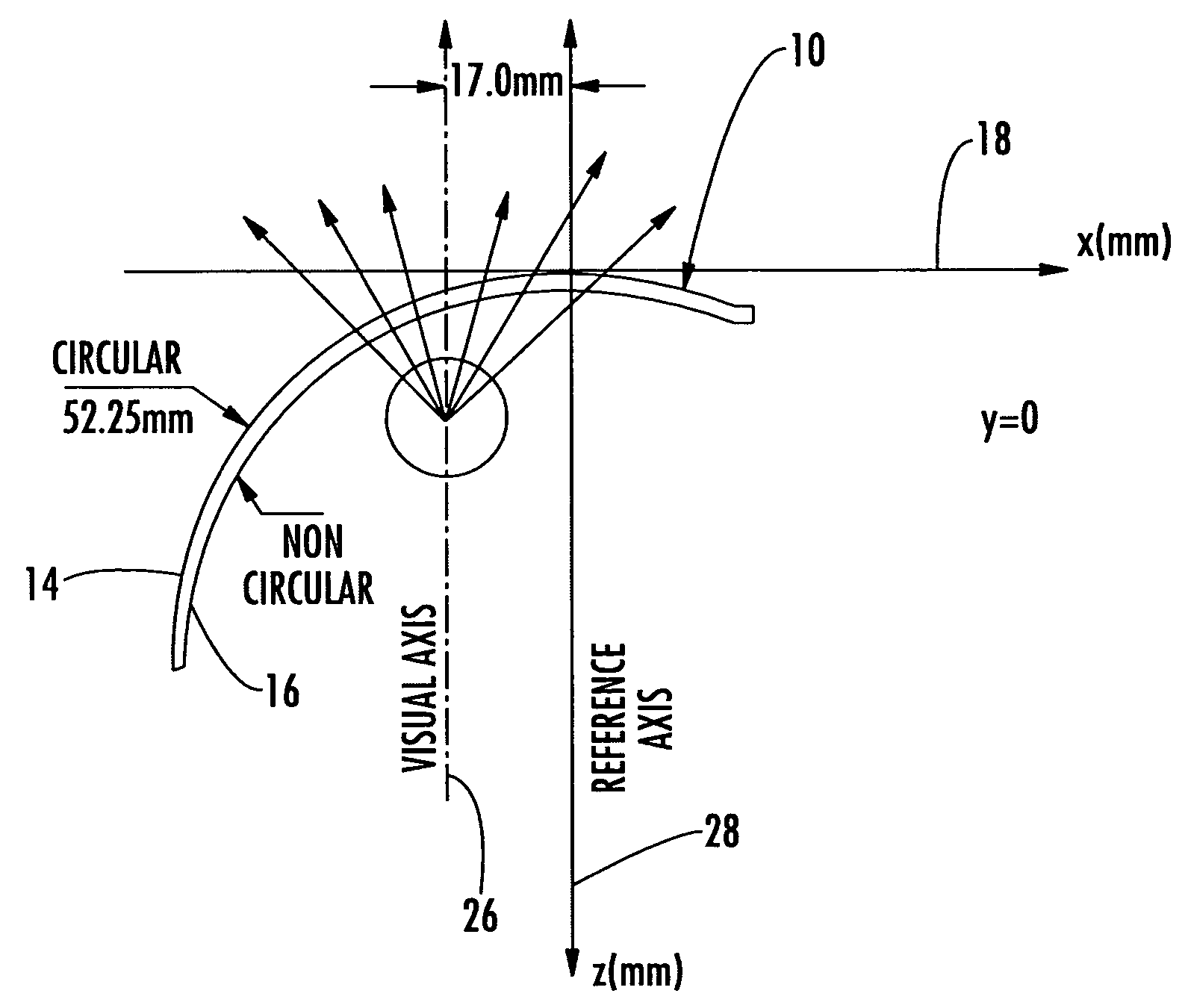
  • Figure 1
    Figure 1
  • Figure 2
    Figure 2
  • Figure 3
    Figure 3
Patent Text Reader

Abstract

A method for modifying the shape of a spheric or toric non-corrective lens blank such that astigmatic and peripheral defects are reduced. The outer convex and inner concave sides of the lens are initially designed according to the Gullstrand Formula. Thereafter, a visual axis of the lens is defined relative to a reference axis of the lens blank. In the preferred toric lens, the visual axis of the lens is offset from the reference axis. Once the visual axis is defined, the inner concave surface of the lens is modified so as to improve optical quality in a visual center surrounding the visual axis.
Need to check novelty before this filing date? Find Prior Art

Description

BACKGROUND AND SUMMARY OF THE INVENTION

[0001] The instant invention relates to non-corrective (non-prescription) lenses for use as sun lenses or safety lenses.

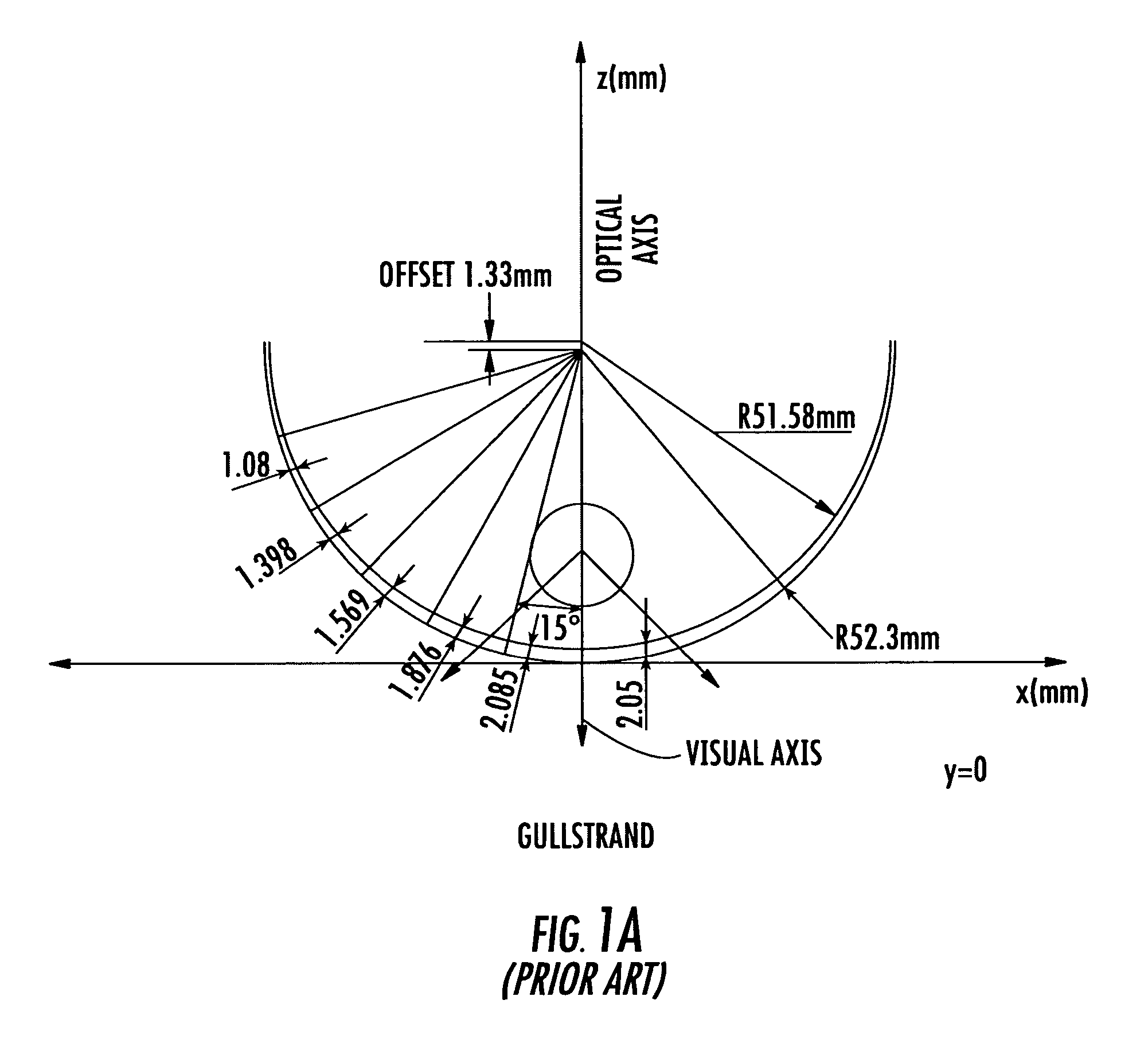
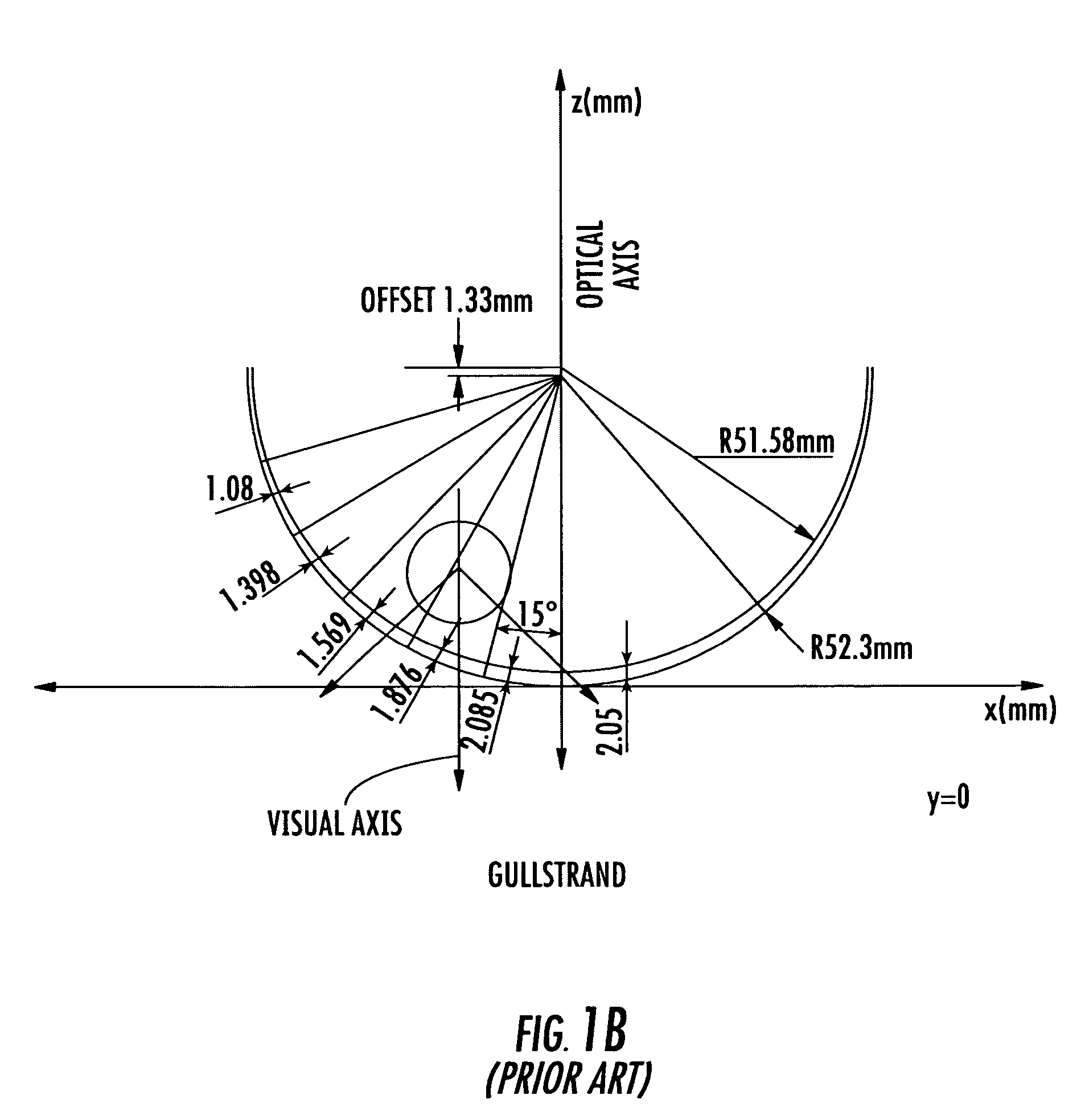
[0002] It is well known in the art that piano (non-corrective) sun lenses and safety lenses have convex and concave optical surfaces that are designed according the Gullstrand formula (See FIGS. 1A and 1B). For a spherical shape lens, the Gullstrand formula allows the designer to calculate the value of the concave side radius knowing the convex side radius, the thickness of the lens and the refractive index of the material. When using the Gullstrand formula for lens design, it is understood that the concave radius and convex radius are constant throughout the arc of the lens, but that the centers of the spheres or circles are slightly offset from one another, the offset being equal to the inner radius plus the thickness of the lens less the external Radius. The offset provides the lens with a shape wherein the lens is slightly t...

Examples

Embodiment Construction

[0036]Referring now to the drawings, the lens of the instant invention is illustrated and generally indicated at 10 in FIGS. 2-6. As will hereinafter be more fully described, the instant invention aims to improve peripheral vision in the case of spherical lenses, cylindrical and toric lenses, and as an extension of the invention may be applied to any shape (free form).

[0037]The lenses described herein are intended to be non-corrective lenses, and thus have no optical power (0 Diopter). The lenses described herein are further intended for primary use as sun lenses and / or safety lenses in dual lens eyewear. However, use is also contemplated in single lens shield-type eyewear as illustrated in FIGS. 9 and 10.

[0038]Referring to FIGS. 2-6, the lens 10 is initially formed as a rectangular blank, and then a lens element 12 (shown in broken line) is trimmed from the blank by the glass maker. The lens 10 has an outer convex surface 14, and an inner concave surface 16. The lens 10 as describe...