[0012]In another embodiment of the present invention, multimedia information may be transcoded using a
service module disposed within the network communication
system. In this embodiment, the
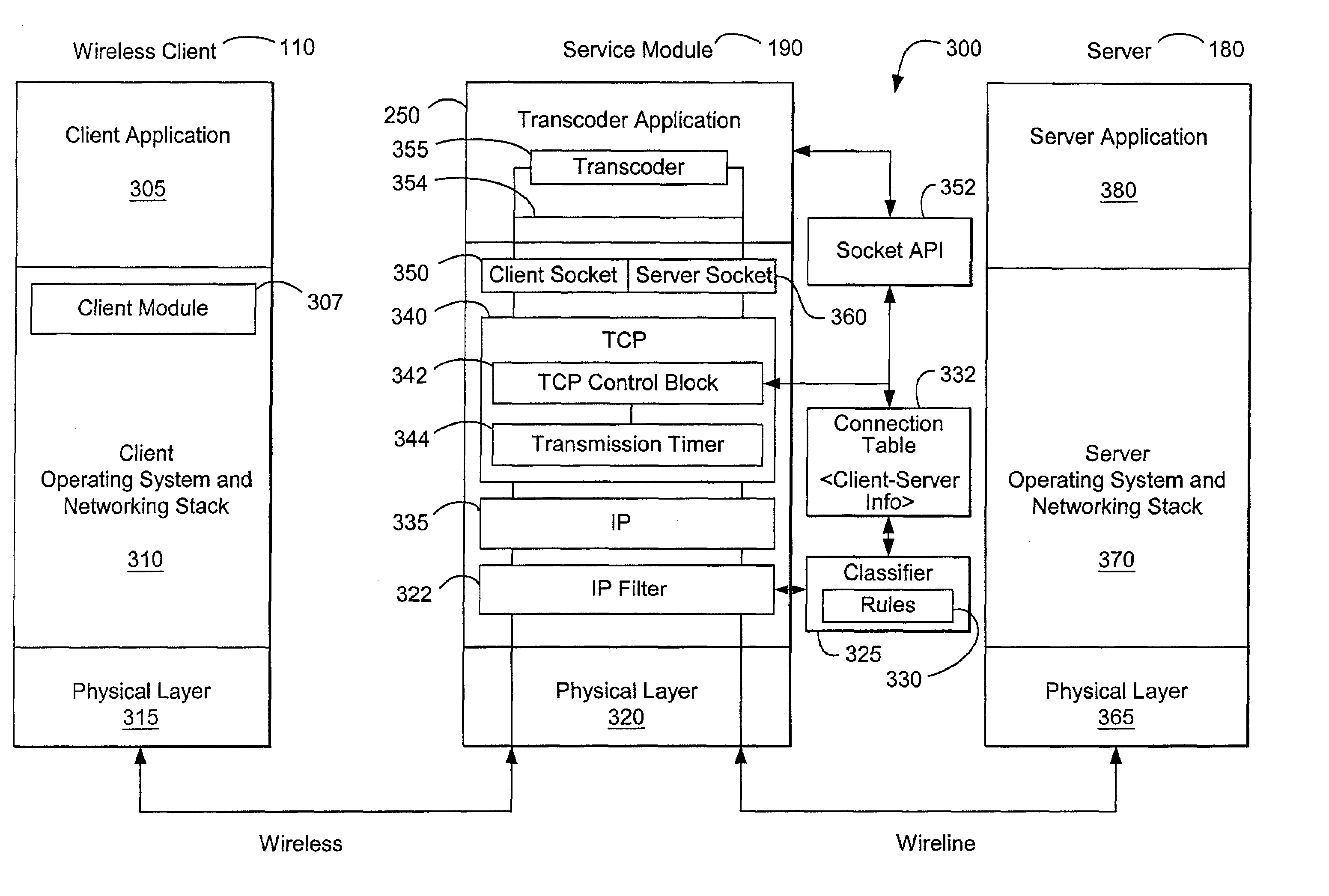
service module may be configured to break a connection between the
transmitter and the receiver to form a first channel between the
transmitter and the
service module and a second channel between the service module and the receiver. The multimedia information communicated from the transmitter to the receiver may then be redirected to the service module via the first channel to enable the service module to transcode the multimedia information based on an
estimation of the available transmission rate of the second channel. If the transmission rate at which the multimedia information is encoded is greater than the available transmission rate, the service module transcodes the multimedia information to conform the multimedia information to the available transmission rate. The transcoded multimedia information may then be transmitted from the service module to the receiver over the second channel. This embodiment of the present invention provides certain advantages in that the multimedia information may be transcoded in a manner transparent to the transmitter and receiver. For example, because the first channel and the second channel may comprise separate and distinct channels, the service module may be configured to act as a
client with respect to the transmitter and a
server with respect to the receiver, thereby enabling the multimedia information to be transcoded without requiring any modification of the transmitter or requiring the receiver to explicitly
direct service requests to the service module.
[0013]Other embodiments of the present invention provide a number of alternative mechanisms for
transcoding the multimedia information, where each embodiment provides certain advantages in terms of the quality of the resulting
signal and associated computational intensity. One embodiment, for example, transcodes the multimedia information by decoding the multimedia information and then re-encoding the decoded multimedia information at a lower transmission rate. This embodiment offers the potential for the highest quality transcoded
signal, but may involve fairly intensive and time-consuming computation. In another embodiment, the multimedia information may be transcoded by
multiplexing between a plurality of versions of the multimedia information that are encoded at a different transmission rate. By
multiplexing frames from different versions of the multimedia information, this process may be configured to form a sequence of frames having an average transmission rate that approximates the available transmission rate. In yet another embodiment,
transcoding may be performed by removing
high frequency code words from selected frames of the multimedia information until the transmission rate of the transcoded
data stream approximates the available transmission rate. This approach effectively applies a
low pass filter to the multimedia information, which reduces the amount of data required to be transmitted and preserves the more perceptually relevant lower
frequency data. In still another embodiment, transcoding may be performed by mapping code words from selected frames of the multimedia information to a decimated set of code words having coarser quantization. Although this approach reduces the resolution of the resulting data, it preserves a significant portion of the
high frequency information.
[0015]By transcoding the multimedia information and using
timer-based data flow control to regulate
data transmission, embodiments of the present inventions alleviate many of problems commonly associated with conventional data communication networks. For example, embodiments of the present invention may be configured to ensure that multimedia information is encoded at a transmission rate that the downlink channel can support. These aspects of the present invention offer significant advantages by ensuring that the receiver will be able to process received multimedia information at a rate necessary to support the underlying application. Furthermore, because the transcoded multimedia information may be transmitted to the receiver using
timer-based data flow control, this timer-based approach, together with the
smoothing that may used to compute the estimated transmission rate, offers a more relevant estimate of the available transmission rate and may reduce or eliminate the bursty transmissions commonly associated with the
acknowledgement-based approach employed by conventional TCP architectures.



 Login to View More
  Login to View More