Check patentability & draft patents in minutes with Patsnap Eureka AI!

Method for producing ethyleneamines

a technology of ethyleneamine and ethyleneamine, which is applied in the preparation of amino compounds, organic chemistry, chemistry apparatus and processes, etc., can solve the problems of low service life of catalysts, high selectivity, and excessive use of ammonia

Active Publication Date: 2009-10-13
BASF AG
View PDF21 Cites 2 Cited by
  • Summary
  • Abstract
  • Description
  • Claims
  • Application Information

AI Technical Summary

Benefits of technology

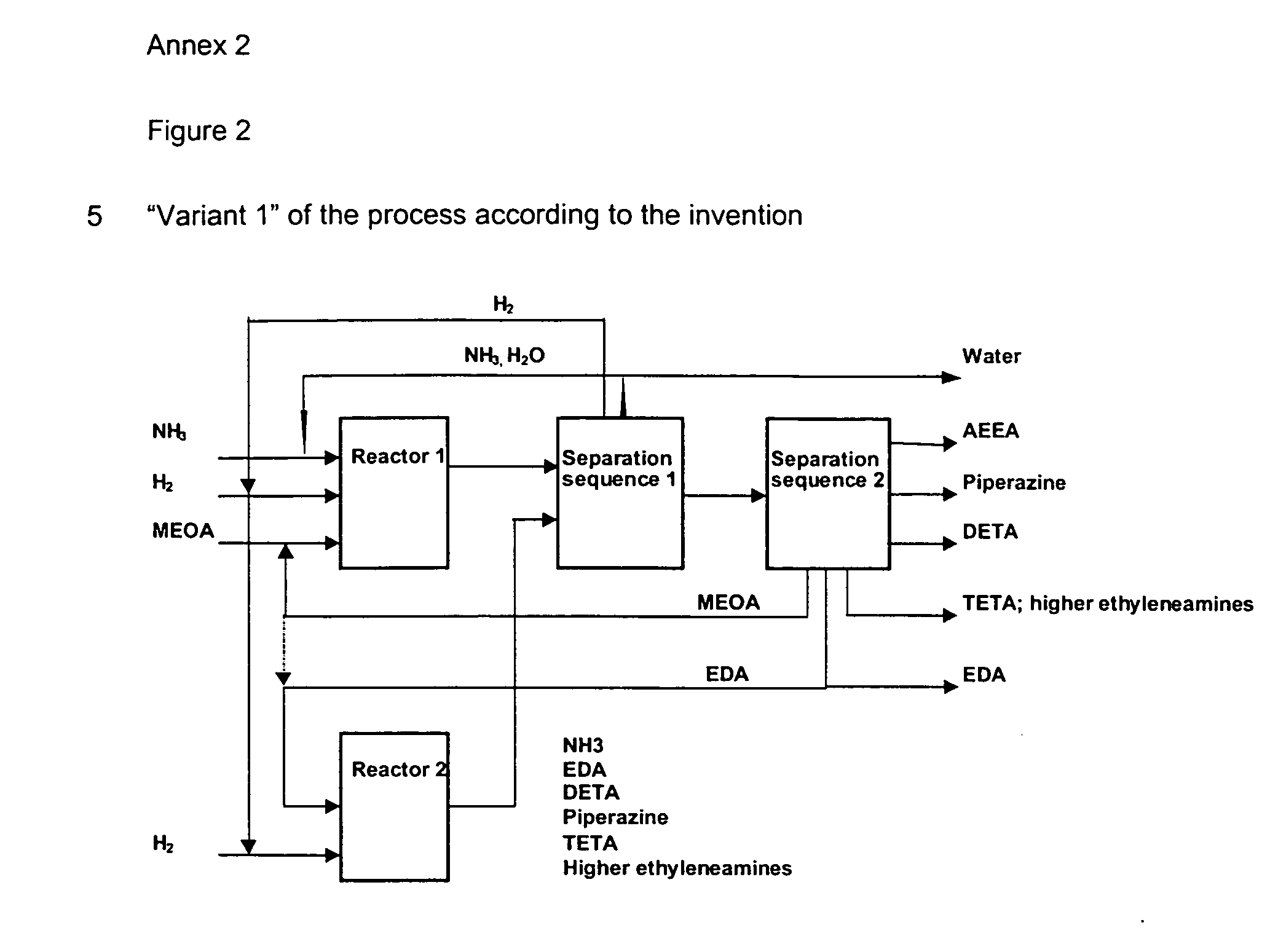
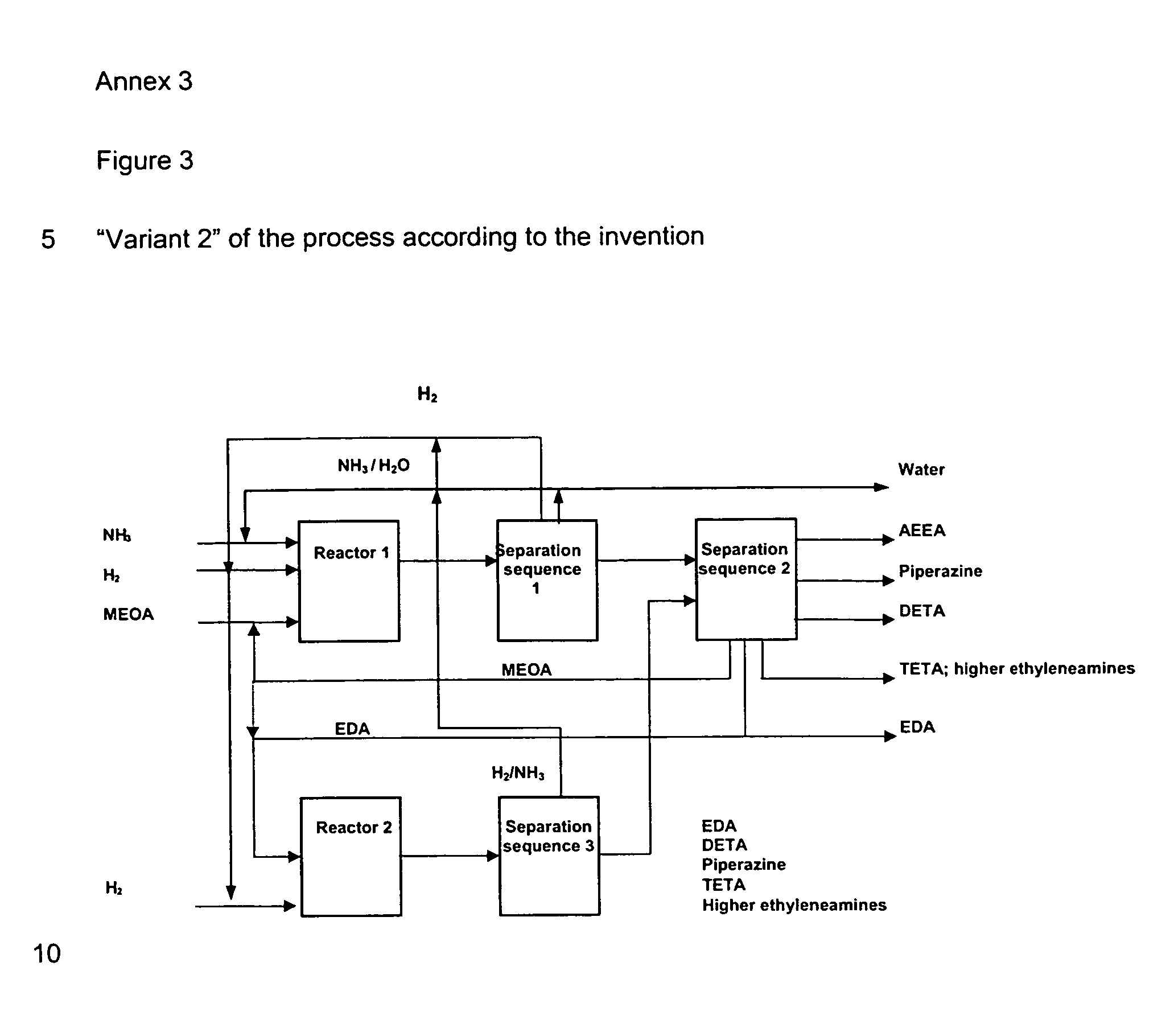
The present invention provides an improved and economical process for the production of ethyleneamines, particularly ethylenediamine, diethylenetriamine, aminoethylethanolamine, piperazine, and triethylenetetramine. The process allows for a greater proportion of diethylenetriamine and a limited amount of piperazine plus aminoethylethanolamine. The overall yield of ethyleneamines is greater than 90%. The process involves reacting monoethanolamine with ammonia in the presence of a catalyst in a reactor, and separating the resulting reaction product to obtain diethylenetriamine in a separate reactor.

Problems solved by technology

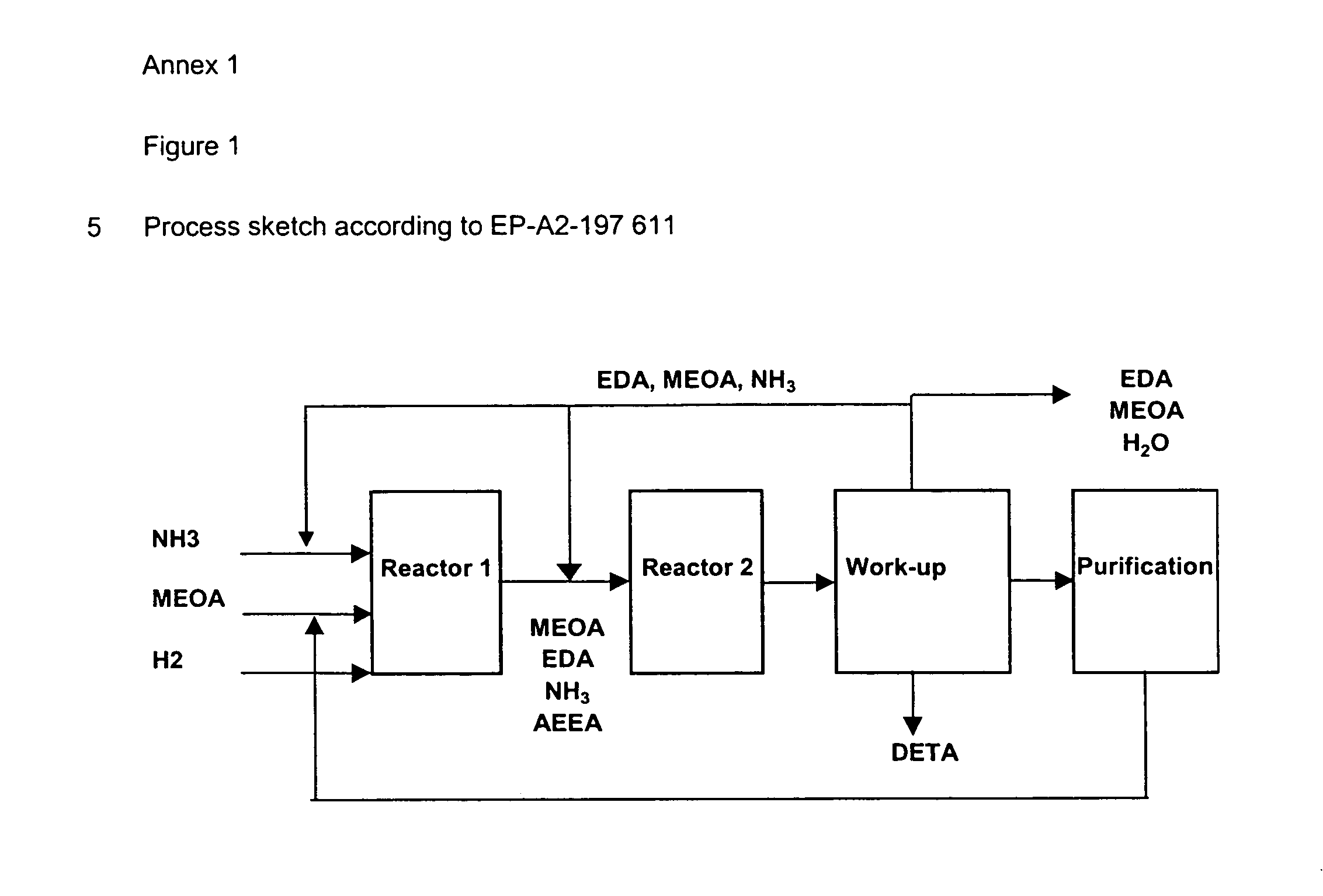
It is disadvantageous here that ammonia has to be used in excess and that high DETA selectivities are achieved only in the presence of EDA at partial MEOA conversion.
Furthermore, a general problem of this technology is the low service life of the catalysts used under the drastic reaction conditions (280-350° C.).
Apart from the gas-phase amination of hydroxyethylpiperazine to give triethylenediamine, these catalysts have hitherto been unable to penetrate the market.
Disadvantages of these technologies (stand alone) are that no ethylenediamine is produced here and ammonia which is released as a result of the condensation of ethylenediamine is lost as feed material.
A disadvantage of this process is that AEEA further reacts preferentially to give piperazine and not to give DETA and additional amounts of AEEA are formed as a result of the reaction of EDA with MEOA.

Method used

the structure of the environmentally friendly knitted fabric provided by the present invention; figure 2 Flow chart of the yarn wrapping machine for environmentally friendly knitted fabrics and storage devices; image 3 Is the parameter map of the yarn covering machine
View more

Image

Smart Image Click on the blue labels to locate them in the text.
Viewing Examples
Smart Image
  • Method for producing ethyleneamines
  • Method for producing ethyleneamines
  • Method for producing ethyleneamines

Examples

Experimental program
Comparison scheme
Effect test

example 1

[0082]A mixture of monoethanolamine, ammonia and hydrogen (molar ratio of MEOA:NH3:H2=1:8:0.14) was passed at a WHSV of 0.4 kg / kg / h (kg of MEOA per kg of catalyst per hour) at a temperature of 170° C. and a pressure of 200 bar continuously into a tubular reactor (reactor 1) which was charged with a catalyst, consisting of 4% by weight of copper, 6% by weight of cobalt and 8% by weight of nickel (in each case based on the supported catalyst) on an aluminum oxide support. The product obtained was a mixture consisting of 65.7% by weight of ammonia, 4.4% by weight of water, 15.5% by weight of MEOA, 10.9% by weight of EDA, 1.3% by weight of DETA, 0.9% by weight of AEEA, 0.74% by weight of piperazine and 0.56% by weight of TETA, AEP, HEP+higher ethyleneamines. (Higher ethyleneamines=ethyleneamines with a boiling point higher than that of TETA (at the same pressure)).

[0083]A mixture of ethylenediamine and hydrogen (molar ratio 50:1) was passed at a WHSV of 0.7 kg / kg / h (kg of EDA per kg of ...

example 2

[0087]A mixture of monoethanolamine, ammonia and hydrogen (molar ratio MEOA:NH3:H2=1:10:0.14) was passed at a WHSV of 0.4 kg / kg / h (kg of MEOA per kg of catalyst per hour) at a temperature of 170° C. and a pressure of 200 bar continuously into a tubular reactor which was charged with a Cu / Co / Ni catalyst, as in Example 1. The product obtained was a mixture consisting of 70.7% by weight of ammonia, 3.7% by weight of water, 13.2% by weight of MEOA, 9.5% by weight of EDA, 1.1% by weight of DETA, 0.68% by weight of AEEA, 0.56% by weight of piperazine and 0.56% by weight of TETA, AEP, HEP+higher ethyleneamines.

[0088]A mixture of ethylenediamine and hydrogen (molar ratio 50:1) was passed at a WHSV of 1.1 kg / kg / h (kg of EDA per kg of catalyst per hour) into a second reactor (reactor 2), which was likewise charged with a Cu / Co / Ni catalyst, as in Example 1. The reaction pressure was adjusted here to 30 bar and the reactor temperature to 160° C. The product obtained was a mixture consisting of ...

the structure of the environmentally friendly knitted fabric provided by the present invention; figure 2 Flow chart of the yarn wrapping machine for environmentally friendly knitted fabrics and storage devices; image 3 Is the parameter map of the yarn covering machine
Login to View More

PUM

PropertyMeasurementUnit
molar ratiosaaaaaaaaaa
Login to View More

Abstract

Preparation of ethyleneamines by reacting monoethanolamine (MEOA) with ammonia in the presence of a catalyst in a reactor (1) and separating the resulting reaction product, where ethylenediamine (EDA) obtained in the separation is reacted in a separate reactor (2) in the presence of a catalyst to give diethylenetriamine (DETA), and the resulting reaction product is passed to the separation of the reaction product resulting from reactor 1.

Description

RELATED APPLICATIONS[0001]This application is a national stage application (under 35 U.S.C. 371) of PCT / EP2004 / 007471 filed Jul. 8, 2004 which claims benefit to German application 103 35 991.5 filed Aug. 1, 2003.[0002]The present invention relates to a process for the preparation of ethyleneamines by reacting monoethanolamine (MEOA) with ammonia in the presence of a catalyst in a reactor (1) and separating the resulting reaction product.[0003]Ethyleneamines are used as solvents, stabilizers, for the synthesis of chelating agents, synthetic resins, medicaments, inhibitors and interface-active substances.[0004]In particular, diethylenetriamine (bis(2-aminoethyl)amine; DETA) is used as a solvent for dyes and is a starting material for the preparation of ion exchangers, pesticides, antioxidants, corrosion inhibitors, complexing agents, textile auxiliaries and absorption agents for (acidic) gases.[0005]The literature describes numerous processes for the preparation of ethyleneamines, inc...

Claims

the structure of the environmentally friendly knitted fabric provided by the present invention; figure 2 Flow chart of the yarn wrapping machine for environmentally friendly knitted fabrics and storage devices; image 3 Is the parameter map of the yarn covering machine
Login to View More

Application Information

Patent Timeline
no application Login to View More
Patent Type & Authority Patents(United States)
IPC IPC(8): C07C209/16C07C211/10C07C211/14
CPCC07C209/16C07C211/10C07C211/14
Inventor FRAUENKRON, MATTHIASEVERS, HOLGERMELDER, JOHANN-PETERROTTGER, RODERICHSIEGERT, MARKUSGERLACK, TILLNOUWEN, JANKRUG, THOMAS
Owner BASF AG
Features
  • R&D
  • Intellectual Property
  • Life Sciences
  • Materials
  • Tech Scout
Why Patsnap Eureka
  • Unparalleled Data Quality
  • Higher Quality Content
  • 60% Fewer Hallucinations
Social media
Patsnap Eureka Blog
Learn More