

Methods of limiting leak off and damage in hydraulic fractures
a hydraulic fracture and leakage prevention technology, applied in the field of improving production, can solve the problems of high fluid loss, affecting fracture geometry, and implying a more expensive treatment, so as to improve cleanup and hydrocarbon production
- Summary
- Abstract
- Description
- Claims
- Application Information
AI Technical Summary
Benefits of technology
Problems solved by technology
Method used
Image

Examples
examples 1 through 3
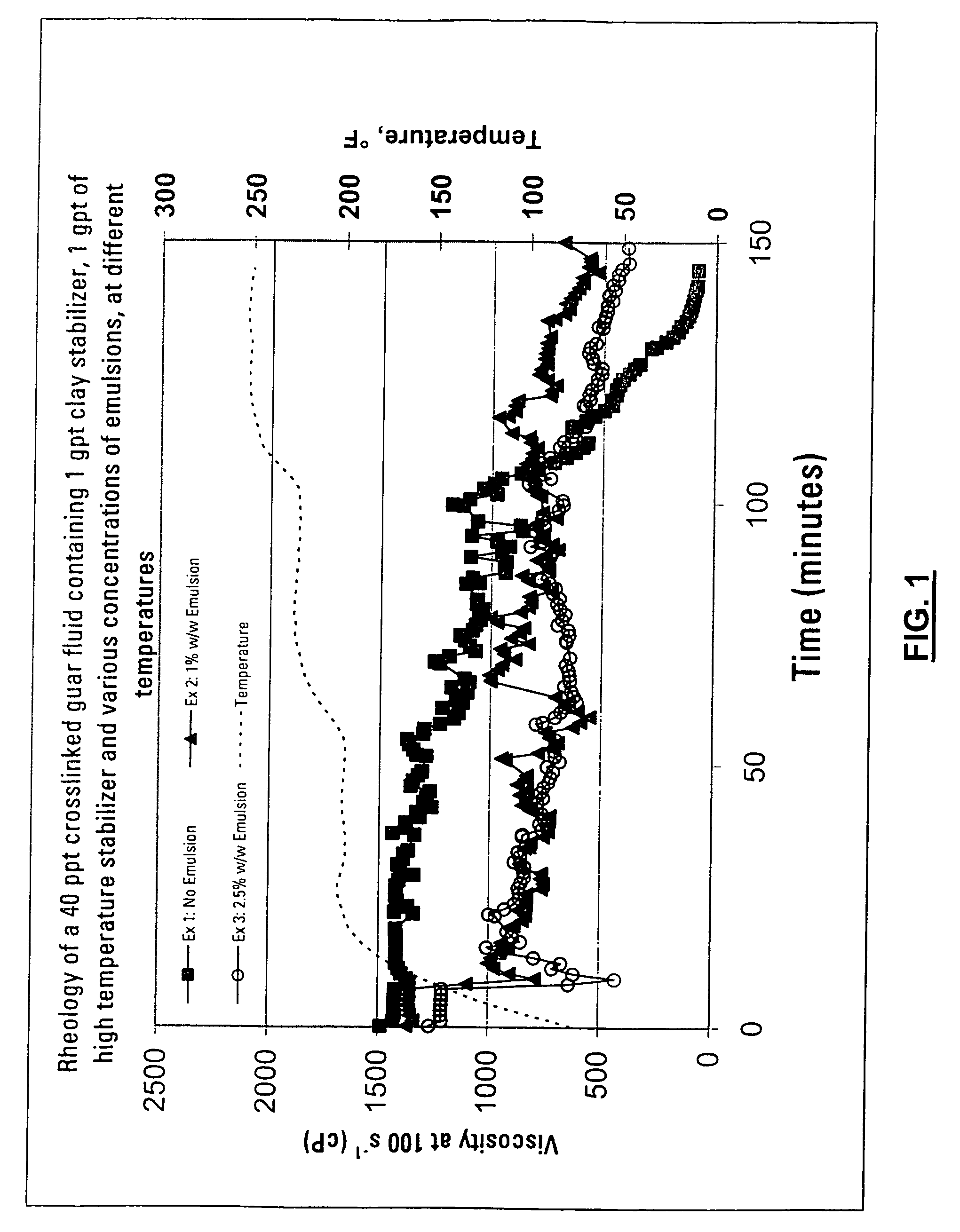
[0093]In these examples the water inert degradable polymer, in the form of an emulsion, is blended with a conventional fracturing fluid during early stages of the treatment (pad), and the rheology of the fluid with and without the water inert degradable polymer is compared to ensure that adequate viscosity is developed and maintained for fracturing. The pad fluid contained 40 ppt [4.8 kg / 1000 L] guar gum supplied by Economy Polymers and Chemicals, Houston, Tex. 77245-0246, the guar being crosslinked with a borate crosslinker (4 ppt [0.48 kg / 1000 L] of boric acid, with a pH adjusted to ˜11 using a 30% weight aqueous solution of caustic soda). The emulsion added was ChemCor PolyEMULSION 330N35. The graph in FIG. 1 shows the viscosity, measured using a conventional Fann 50 rheometer, of the pad fluid containing no emulsion (Example 1), 1% by weight of ChemCor HDPE PolyEMULSION 330N35 emulsion based upon total fluid weight (Example 2), and 2.5% by weight of ChemCor HDPE PolyEMULSION 330...
examples 4 through 7
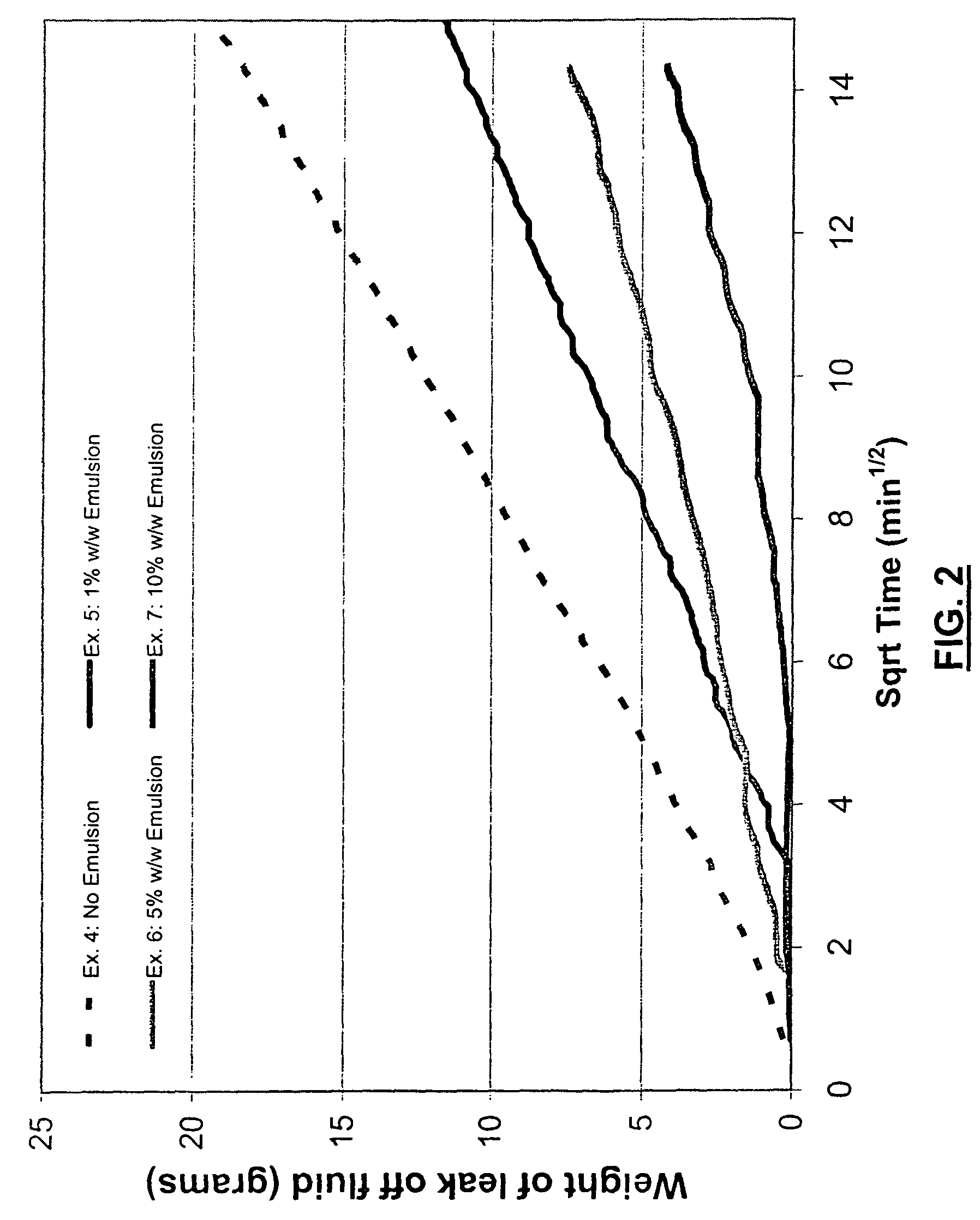
[0095]In examples 4 through 7, and referring to FIG. 2, the fluid loss is measured on samples with a water inert degradable polymer, in the form of an emulsion, blended with conventional fracturing pad fluids, and fluid loss is determined for the fluid with and without the water inert degradable polymer. The pad fluids contained 25 ppt [3 kg / 1000 L] guar gum supplied by Economy Polymers and Chemicals, the guar being crosslinked with a borate crosslinker (4 ppt 0.48 kg / 1000 L] of boric acid, with a pH adjusted to ˜11 with caustic soda). The pad fluid also included DI water, contained a 50% by weight aqueous solution of tetramethyl ammonium chloride clay stabilizer added at 2 gpt [Lpt], and 1 gpt [Lpt] of a 85% by weight solution of triethanol amine high temperature stabilizer. In examples 5 through 7, the emulsion added was ChemCor PolyEMULSION 330N35.
[0096]The fluids were evaluated on a static fluid loss cell using 1″ diameter cores of varied permeability at 175° F. [79.4° C.] with ...
examples 8 through 15
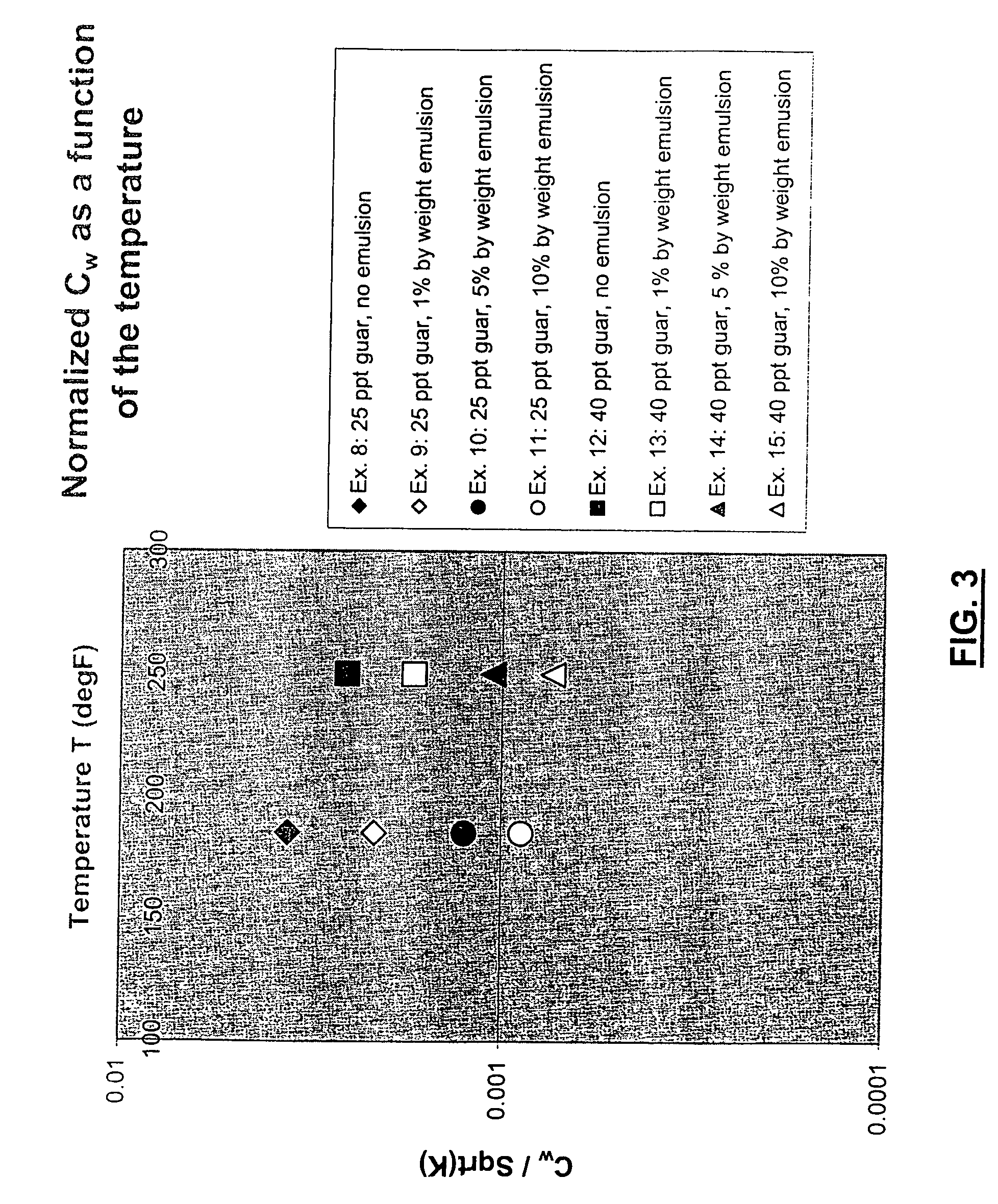
[0097]For examples 8 through 15, pad fluids, formulated in accordance with the pad fluids of examples 1 and 4 above, with and without either ChemCOR PolyEMULSION 330N35 or PolyEMULSION 629N40, were tested at different temperatures and normalized leak-off coefficients (Cw / sqrt(K)) determined and reported in FIG. 3. Cw is discussed in Navarrete, R. C., Caweizel, K. E., and Constien, V. G.: “Dynamic Fluid Loss in Hydraulic Fracturing Under Realistic Shear Conditions in High-Permeability Rocks,” SPE Production and Facilities, pp 138-143 (August, 1996). To determine leak-off rates, experiments were conducted in a conventional static fluid loss cell at 1200 psi [8.27 MPa] total pressure and a back pressure of 200 psi [1.38 MPa] back pressure, for a net pressure of 1000 psi [6.89 MPa. The core was held at constant temperature, as indicated in FIG. 3, and the fluid collected at the discharge of the core. The rate of fluid leaking off through the core was measured as a function of time. The ...
PUM
 Login to View More
 Abstract
Description
Claims
Application Information
 Login to View More