
Driving apparatus
a technology of driving apparatus and motor shaft, which is applied in the direction of printing mechanism, spacing mechanism, printing, etc., can solve the problems of reducing the operation affecting the operation efficiency of the printer, and causing noise, etc., to achieve the effect of reducing the operation efficiency and impact for
- Summary
- Abstract
- Description
- Claims
- Application Information
AI Technical Summary
Benefits of technology
Problems solved by technology
Method used
Image

Examples
first embodiment
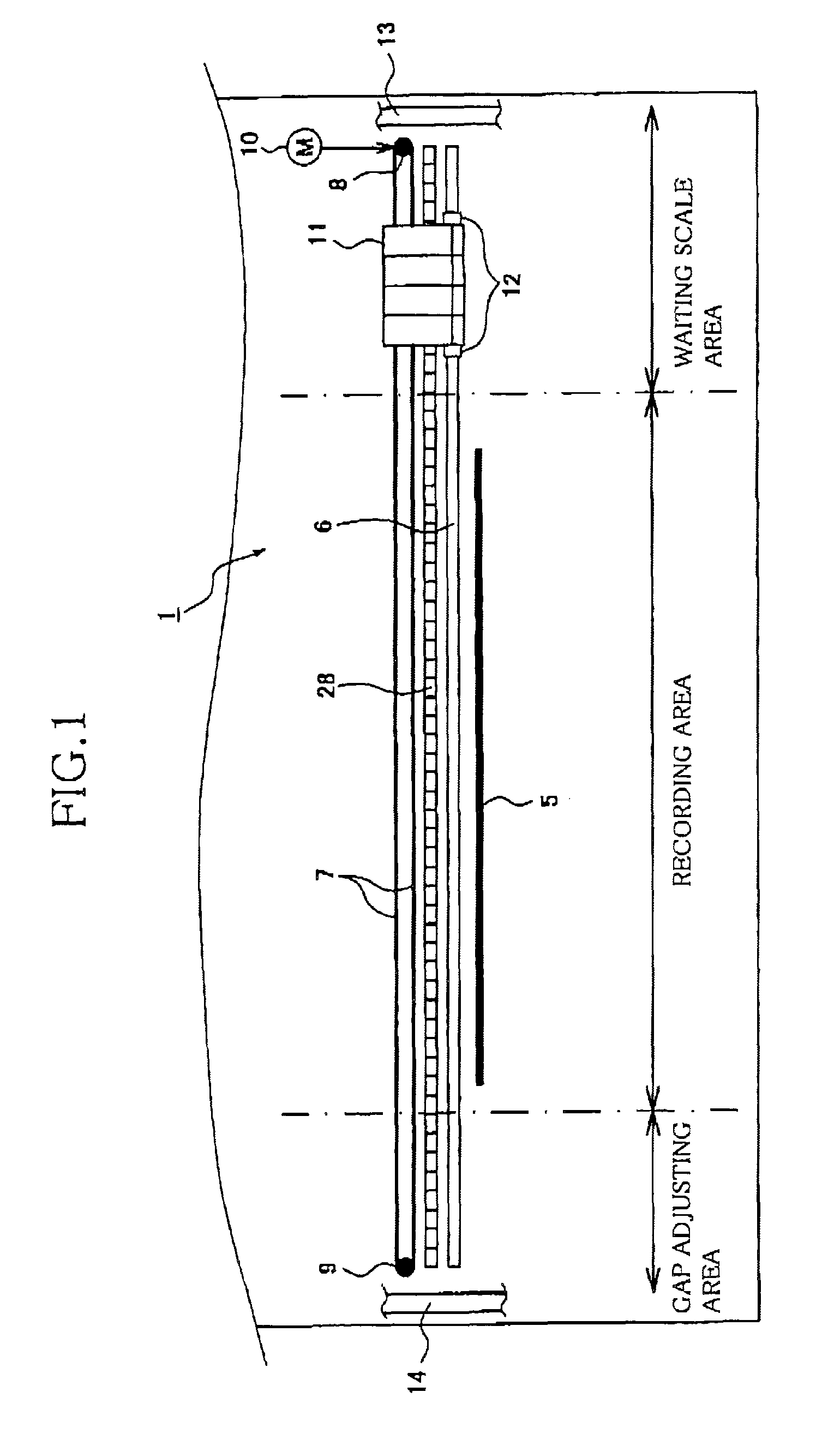
[0044]FIG. 1 schematically shows a construction of a carriage driving apparatus 1, employed by an ink-jet printer (hereinafter, simply referred to as the printer), to which the present invention is applied.
[0045]As shown in FIG. 1, the carriage driving apparatus 1 employs a guide bar 6 extending in a widthwise direction of a recording sheet 5 that is fed by a feeding roller, not shown. The guide bar 6 supports a carriage 12 on which a head unit 11 is mounted. The head unit 11 is supplied with four sorts of inks from four ink cartridges, not shown, and includes a recording head, not shown, that has four groups of nozzles for ejecting droplets of the four inks toward the recording sheet 5 and thereby recording a full-color image on the same 5.
[0046]The carriage 12 is connected to an endless belt 7 extending along the guide bar 6, and the endless belt 7 is wound on a drive pulley 8 connected to a carriage motor 10 provided in the vicinity of one of opposite ends of the guide bar 6 and ...
second embodiment
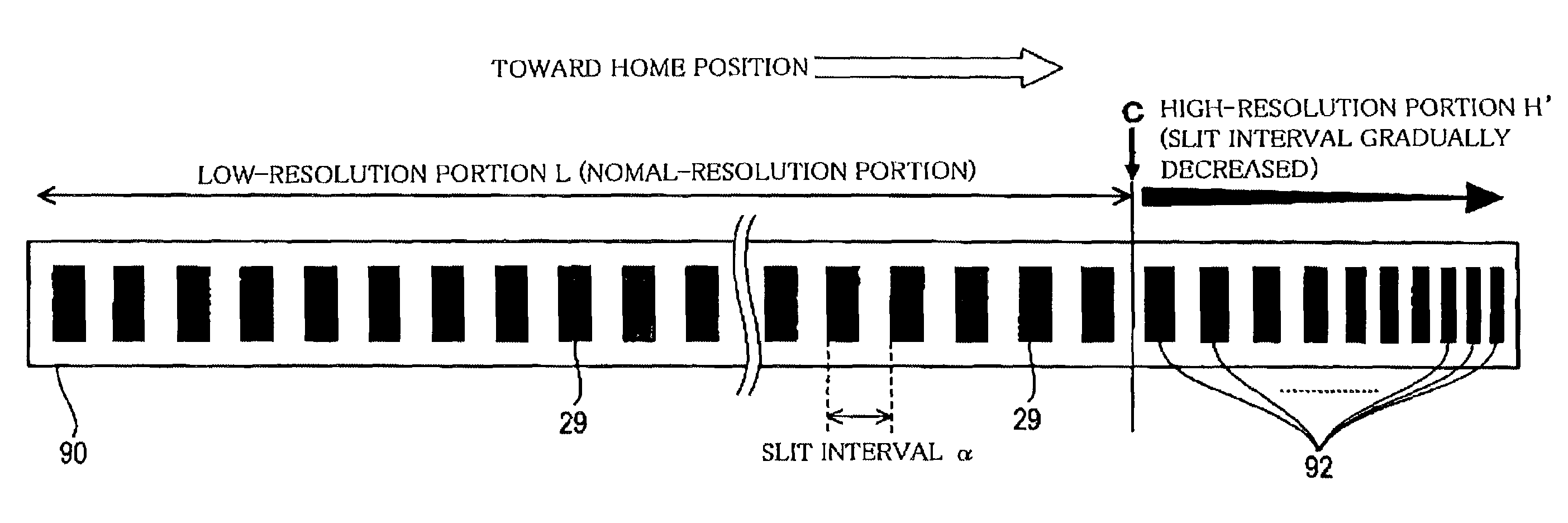
[0107]Next, a second embodiment of the present invention will be described by reference to FIGS. 13 and 14. The second embodiment also relates to a carriage driving apparatus of an ink-jet printer, and differs from the carriage driving apparatus 1 as the first embodiment, only in that though the slit intervals β of the high-resolution scale portion H of the linear scale 28 employed in the first embodiment are constant, intervals of encoder slits 92 of a high-resolution scale portion H′ of a linear scale 90 of a linear encoder employed in the second embodiment gradually decrease in a direction toward the origin (i.e., home position) of the carriage 12. The same reference numerals as used in the first embodiment are used to designate the corresponding elements or parts of the second embodiment, and the description thereof is omitted. Hereinafter, only differences of the first and second embodiments will be described.
[0108]As is apparent from the comparison of the linear scale 90, show...
third embodiment
[0113]Next, a third embodiment of the present invention will be described by reference to FIG. 15. The third embodiment also relates to a carriage driving apparatus of an ink-jet printer, and differs from the carriage driving apparatus 1 as the first embodiment, only with respect to a manner of judging whether the carriage 12 has impacted on the side frame 13. In the first embodiment, the home-position detecting operation is carried out according to the flow chart shown in FIG. 12, so as to judge whether the carriage 12 has passed through the resolution-change point C, based on the difference values, diff_v, obtained by the difference obtaining portion 71, and likewise judge, based on the difference values, diff_v, whether the carriage 12 has impacted on the side frame 13 after having passed through the resolution-change point C. However, in the third embodiment, the carriage driving apparatus judges whether the carriage 12 has impacted on the side frame 13, by judging whether the c...
PUM
 Login to View More
 Abstract
Description
Claims
Application Information
 Login to View More