
Method for the translation of programs for reconfigurable architectures
a reconfigurable architecture and program technology, applied in the field of reconfigurable architecture program translation, can solve the problems of pipeline problems, complete processing pipeline deletion, and conventional methods that are not suitable for combining functionally specified architectures with particular dynamic responses
- Summary
- Abstract
- Description
- Claims
- Application Information
AI Technical Summary
Benefits of technology
Problems solved by technology
Method used
Image

Examples
example
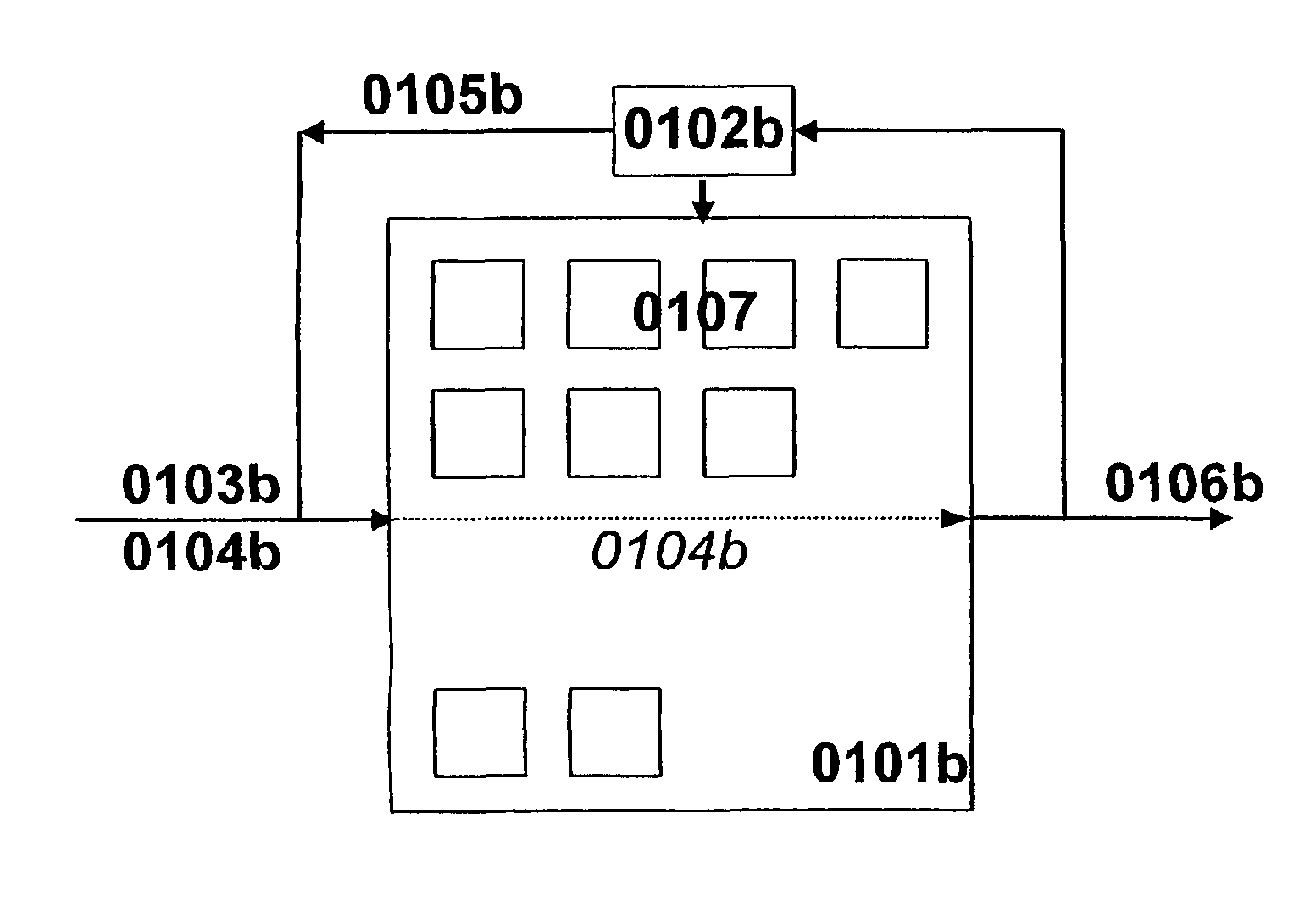
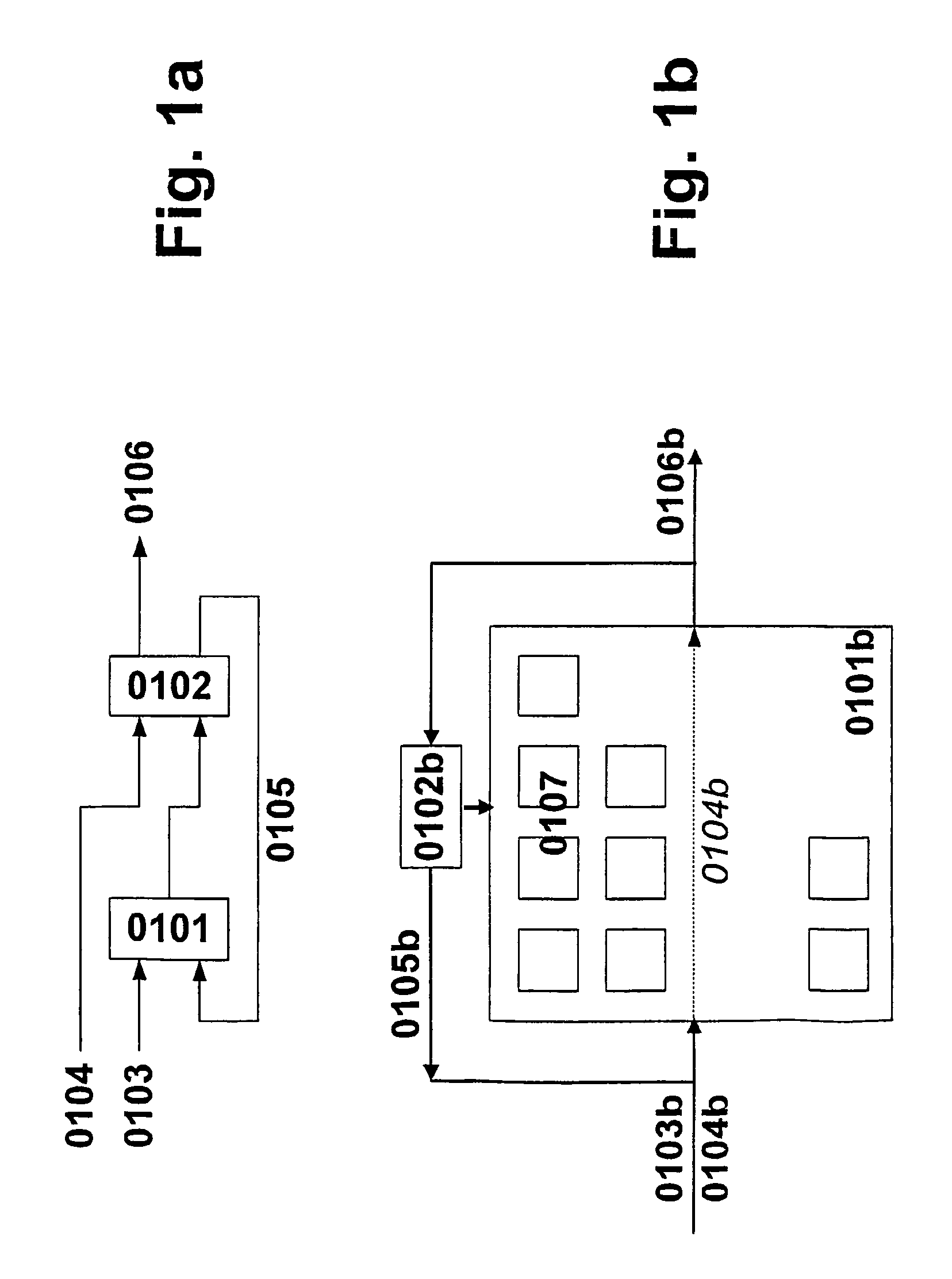
[0083]a) The state information of a comparison is relevant for further processing of data because it determines the functions to be executed.[0084]b) It is assumed that a sequential divider is formed, e.g., by mapping a division instruction onto hardware which supports only sequential division. This results in a state which characterizes the computation step within the division. This state is irrelevant because only the result (i.e., the division that is performed) is necessary for the algorithm. Thus, only the result and the time information (i.e., the availability) are required in this case. The compiler preferably differentiates between such relevant and irrelevant states.
[0085]The time information is accessible, for example, via the RDY / ACK handshake in VPU technology described in PACT01, 02, 13. However, it should be pointed out here that the handshake also does not represent a relevant state because it only signals the validity of the data so this in turn reduces the remaining...
example #
example#dstore: writes the results from the internal memories to external memories, peripherals, etc.
[0105]
function example# (a, b integer) → x : integersubconfig example#dloadfor i := 1 to 100 r#a[i] := a[i]for j := 1 to 100 r#b[j] := b[j]subconfig example#processfor i := 1 to 100for j := 1 to 100 r#x[i] := r#a[i] * r#b[j]subconfig example#dstorefor i := 1 to 100 x[i] := r#x[i]
[0106]One effect of this method is that instead of i*j=100*100=10,000 external accesses, only i+j=100+100=200 external accesses are executed to read the operands. These accesses are also completely linear, which greatly speeds up the transfer rate with today's bus systems (burst) and / or memories (SDRAM, DDRAM, RAMBUS, etc.).
[0107]The internal memory accesses are performed in parallel because different memories have been assigned to the operands.
[0108]For writing the results, i=100 external accesses are necessary and these may also be performed again linearly with maximum performance.
[0109]If the number of dat...
example a
[0183]
Line 1: i++Line 2: a = i * bLine 3: x = p − aLine 4: j = i * i
[0184]The language definition fixedly predetermines that line 1 is executed before line 2 before line 3 before line 4. However, line 4 could also be executed directly after line 1 and thus simultaneously with lines 2 and 3.
[0185]In other words, through sequential languages, additional artificial and not algorithmically determined states are incorporated. Only the correct chronological sequence of the computations in example A is important. Line 4 must not be computed until i is correctly defined, i.e., after the processing of line 1. Line 2 also must not be processed until after the correct definition of i (i.e., after processing line 1). Line 3 requires the results of line 2 (variable a) and therefore may not be computed until after correct definition of variable a. This results in a data dependence but no particular states.
[0186]On the basis of the data dependencies of variable a in lines 2 and 3 (line 3 u...
PUM
 Login to View More
 Abstract
Description
Claims
Application Information
 Login to View More