
Chimeric proteins with natriuretic activity
a natriuretic activity and protein technology, applied in the field of proteinaceous compounds, can solve the problems of ineffective snake venom peptides, not particularly useful tnps in therapeutic or prophylactic applications, etc., and achieve the effect of useful bioactivity profiles
- Summary
- Abstract
- Description
- Claims
- Application Information
AI Technical Summary
Benefits of technology
Problems solved by technology
Method used
Image

Examples
example 1
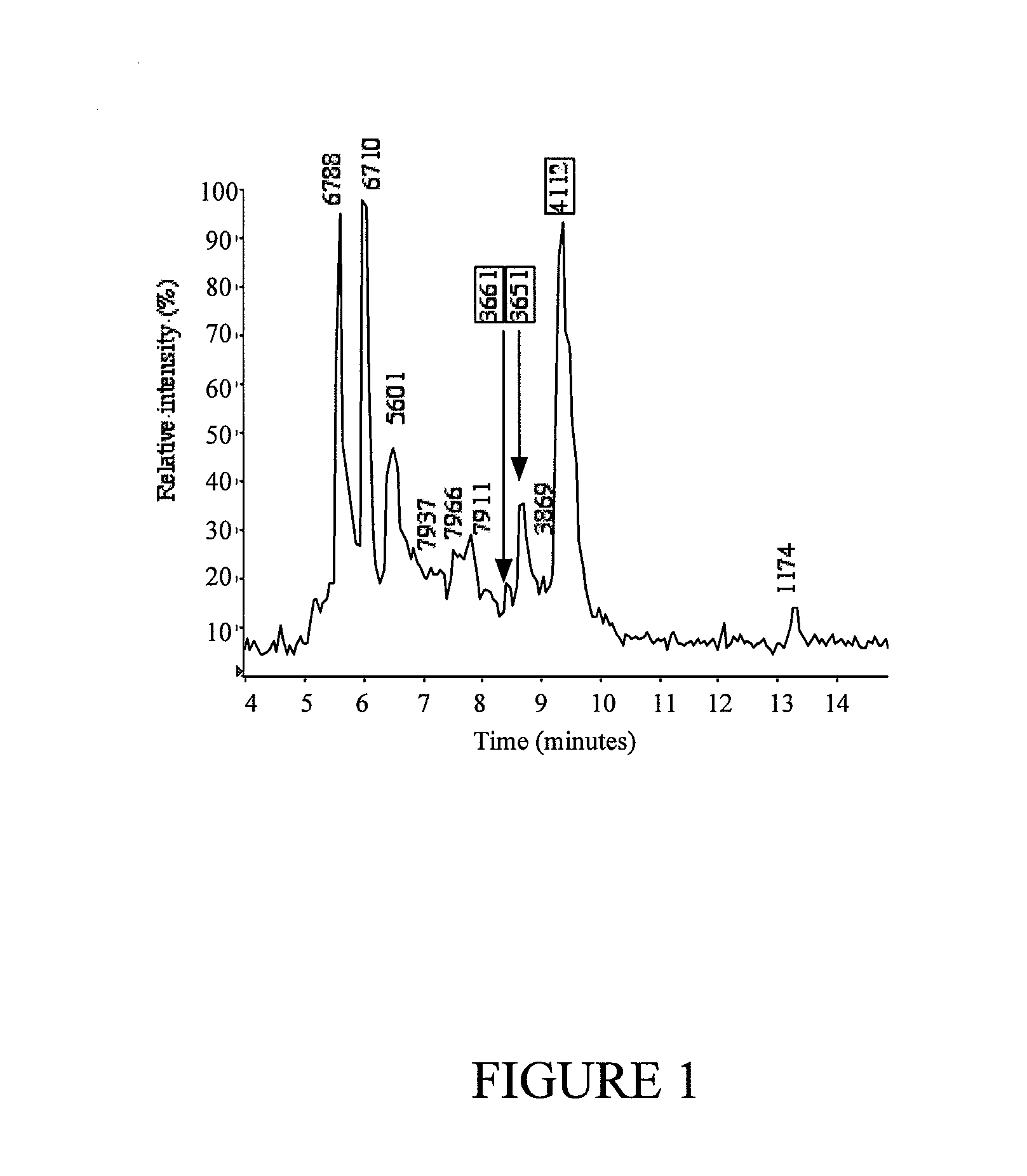
Isolation, Purification and Identification of Peptides from Snake Venom
Materials And Methods
Venom Collection
[0328]Venom was collected from specimens of Oxyuranus microlepidotus (Inland taipan) from Goydnor's Lagoon, South Australia, Australia and pooled to minimize the effects of individual variations.
[0329]Venoms were diluted to 10 mg / mL with buffered saline solution, centrifuged at 1,500×g for two hours in Centricon 50 centrifuge filters (Millipore, 50 kDa cut-off), and then the filtrate centrifuge filtered again at 3,000 G using Centricon 10 tubes (Millipore, 10 kDa cut-off). The filtrates from this step were then lyophilized and stored until needed for LC-MS analysis and RP-HPLC analysis.
LC-MS Analysis of Centrifuge Fractionated Venom
[0330]Venom fractions 2O) and Solvent B (90% acetonitrile in 0.045% TFA) at a turbospray flow rate of 130 μL / min. The solvent delivery and gradient formation was achieved using an Applied Biosystems 140 B solvent delivery system...
example 2
Synthesis of Natriuretic Peptides
Synthesis and Oxidation
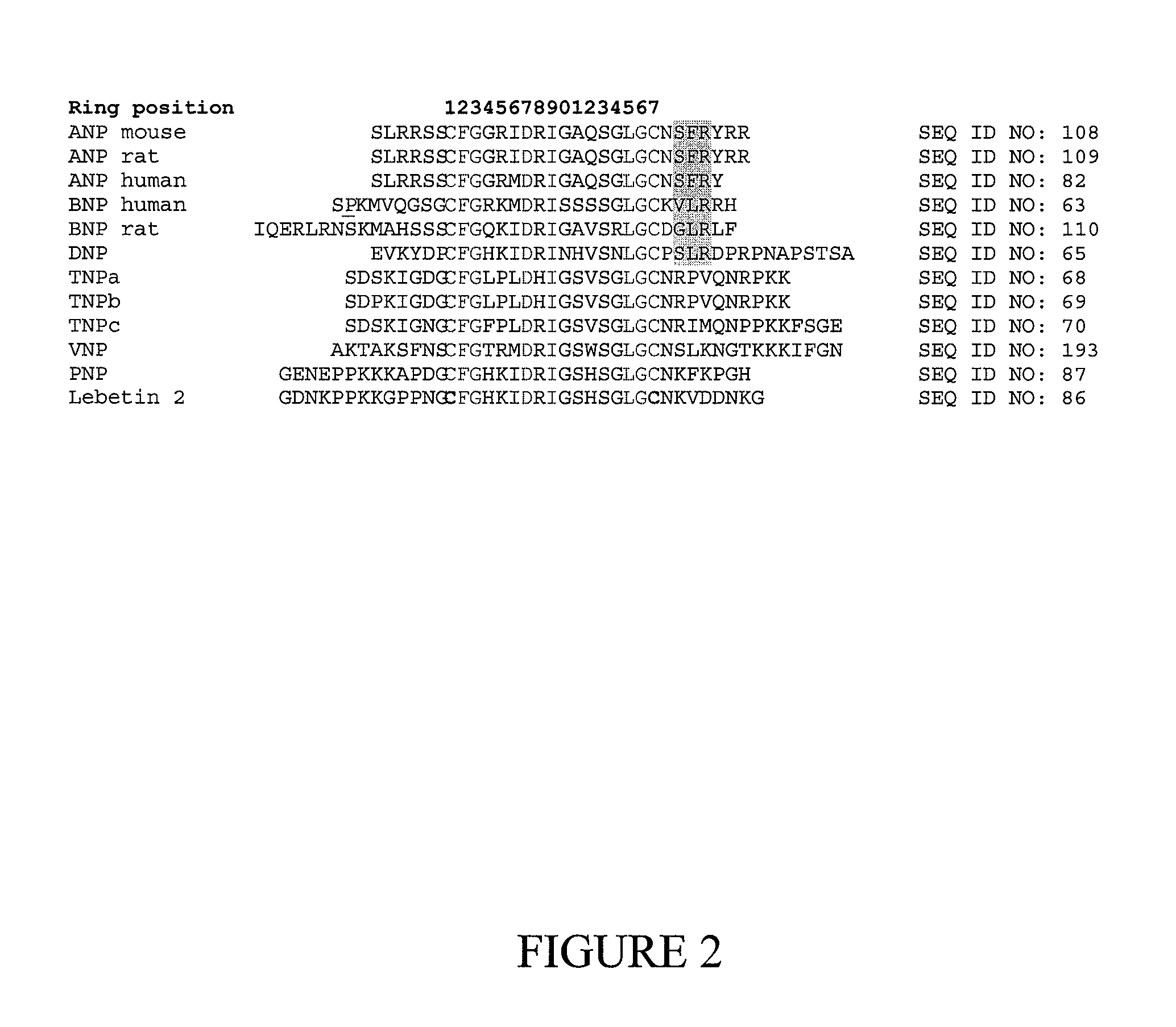
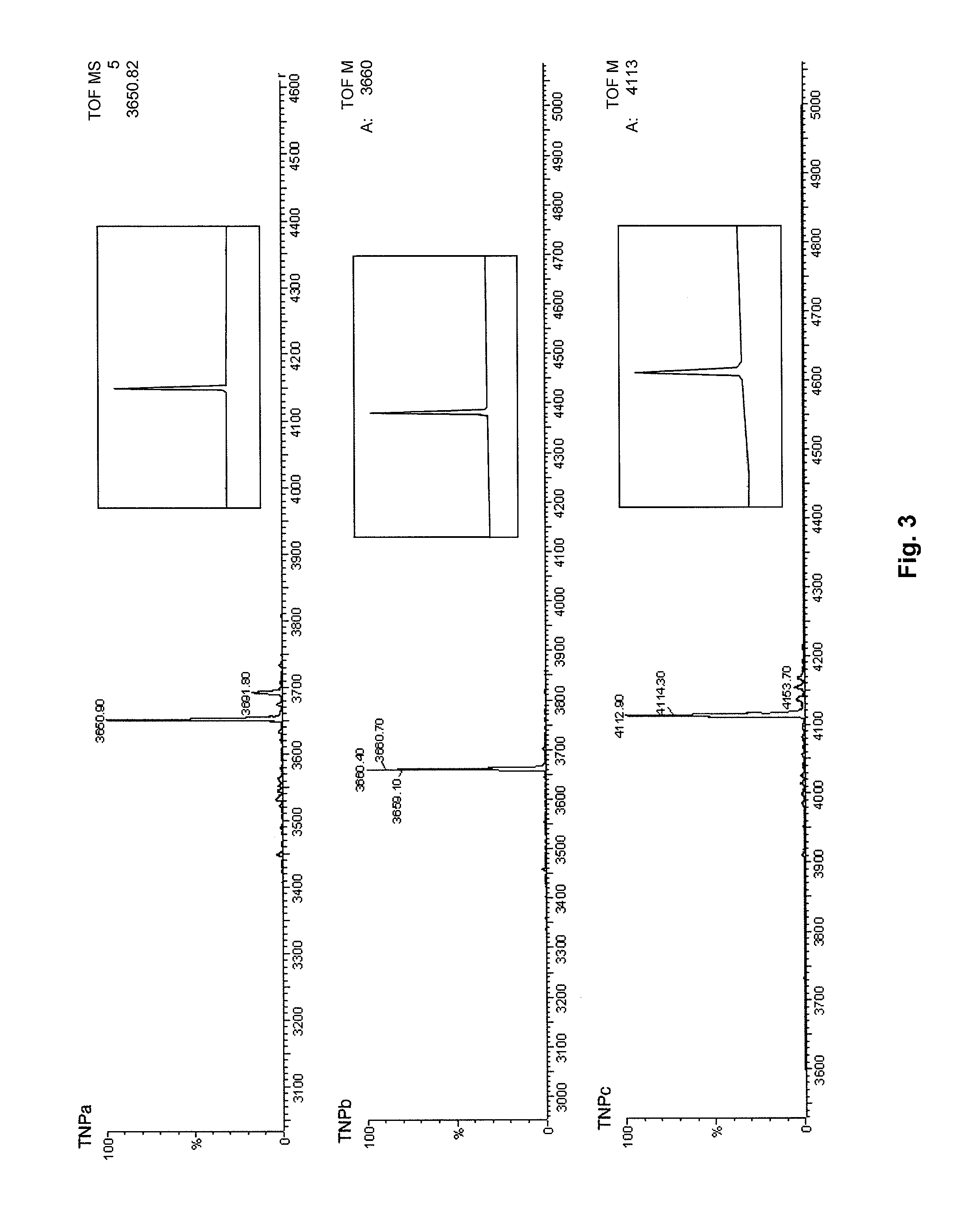
[0334]Analogs of the naturally occurring natriuretic peptides were manually synthesized in accordance with known methods previously described for other disulfide bearing peptides (Nielsen et al., 1999 J. Mol. Biol. 289, 1405-1421). In brief, the peptides, including ANP, BNP, and TNP toxins and analogs (see sequences in Tables 1 and 2) were manually assembled using the stepwise in situ neutralization protocol for Boc chemistry. The amino acid side-chain protection was as follows: Cys (MeBzl), Tyr (BrZ), Asn (Xan), Asp (OcHex), selenocys (MeBzl), Lys (ClZ), Gln (Xan) and Ser (Bzl). All the syntheses were performed on either Boc-EGlu-(OBzl)-OCH2-Pam, Boc-EGlu-(OcHx)-OCH2-Pam or Boc-Ala-OCH2-Pam resins. Deprotection and cleavage were carried out in HF:p-cresol:p-thiocresol (9:0.5:0.5) for 1.5 h. The pure, reduced peptides (0.02-0.05 mM) were oxidized in aqueous 0.1M NH4HCO3 (pH 8.0, adjusted with 0.1 M NH4OH). The peptide solutions...
example 3
Aortic Ring Experiments
Materials And Methods
[0342]Male Sprague Dawley rats were killed and the descending thoracic aorta rapidly removed and flushed with physiological solution. After being cleared of adhering fat and connective tissue, 5 mm rings were mounted under 10 g resting tension, between two stainless steel hooks, in organ baths (37° C.) containing carbogenated (95% O2 and 5% CO2) physiological salt solution of the following composition (mM): NaCl, 118.4; NaHCO3, 25; glucose, 11; KCl, 4.7; MgSO4, 1.2; KH2PO4, 1.2 and CaCl2, 2.5. The lower hook was attached to a tissue holder and the upper hook to a force displacement transducer (Grass FTO3). Where indicated endothelial cells were removed by gentle rubbing of the intimal surface with a wire. To confirm the presence or absence of endothelial cells, tissues were precontracted with a sub-maximal concentration of phenylephrine (0.3 μM) and the response to acetylcholine (ACh, 10 μM) observed. Ach-induced relaxation greater than 80...
PUM
| Property | Measurement | Unit |
|---|---|---|
| particle size | aaaaa | aaaaa |
| mass | aaaaa | aaaaa |
| dry weight | aaaaa | aaaaa |
Abstract
Description
Claims
Application Information
 Login to View More