Unlock instant, AI-driven research and patent intelligence for your innovation.

System and method for generating particles

a technology of system and method, applied in the field of electrochemistry, can solve the problems of failure to create a reproducible method and a corresponding system to generate particles during electrolysis of palladium in heavy water, and achieve the effect of reducing the number of particles and reducing the number of electrolysis steps

Active Publication Date: 2013-04-16
JWK INT
View PDF22 Cites 9 Cited by
  • Summary
  • Abstract
  • Description
  • Claims
  • Application Information

AI Technical Summary

Benefits of technology

The patent text describes a method and system for generating particles using electrochemistry. The method involves using an electrochemical cell and a specific charging profile to create particles. The technical effect of this patent is the development of a reliable method for generating particles, which can be used for various applications such as creating new elements, remedying nuclear waste, treating cancerous tumors, and creating strategic materials. The method can also be performed using an external magnetic field or an external electric field. The system includes a cathode and an anode, and the particles can be captured using a microscope optics. The method and system can be used at ambient temperature and standard atmospheric pressure.

Problems solved by technology

Previous efforts to create a reproducible method and corresponding system to generate particles during electrolysis of palladium in heavy water have been unsuccessful.

Method used

the structure of the environmentally friendly knitted fabric provided by the present invention; figure 2 Flow chart of the yarn wrapping machine for environmentally friendly knitted fabrics and storage devices; image 3 Is the parameter map of the yarn covering machine
View more

Image

Smart Image Click on the blue labels to locate them in the text.
Viewing Examples
Smart Image
  • System and method for generating particles
  • System and method for generating particles
  • System and method for generating particles

Examples

Experimental program
Comparison scheme
Effect test

specific example

Materials

[0053]Palladium chloride (99%, Aldrich), lithium chloride (analytical grade, Mallinckrodt), deuterated water (99.9% D, Aldrich), 0.25 mm diameter gold wire (99.9%, Aldrich), 0.5 mm diameter silver wire (99.9% Aldrich), 0.25 mm diameter platinum wire (99.9%, Aldrich), nickel screen (Delker, 0.35 mm thick and eyelet dimensions of 3 mm×1.9 mm).

Cell Design

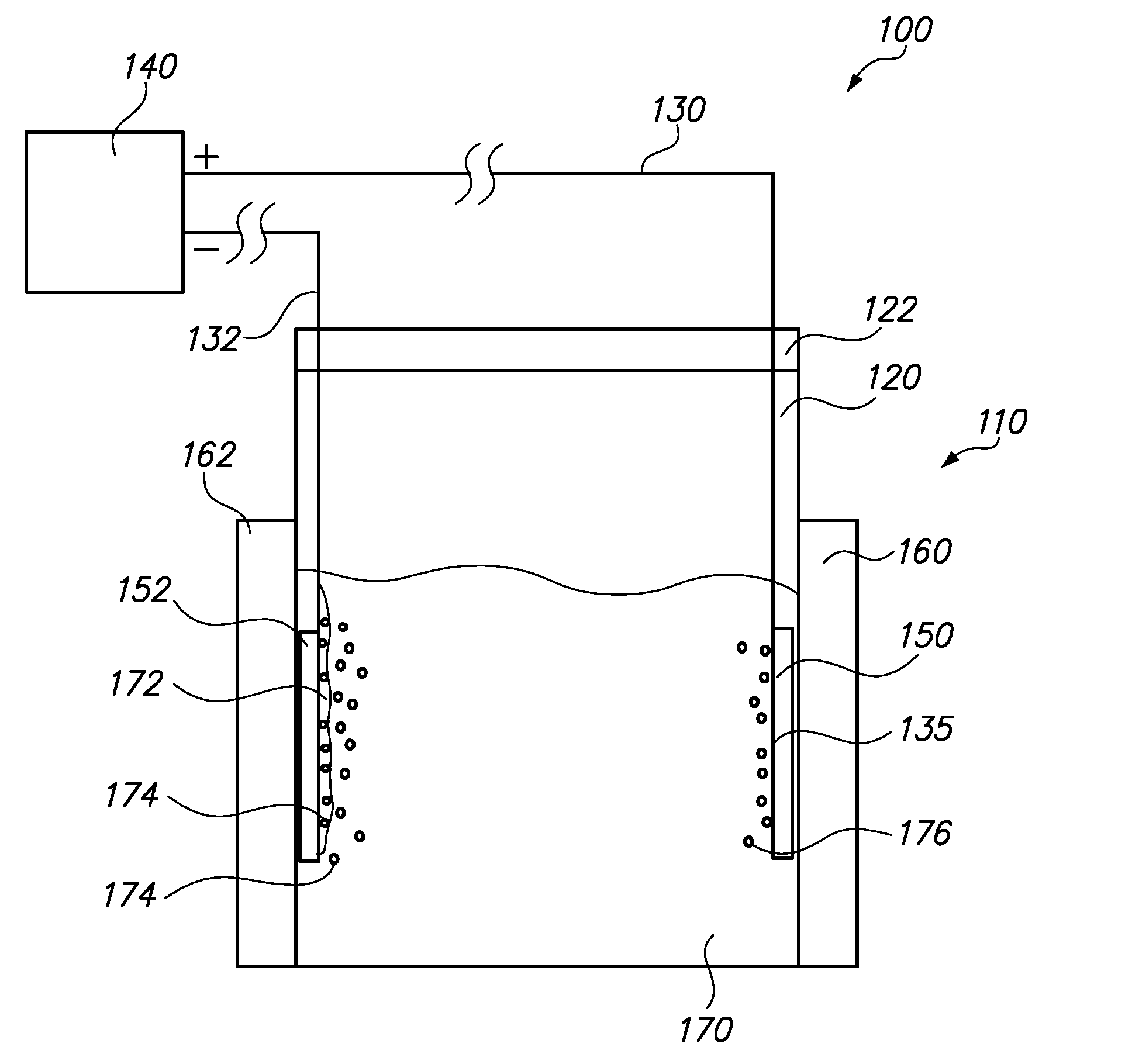
[0054]Cell design as shown in FIGS. 4-6.

Charging Procedure

[0055]Typically 20-25 mL solution of 0.03 M palladium chloride and 0.3 M lithium chloride in deuterated water is added to the cell. Palladium is then plated out onto the cathode substrate using a charging profile of 100 μA for 24 h, followed by 200 μA for 48 h followed by 500 μA until the palladium has been plated out. This charging profile assures good adherence of the palladium on the electrode substrate. Once the palladium has been plated out of solution, the external electric or magnetic fields are applied. In the external electric field configuration as shown in FI...

the structure of the environmentally friendly knitted fabric provided by the present invention; figure 2 Flow chart of the yarn wrapping machine for environmentally friendly knitted fabrics and storage devices; image 3 Is the parameter map of the yarn covering machine
Login to View More

PUM

PropertyMeasurementUnit
currentaaaaaaaaaa
timeaaaaaaaaaa
currentaaaaaaaaaa
Login to View More

Abstract

A method may include the steps of supplying current to the electrodes of an electrochemical cell according to a first charging profile, wherein the electrochemical cell has an anode, cathode, and electrolytic solution; maintaining a generally constant current between the electrodes; exposing the cell to an external field either during or after the termination of the deposition of deuterium absorbing metal on the cathode; and supplying current to the electrodes according to a second charging profile during the exposure of the cell to the external field. The electrolytic solution may include a metallic salt including palladium, and a supporting electrolyte, each dissolved in heavy water. The cathode may comprise a second metal that does not substantially absorb deuterium, such as gold. The external field may be a magnetic field.

Description

CROSS-REFERENCE TO RELATED APPLICATIONS[0001]This application claims the benefit of U.S. Provisional Patent Application Ser. No. 60 / 919,190, filed Mar. 14, 2007, entitled “Method and Apparatus for Generating Particles,” the content of which is fully incorporated by reference herein.BACKGROUND OF THE INVENTION[0002]The embodiments of the invention relate generally to the field of electrochemistry.[0003]Generated particles may be captured by other nuclei to create new elements, to remediate nuclear waste, to treat cancerous tumors, or to create strategic materials. Previous efforts to create a reproducible method and corresponding system to generate particles during electrolysis of palladium in heavy water have been unsuccessful.[0004]Therefore, a need currently exists for a reproducible method and corresponding system that can generate particles.BRIEF DESCRIPTION OF THE DRAWINGS[0005]FIG. 1 illustrates a flow chart of an implementation of a method for generating particles.[0006]FIG. ...

Claims

the structure of the environmentally friendly knitted fabric provided by the present invention; figure 2 Flow chart of the yarn wrapping machine for environmentally friendly knitted fabrics and storage devices; image 3 Is the parameter map of the yarn covering machine
Login to View More

Application Information

Patent Timeline
no application Login to View More
Patent Type & Authority Patents(United States)
IPC IPC(8): C25D5/48C25C1/20
CPCC25C1/20C25C5/02C25C7/00
Inventor BOSS, PAMELA A.GORDON, FRANK E.SZPAK, STANISLAWFORSLEY, LAWRENCE PARKER GALLOWAY
Owner JWK INT