Doppler frequency estimation system and method
a frequency estimation and doppler technology, applied in the field of wireless transmissions, can solve the problems of increasing the uncertainty of signal quality, increasing the bit error rate (ber) of the receiver, and increasing the amount of data to be processed in the frequency domain, so as to save system cost, accurately and quickly estimate the doppler frequency, and reduce the amount of processed data
- Summary
- Abstract
- Description
- Claims
- Application Information
AI Technical Summary
Benefits of technology
Problems solved by technology
Method used
Image



Examples
Embodiment Construction
[0026]Features and advantages of the present invention will be more clearly understood by the following detailed description of the present preferred embodiments by reference to the accompanying drawings.
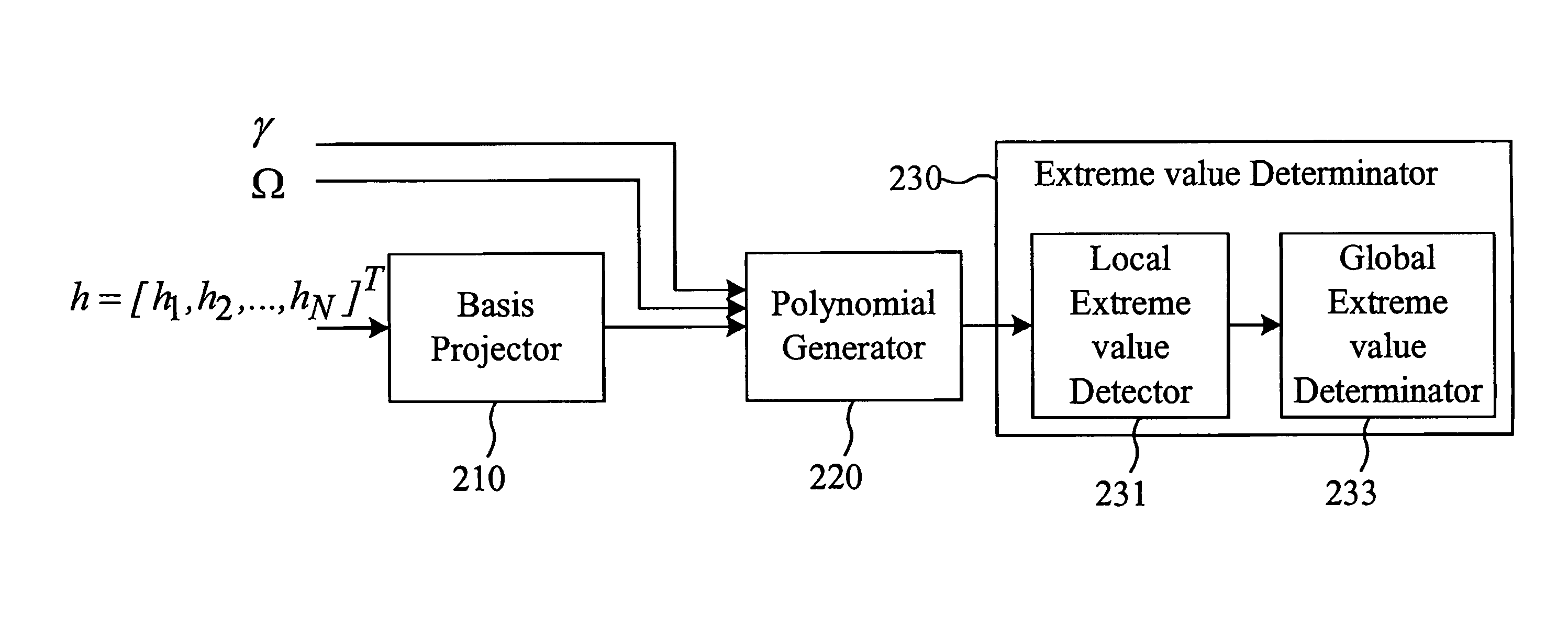
[0027]FIG. 2 is a schematic diagram of a configuration of a Doppler frequency estimation system according to an embodiment of the invention, which is applied to a receiver of a wireless transmission system. The estimation system includes a basis projector 210, a polynomial generator 220 and an extreme value determinator 230.
[0028]The basis projector 210 receives and projects N channel sampling signals h=[h1, h2, . . . , hN]T to a set of orthogonal bases VK to thereby generate multiple channel correlation vectors ν, i.e., ν=VTh.
[0029]The polynomial generator 220 is connected to the basis projector 210 in order to accord to the channel correlation vectors ν, an estimated channel-envelope-to-noise-plus-interference power-ratio γ and a channel-envelope power Ω to produce a target polyno...
PUM
 Login to View More
 Abstract
Description
Claims
Application Information
 Login to View More