Check patentability & draft patents in minutes with Patsnap Eureka AI!

Shared virtual memory between a host and discrete graphics device in a computing system

Active Publication Date: 2014-10-21
INTEL CORP
View PDF3 Cites 0 Cited by
  • Summary
  • Abstract
  • Description
  • Claims
  • Application Information

AI Technical Summary

Benefits of technology

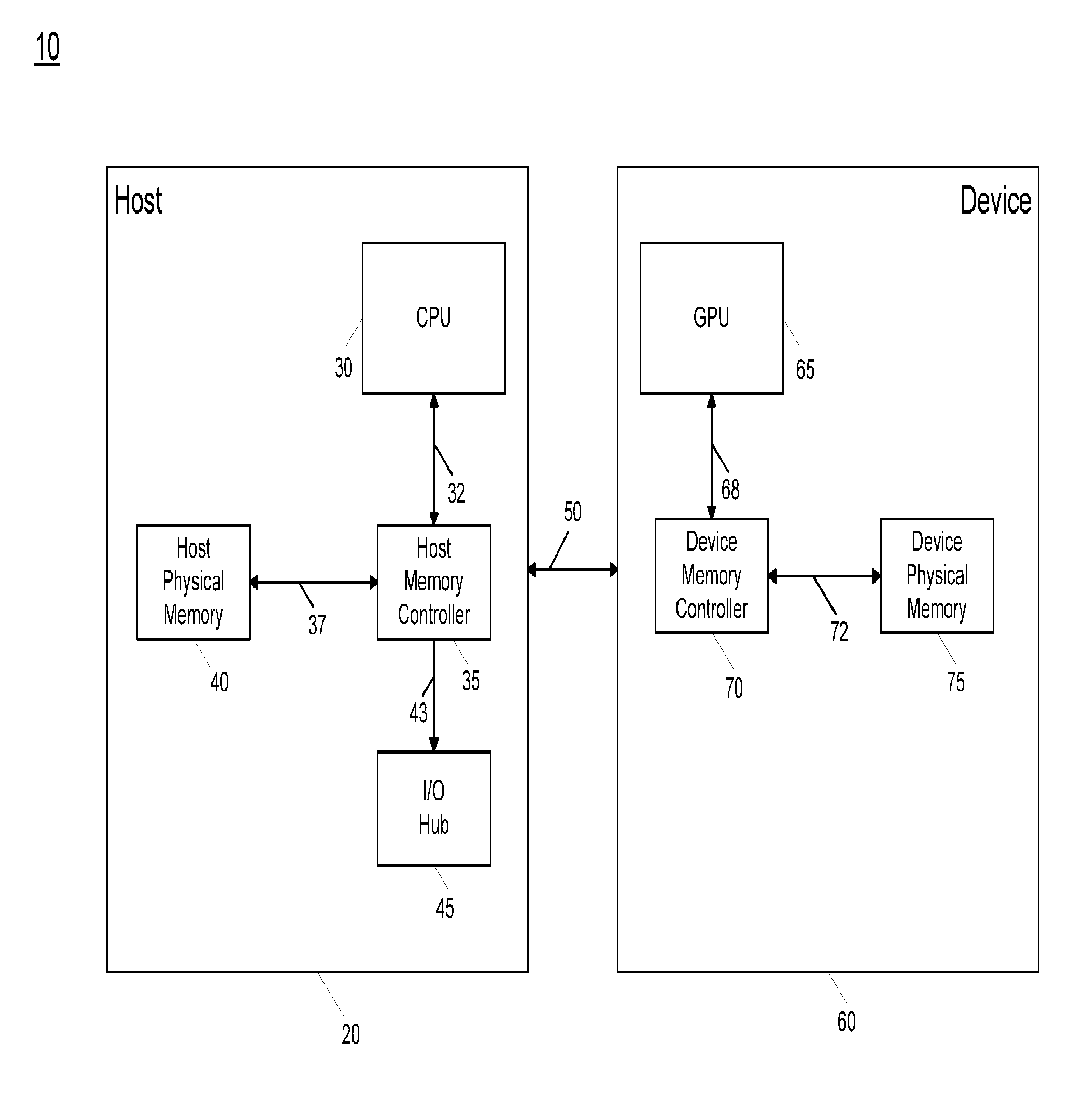
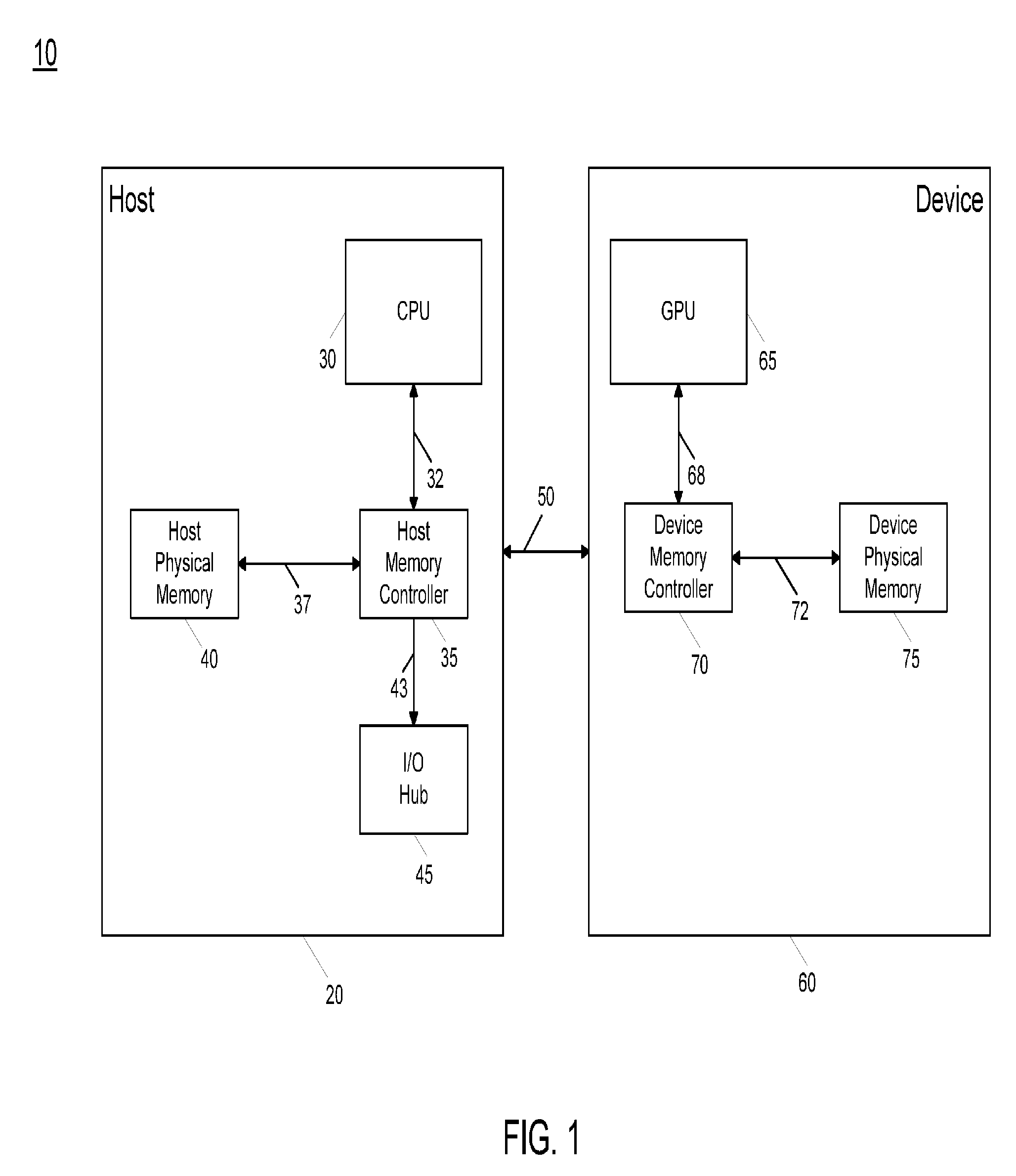
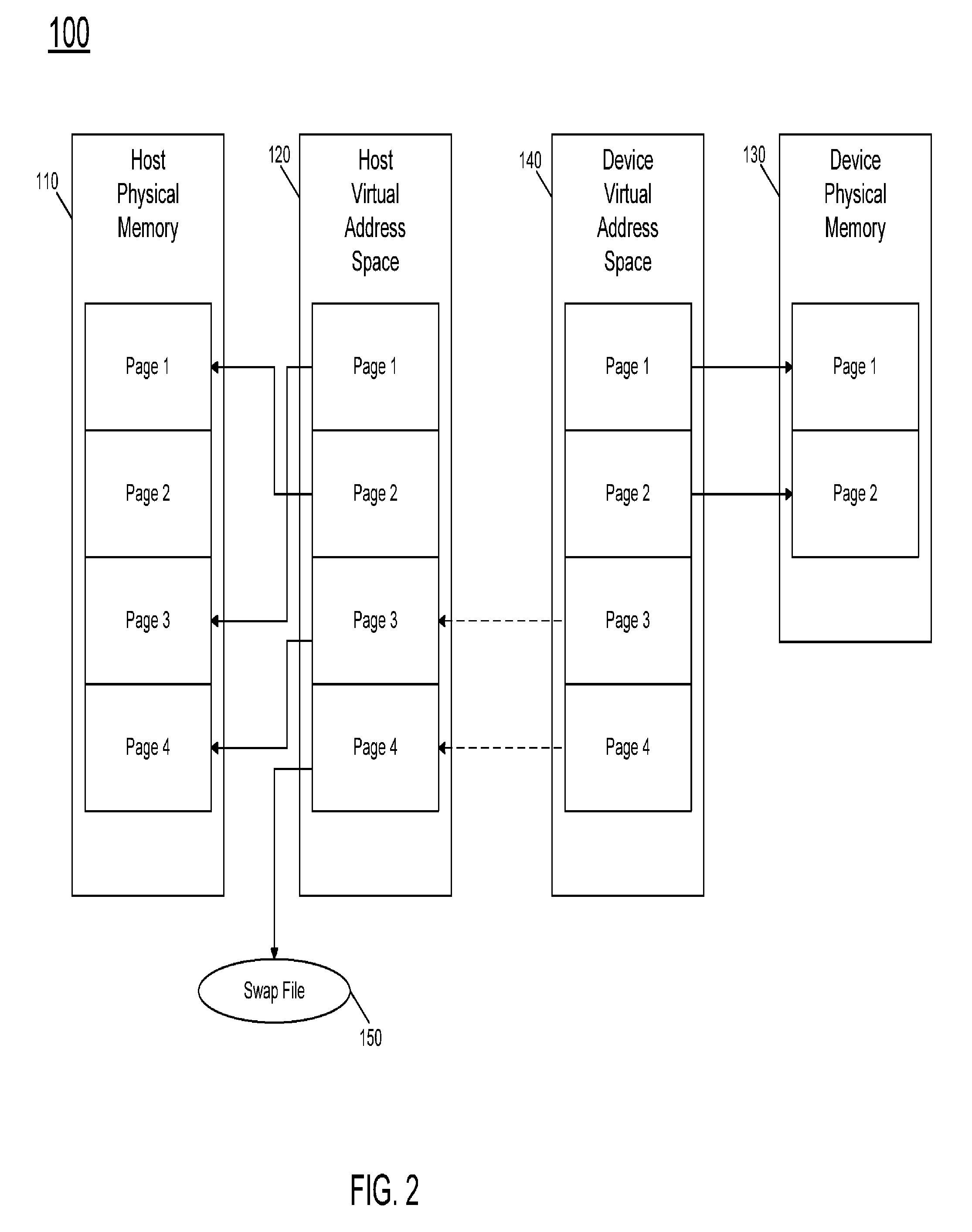
The patent text describes a system where a host computer has a processor and a device that can provide graphics functionality. However, there are limitations in the current programming model for these devices. The host and device have separate memory spaces, so data cannot be easily exchanged between them. Additionally, current graphics cards do not support virtual paging mechanisms, which can make programming sensitive to the size of the physical memory. The patent proposes an Asymmetric Shared Virtual Memory (A-SVM) model that allows for efficient memory usage and dynamic access between the host and device. This model provides a way to overcome these limitations and improve the performance of graphics cards.

Problems solved by technology

As a result, host code and device code cannot exchange general data structures (e.g., lists, trees, etc.) that use pointers.
Instead, the current GPU model is limited to data arrays only, so a programmer must use index (offset) instead of pointers, which is inefficient.
Another problem with current graphics cards is that they do not support virtual paging mechanisms.
A lack of a virtual paging mechanism in conventional graphics units makes existing GPU programming extremely sensitive to the size of physical memory located on the graphics card.

Method used

the structure of the environmentally friendly knitted fabric provided by the present invention; figure 2 Flow chart of the yarn wrapping machine for environmentally friendly knitted fabrics and storage devices; image 3 Is the parameter map of the yarn covering machine
View more

Image

Smart Image Click on the blue labels to locate them in the text.
Viewing Examples
Smart Image
  • Shared virtual memory between a host and discrete graphics device in a computing system
  • Shared virtual memory between a host and discrete graphics device in a computing system
  • Shared virtual memory between a host and discrete graphics device in a computing system

Examples

Experimental program
Comparison scheme
Effect test

Embodiment Construction

[0010]In various embodiments, an Asymmetric Shared Virtual Memory (A-SVM) model may be provided for host and peripheral device arrangements such as a CPU / GPU system, in which memory on the device serves as a so-called “mega-cache” for memory on the host. That is, rather than a typically limited cache that operates using information units of a small size (e.g., cache line, which may be 64, 128 or other amount of bytes), embodiments may use a device memory as a page-level cache structure such that entire memory pages may be efficiently stored in the device memory to enable local access by the device. While the scope of the present invention is not limited in this regard, embodiments may be applicable to 4 kilobytes (KB) page sizes. Thus, the swapping of memory between CPU and GPU is dynamic with a page size unit for swapping. Coherency of memory between CPU and GPU may be based on a modification to conventional operating system (OS) mechanisms for page protection. Still further, embod...

the structure of the environmentally friendly knitted fabric provided by the present invention; figure 2 Flow chart of the yarn wrapping machine for environmentally friendly knitted fabrics and storage devices; image 3 Is the parameter map of the yarn covering machine
Login to View More

PUM

No PUM Login to View More

Abstract

In one embodiment, the present invention includes a device that has a device processor and a device memory. The device can couple to a host with a host processor and host memory. Both of the memories can have page tables to map virtual addresses to physical addresses of the corresponding memory, and the two memories may appear to a user-level application as a single virtual memory space. Other embodiments are described and claimed.

Description

[0001]This application is a continuation of U.S. patent application Ser. No. 13 / 895,723, filed May 16, 2013, which is a continuation of U.S. patent application Ser. No. 12 / 489,954, filed Jun. 23, 2009, now U.S. Pat. No. 8,451,281, issued May 28, 2013, the content of which is hereby incorporated by reference.BACKGROUND[0002]Many computer systems include a general-purpose processor such as a microprocessor, and additional devices such as components that may be configured into a system or later added in. For example, one such device can provide for graphics functionality that may be implemented by way of an add-in device that typically includes a graphics processing unit (GPU) and a separate memory on an add-in card.[0003]Conventionally, a central processing unit (CPU) / GPU system model can be described as two independent computing complexes connected by an interconnect. The corresponding GPU programming model considers the host (i.e., CPU) and device (i.e., GPU) memory subsystems as tw...

Claims

the structure of the environmentally friendly knitted fabric provided by the present invention; figure 2 Flow chart of the yarn wrapping machine for environmentally friendly knitted fabrics and storage devices; image 3 Is the parameter map of the yarn covering machine
Login to View More

Application Information

Patent Timeline
no application Login to View More
IPC IPC(8): G09G5/36G06T1/60G09G5/39G06F12/12G06F15/167G06F3/14G06F12/10G06F15/16
CPCG09G5/363G06F12/12G09G5/39G06F3/14G06F12/1009G09G2360/121G06F12/1081G09G2360/125G06F12/1063G06F2212/656G06T1/60G06F12/109G06F12/1027G06F12/0802G06F12/1045G06F2212/302G06F2212/455G06T2200/28G06F12/1036
Inventor GINZBURG, BORIS
Owner INTEL CORP
Features
  • R&D
  • Intellectual Property
  • Life Sciences
  • Materials
  • Tech Scout
Why Patsnap Eureka
  • Unparalleled Data Quality
  • Higher Quality Content
  • 60% Fewer Hallucinations
Social media
Patsnap Eureka Blog
Learn More