
High strength polyurethane foam compositions and methods
a polyurethane foam, high-performance technology, applied in the field of polyurethane foams, can solve the problems of difficult formulation of sub>2 /sub>copolymer as the primary polyol component in the b-side, lack of desirable physical properties, and friable foam produced, etc., to achieve the effect of increasing desirable properties such as strength, solvent resistance, and compression force deflection
- Summary
- Abstract
- Description
- Claims
- Application Information
AI Technical Summary
Benefits of technology
Problems solved by technology
Method used
Image

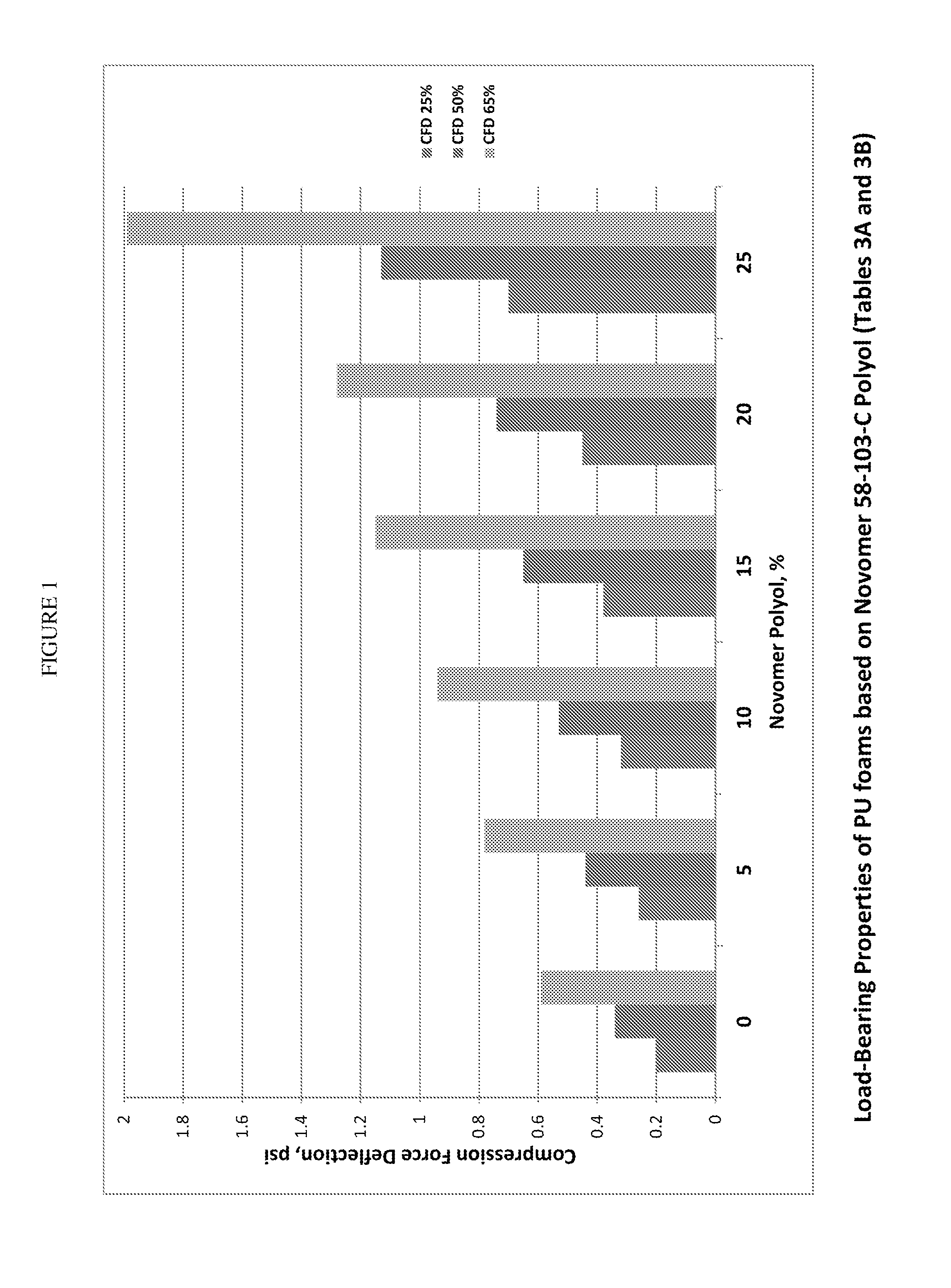
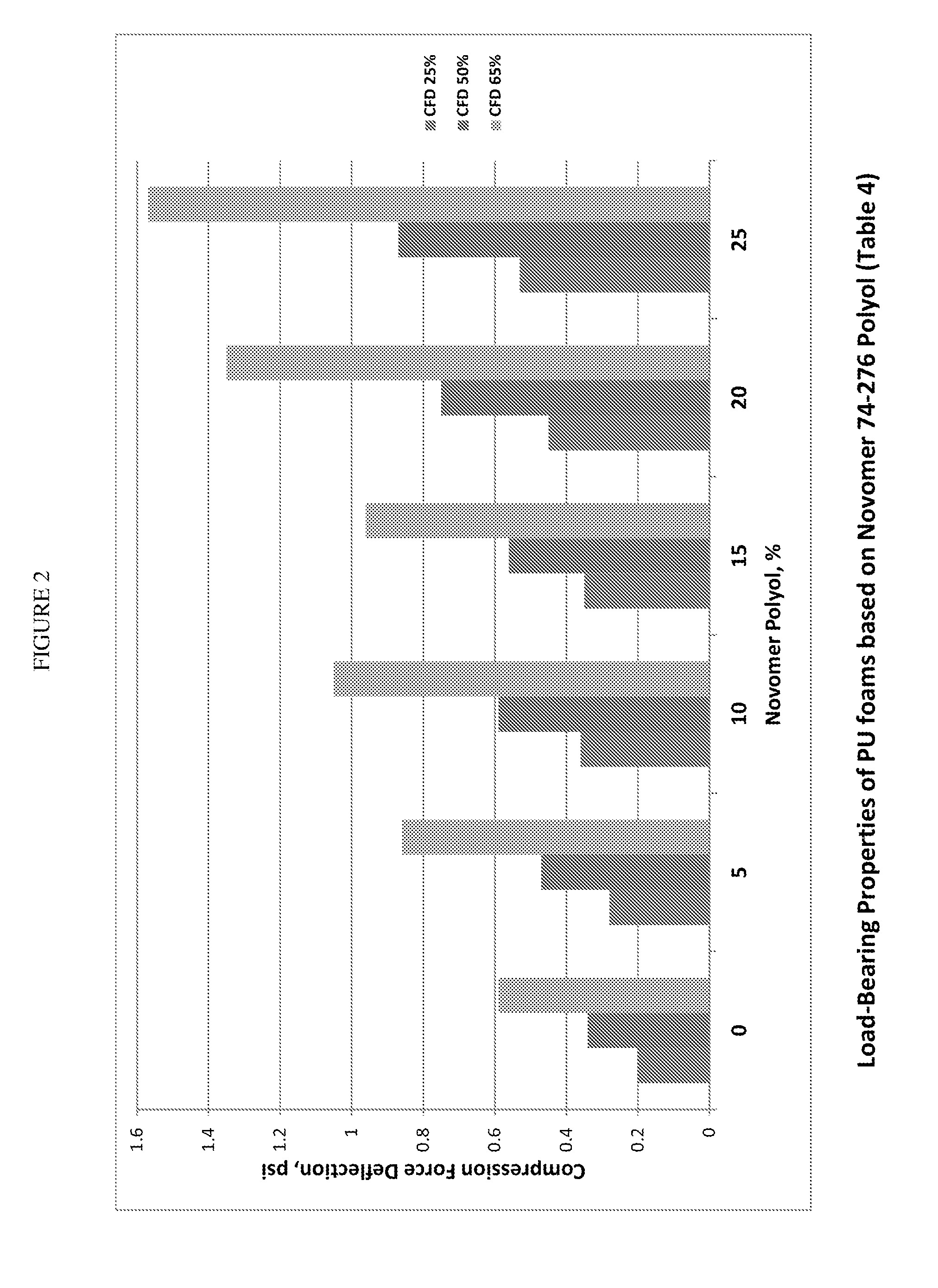
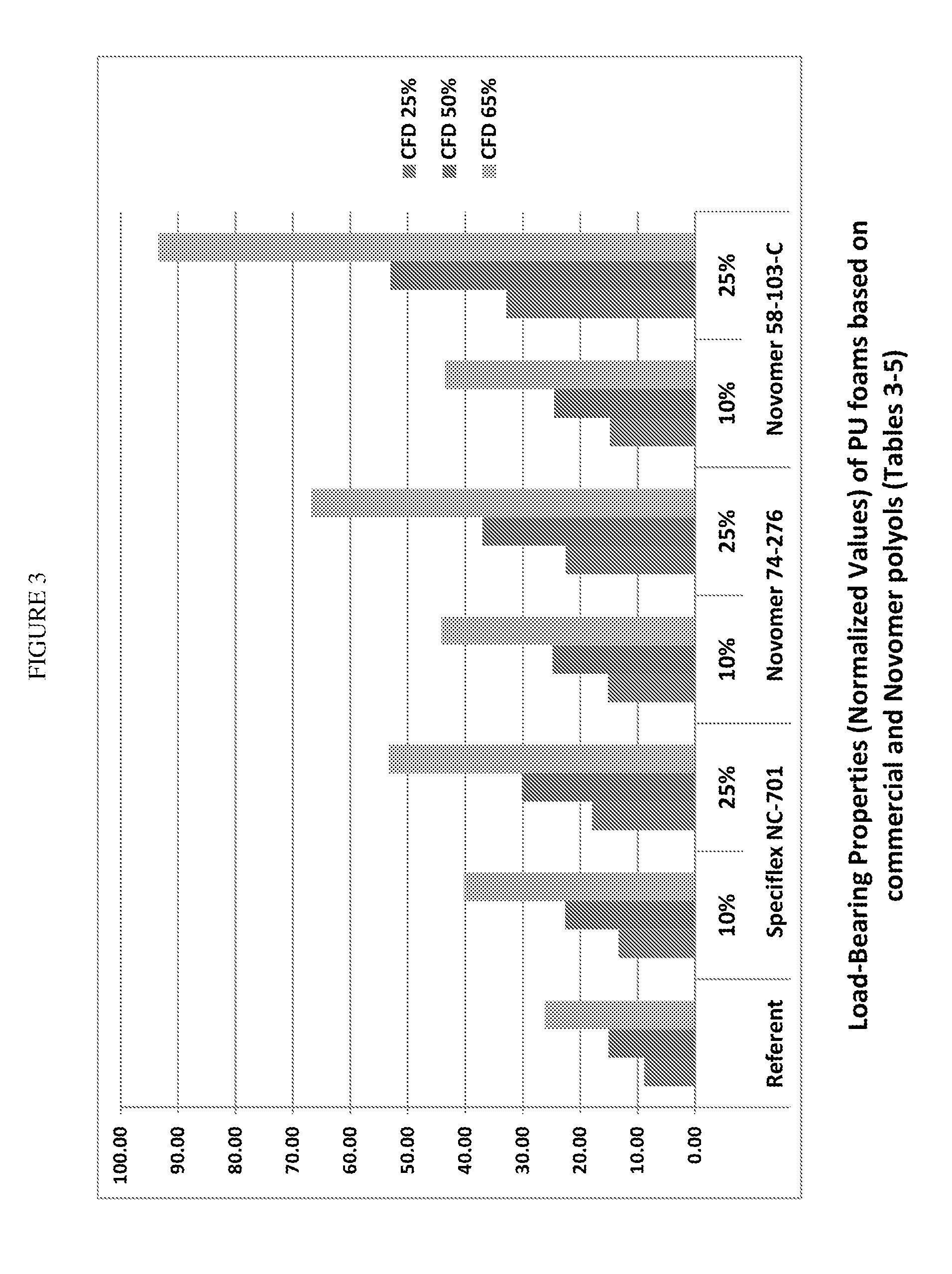
Examples
example 1
High Strength Flexible Foams
[0204]Presented below are the formulations of high strength flexible polyurethane foams according to the principles of the present invention. These materials were made using aliphatic polycarbonate polyol additives as defined herein. Specifically, the aliphatic polycarbonate polyols hereinafter also referred to as “Novomer Polyols” used in the formulations below have the following properties:
[0205]
Property58-103-C74-276Acid Value, mg KOH / g0.280.51Hydroxyl Value, mg KOH / g11961.1Mn (GPC)1,2702,213Mw (GPC)1,3702,443Polydispersity, Mw / Mn1.071.06Glass Transition Temp. (DSC), Tg−5° C.−5.5° C.Viscosity, cPs4,990 @ 80° C.—
[0206]Polyol 58-103-C is a linear 1270 g / mol poly(propylene carbonate) polyol initiated with dipolypropylene glycol (a mixture of isomers) having a PDI of 1.06, greater than 99% —OH end groups and greater than 99% carbonate linkages (exclusive of the ether bonds in the dipropylene glycol). This polyol conforms to the formula:
[0207][0208]where n ...
example 2
Viscoelastic Foam Compositions
[0259]Presented below are the formulations of viscoelastic polyurethane foams according to the principles of the present invention. These materials were made using aliphatic polycarbonate polyol additives as defined herein. Specifically, the aliphatic polycarbonate polyols hereinafter also referred to as “Novomer Polyols” used in the formulations below have the following properties:
[0260]
58-103-C74-21774-277Acid Value, mg KOH / g0.280.020.01Hydroxyl Value, mg KOH / g119169.9567.07Mn (GPC)1,2708102290Mw (GPC)1,3709202400Polydispersity, Mw / Mn1.071.131.05Glass Transition Temp.−5° C.−20° C.−5° C.(DSC), TgViscosity, cPs4,990 @330 @3700 @80° C.75° C. -75° C.
[0261]Polyol 58-103-C is a linear 1270 g / mol poly(propylene carbonate) polyol initiated with dipolypropylene glycol (a mixture of isomers) having a PDI of 1.06, greater than 99% —OH end groups and greater than 99% carbonate linkages (exclusive of the ether bond in the dipropylene glycol). This polyol conforms ...
example 3
TDI-Based Seating Foams
[0331]Presented below are the formulations and properties of high strength TDI-based polyurethane foams prepared according to the principles of the present invention. These materials were made to evaluate their suitability for seating foam applications. The TDI foams were made using aliphatic polycarbonate polyol additives as defined herein. Specifically, the aliphatic polycarbonate polyols hereinafter also referred to as “Novomer Polyols” used in the formulations below have the following properties:
[0332]
Polyol Batch No.58-103-C74-27680-14880-163Acid Value, mg KOH / g0.280.512.682.09Hydroxyl Value, mg11961.1111.764.9KOH / gMn (GPC)1,2702,21313372205Mw (GPC)1,3702,44314532345Polydispersity, Mw / Mn1.071.061.091.06Glass Transition Temp.−5° C.−5.5° C.6.0° C.−9.9° C.(DSC), Tg
[0333]The structures of polyols 58-103-C and 74-276 are shown above in previous examples.
[0334]Polyol 80-163 is a linear 2250 g / mol poly(propylene carbonate) polyol initiated with 600 g / mol polypro...
PUM
| Property | Measurement | Unit |
|---|---|---|
| weight percent | aaaaa | aaaaa |
| density | aaaaa | aaaaa |
| density | aaaaa | aaaaa |
Abstract
Description
Claims
Application Information
 Login to View More