Check patentability & draft patents in minutes with Patsnap Eureka AI!

Pavement joints and methods for treating the same

a technology for pavement joints and joints, applied in bridges, bridges, roads, etc., can solve the problems of limited lifespan of joint seals, early distress and/or deterioration, and premature deterioration, and achieve the effect of prolonging the life of joints and adjacent pavement surfaces

Active Publication Date: 2017-10-10
ADHESIVES TECH
View PDF23 Cites 2 Cited by
  • Summary
  • Abstract
  • Description
  • Claims
  • Application Information

AI Technical Summary

Benefits of technology

The solution significantly prolongs the life of pavement joints and adjacent surfaces by reducing porosity, preventing corrosion, and enhancing adhesion of sealants, thereby improving the joint's resistance to environmental factors and chemical damage.

Problems solved by technology

The composition of the pavement or adjacent structures may also lead to premature deterioration, particularly where softer aggregates are used (e.g., soft limestone, medium limestone, etc.) or the mix (e.g., concrete mix, etc.) is not particularly durable.
The quality of the finish, the finishing technique and / or the manner in which a pavement material or the material of an adjacent structure is cured may also lead to early distress and / or deterioration.
The lifespans of joint seals are, however, limited.
Such corrosion or deterioration may allow for moisture intrusion, as well as the ability of the moisture to wick through the surface and into the structure, which may cause surface deterioration, such as spalling, edge chipping or edge cracking.
Even during their useful lives, conventional joint seals do not prevent moisture or chemicals that collect on a pavement surface from creeping into the joint through the concrete or other materials that define the pavement in which the joint is defined.
Thus, the protection provided by conventional joint seals is limited.
Consequently, water may evaporate from the newly defined surfaces of the joint differently (e.g., more quickly) than it evaporates from the cured surfaces, which may cause salt migration through the pavement structure and, thus, efflorescence, as well as increased porosity of the uncured surfaces of the joint and dusting.
In addition, saw cutting may distress the pavement structure, potentially resulting in micro-fissures and other weaknesses.
A joint may also be protected in conjunction with smoothing one or both pavement surfaces adjacent to the joint (e.g., by diamond grinding; etc.), which opens surface pores and, without some protection, might subject the joint and adjacent areas of the pavement structure to premature deterioration.

Method used

the structure of the environmentally friendly knitted fabric provided by the present invention; figure 2 Flow chart of the yarn wrapping machine for environmentally friendly knitted fabrics and storage devices; image 3 Is the parameter map of the yarn covering machine
View more

Image

Smart Image Click on the blue labels to locate them in the text.
Viewing Examples
Smart Image
  • Pavement joints and methods for treating the same
  • Pavement joints and methods for treating the same
  • Pavement joints and methods for treating the same

Examples

Experimental program
Comparison scheme
Effect test

examples

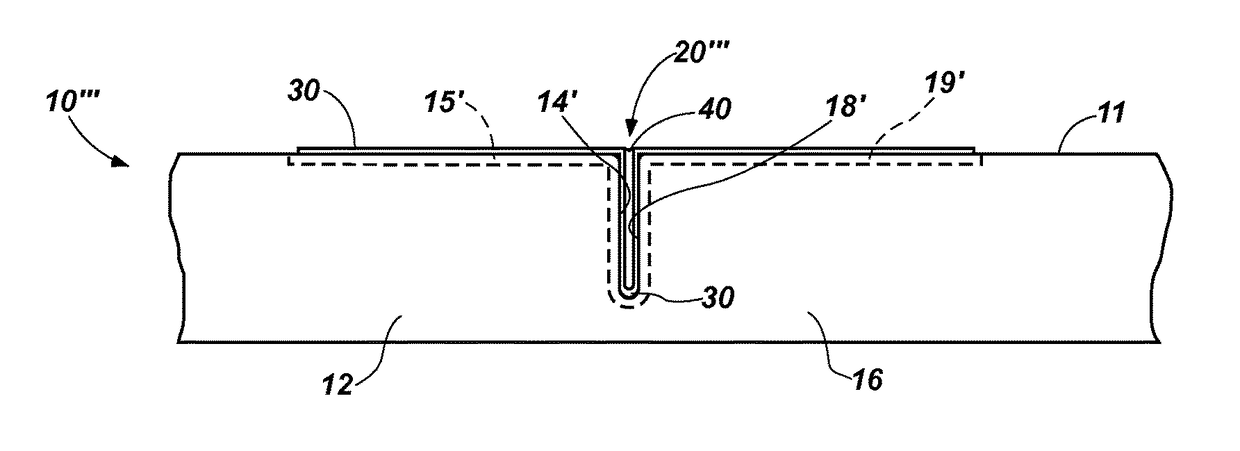
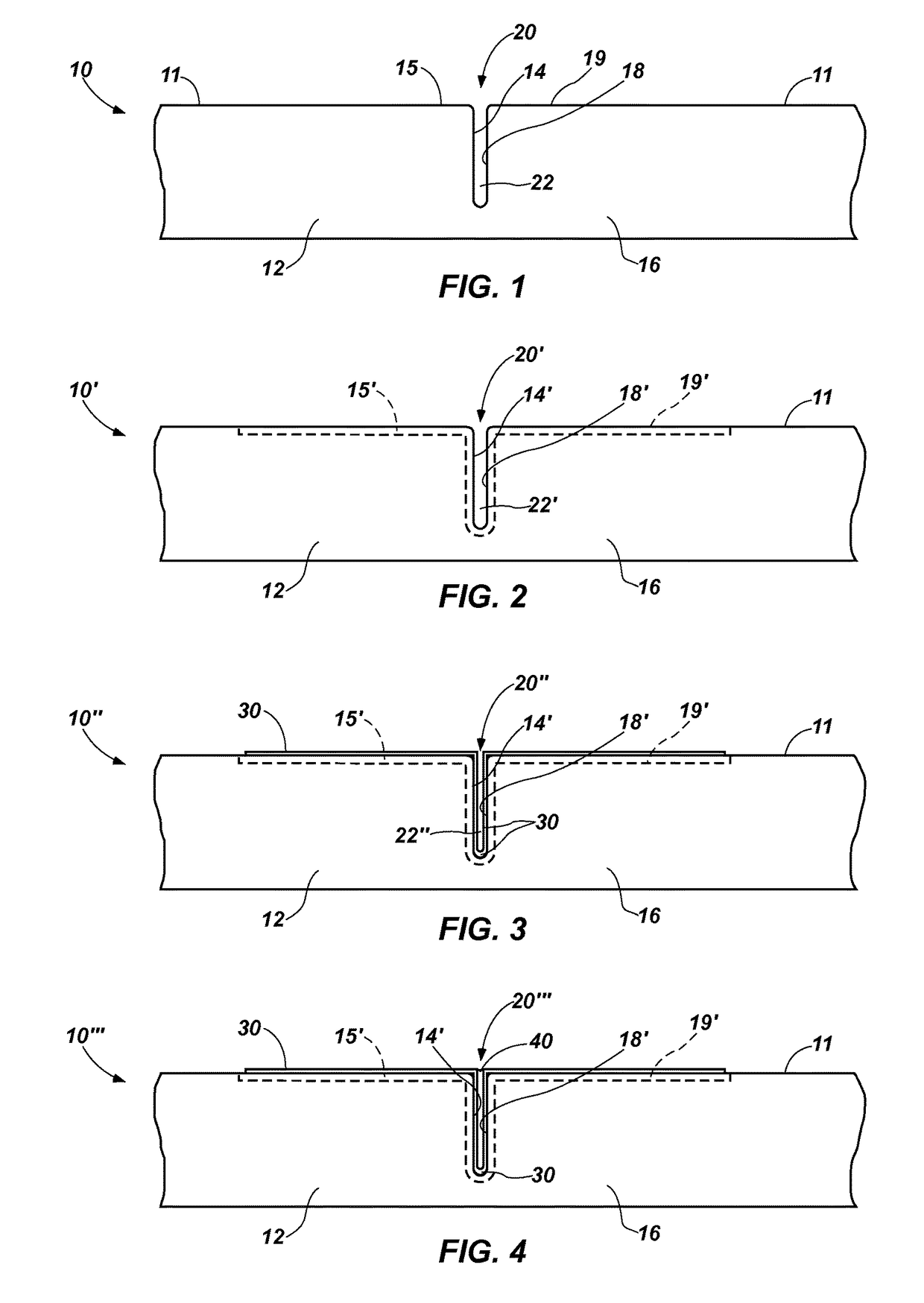
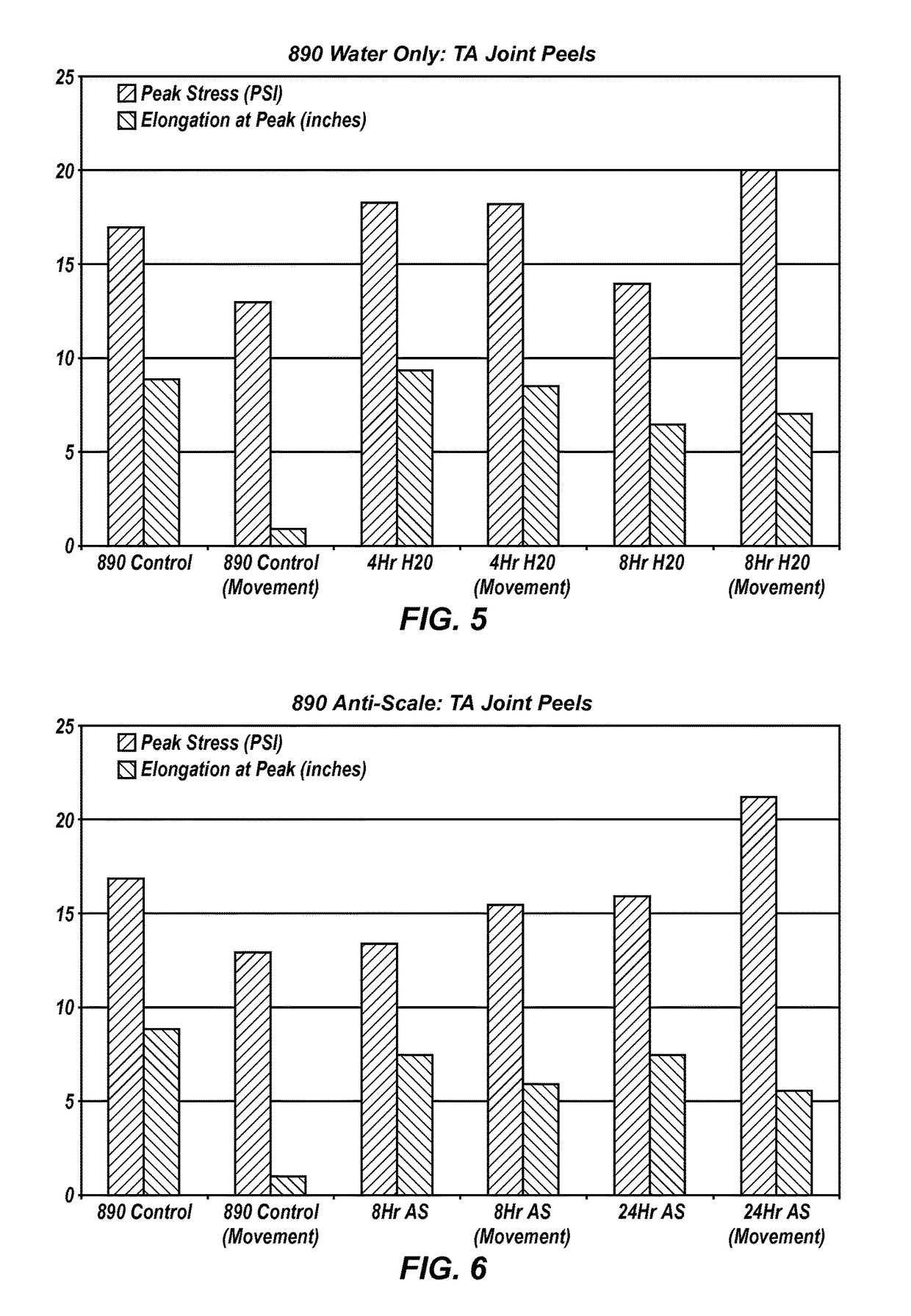
[0049]TABLES 1 and 2, which follow, provide some specific, but non-limiting examples of the manner in which a joint in pavement may be treated.

[0050]

TABLE 1PlannedActualDesignationJoint #PretreatmentSealPretreatmentCommentsC96NOTHINGEXISTINGD198791 Anti-ScaleSilicone 888791 Anti-ScaleTreated 12″ on either sideof joint & Inside JointT199TK SilaneSilicone 888D2100Dual systemSilicone 888Dual System790 (WB) - 8″ to 12″ onsolvent basedH2O Basedeither side of joint, not inthe joint791 - 12″ on either side andinside jointT2102TK SiloxaneSilicone 888C103NOTHINGEXISTINGD1105Treated DualSilicone 888Dual System790 - 6″ on either side ofSystem H2OSolvent Basedand inside jointbased791 - 12″ on either side ofjoint and inside jointT1106TK SilaneSilicone 888D2108791 Anti-ScaleSilicone 888791 Anti-ScaleTreated 12″ on either sideof joint and inside jointT2109TK SiloxaneSilicone 888C113NOTHINGEXISTINGD1114Dual systemSilicone 888Dual System790 (WB) - 8″ to 12″ onsolvent basedH2O Basedeither side of joi...

the structure of the environmentally friendly knitted fabric provided by the present invention; figure 2 Flow chart of the yarn wrapping machine for environmentally friendly knitted fabrics and storage devices; image 3 Is the parameter map of the yarn covering machine
Login to View More

PUM

PropertyMeasurementUnit
distanceaaaaaaaaaa
timeaaaaaaaaaa
timeaaaaaaaaaa
Login to View More

Abstract

Techniques for protecting joints in pavement structures include applying a hardener / densifier to one or more surfaces that define a joint in a pavement structure and, optionally, to portions of one or more surfaces that are located adjacent to the joint. One or more other compounds, such as hydrophobic materials, water resistant materials, anti-scaling compounds, anti-wear compounds, multi-functional blended compositions and the like, may also be applied to the surfaces that define a joint and / or to portions of one or more surfaces that are adjacent to the joint. A seal may also be formed in a joint in a pavement structure.

Description

CROSS-REFERENCE TO RELATED APPLICATION[0001]A claim for the benefit of priority to the Jan. 14, 2014 filing date of U.S. Provisional Patent Application No. 61 / 926,950, titled SEALED PAVEMENT JOINTS (“the '950 Provisional Application”) is hereby made pursuant to 35 U.S.C. §119(e). The entire disclosure of the '950 Provisional Application is incorporated herein by this reference.TECHNICAL FIELD[0002]This disclosure relates generally to joints in pavement and to techniques and methods for protecting and / or prolonging the useful lives of joints in pavement. More specifically, this disclosure relates to techniques in which the surfaces of pavement (e.g., concrete pavement, etc.) that define joints in the pavement, as well as pavement surfaces that are adjacent to the joint may be protected by hardening and / or densification. Protected joints may be open, or “unsealed,” or they may be closed, or “sealed.” This disclosure also relates to joints and adjacent pavement surfaces that have been ...

Claims

the structure of the environmentally friendly knitted fabric provided by the present invention; figure 2 Flow chart of the yarn wrapping machine for environmentally friendly knitted fabrics and storage devices; image 3 Is the parameter map of the yarn covering machine
Login to View More

Application Information

Patent Timeline
no application Login to View More
Patent Type & Authority Patents(United States)
IPC IPC(8): E01C11/10E01D19/06E01C11/06
CPCE01C11/103E01D19/06E01C11/06
Inventor HILLS, DAL N.KOEBRICK, JEFFHILLS, KASON
Owner ADHESIVES TECH
Features
  • R&D
  • Intellectual Property
  • Life Sciences
  • Materials
  • Tech Scout
Why Patsnap Eureka
  • Unparalleled Data Quality
  • Higher Quality Content
  • 60% Fewer Hallucinations
Social media
Patsnap Eureka Blog
Learn More