Supercharge Your Innovation With Domain-Expert AI Agents!

Method for manufacturing monocrystalline graphene

a monocrystalline graphene and graphene technology, applied in the direction of polycrystalline material growth, crystal growth process, chemically reactive gas, etc., can solve the problem that the thickness of high-integrated semiconductor devices equal to or less than 30 nm cannot be easily manufactured, the electrodes cannot be easily patterned using electron beam lithography,

Active Publication Date: 2017-12-05
KOREA RES INST OF STANDARDS & SCI
View PDF13 Cites 0 Cited by
  • Summary
  • Abstract
  • Description
  • Claims
  • Application Information

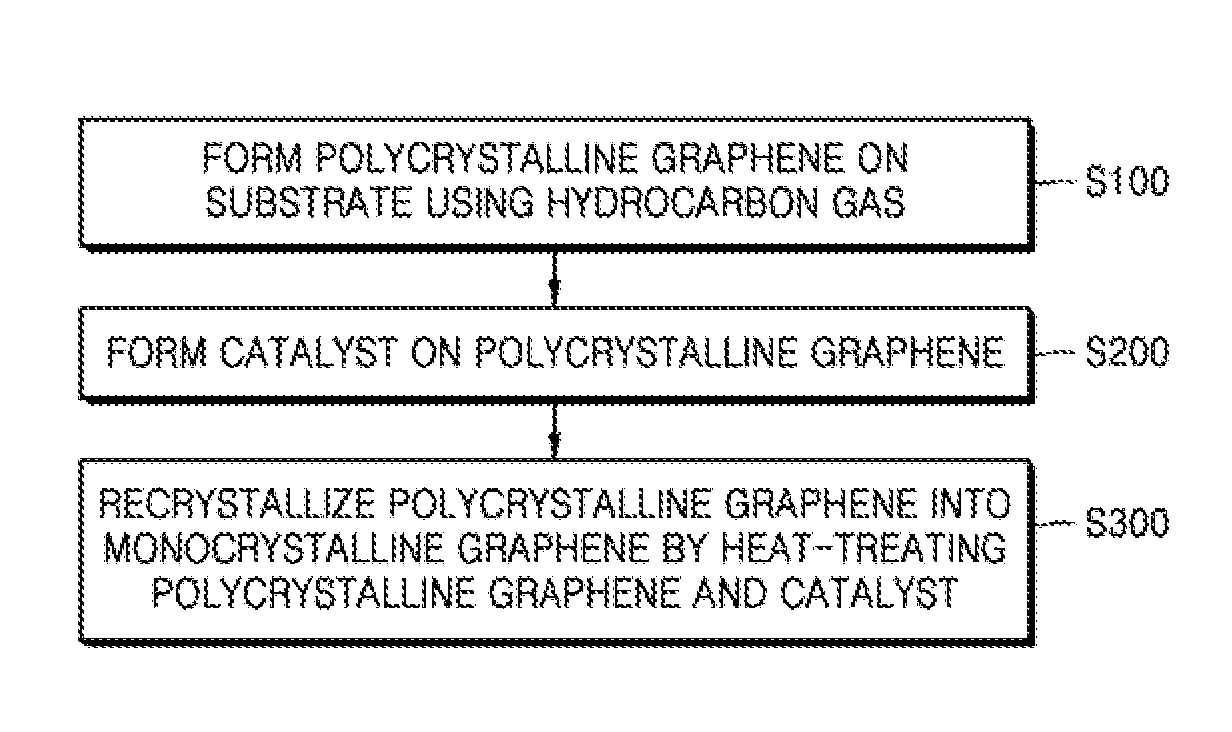
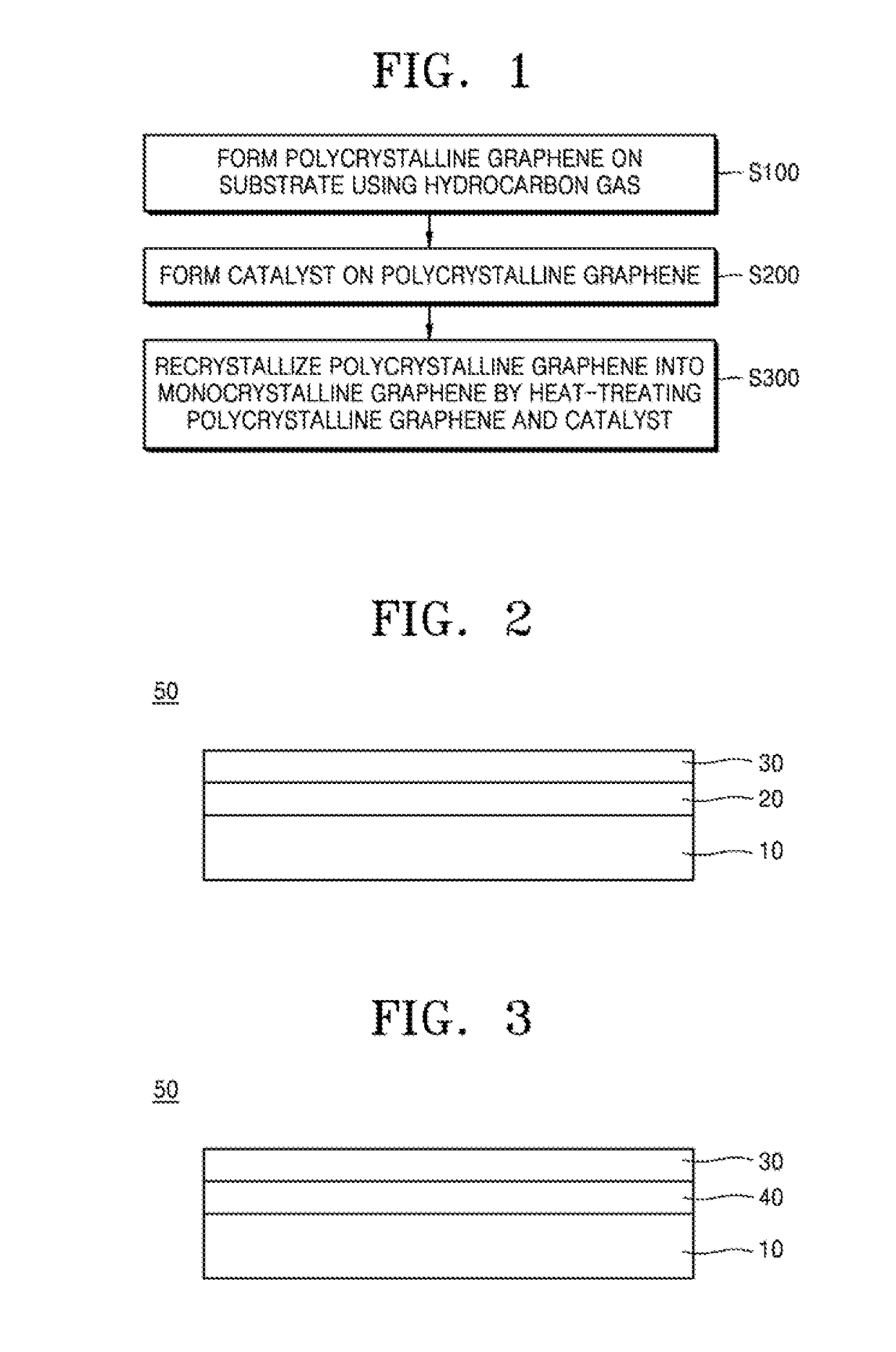
AI Technical Summary

Benefits of technology

[0019]According to an embodiment of the present invention, a method of growing a graphene layer oriented in a direction, e.g., a monocrystalline graphene layer, on a wafer-scale insulating substrate may be provided. According to an embodiment of the present invention, by growing a graphene layer oriented in a direction, e.g., a monocrystalline graphene layer, on a wafer-scale insulator, graphene electronic devices may be commercialized and thus may lead the post-silicon era. However, the scope of the present invention is not limited to the above-described effect.

Problems solved by technology

Using a conventional silicon-based semiconductor process technology, a highly-integrated semiconductor device having a thickness equal to or less than 30 nm may not be easily manufactured because atoms of metal, e.g., gold (Au) or aluminum (Al), deposited on a substrate are thermodynamically unstable, stuck to each other, and thus incapable of obtaining a uniform thin layer if the thickness of the layer thereof is equal to or less than 30 nm, and because the density of impurities doped on silicon is not uniform at the above-mentioned nano-size.
However, this method depends on the quality of the adhesive tape, and electrodes may not be easily patterned using electron-beam lithography due to a large number of useless and thick graphite particles.
However, this substrate does not have good performance to be used as an electronic material.
However, in this method, only a piece of graphite having a thickness of several hundred nanometers may be obtained and graphene may not be obtained.
In addition, a chemical material inserted between graphite layers may not be completely removed and thus a large number of defects may be caused.
However, in this method, graphene may not be oriented in a direction due to growth characteristics thereof.
The largest obstacle to commercialization of graphene electronic devices is not a fact that a bandgap may not be easily provided due to material characteristics and thus a logic circuit may not be easily configured, but is a fact that a large-area single crystal, e.g., silicon, may not be easily found.
However, even in this case, directivities are not equal and thus growing of a large-area graphene single crystal is impossible.

Method used

the structure of the environmentally friendly knitted fabric provided by the present invention; figure 2 Flow chart of the yarn wrapping machine for environmentally friendly knitted fabrics and storage devices; image 3 Is the parameter map of the yarn covering machine
View more

Image

Smart Image Click on the blue labels to locate them in the text.
Viewing Examples
Smart Image
  • Method for manufacturing monocrystalline graphene
  • Method for manufacturing monocrystalline graphene
  • Method for manufacturing monocrystalline graphene

Examples

Experimental program
Comparison scheme
Effect test

Embodiment Construction

Technical Problem

[0010]The present invention provides a method of growing a graphene layer oriented in a direction, e.g., a monocrystalline graphene layer, on a wafer-scale insulating substrate. However, the scope of the present invention is not limited thereto.

Technical Solution

[0011]According to an aspect of the present invention, there is provided a method of manufacturing monocrystalline graphene, the method including forming polycrystalline graphene on a substrate using a hydrocarbon gas, forming a catalyst on the polycrystalline graphene, and recrystallizing the polycrystalline graphene into monocrystalline graphene by heat-treating the polycrystalline graphene and the catalyst.

[0012]The substrate may be an insulating substrate including Al2O3, AlN, Si3N4, SrTiO3, or BN. Alternatively, the substrate may be a composite substrate obtained by growing a transition metal including copper (Cu) or nickel (Ni) in a form of a thin layer having a thickness of 0.5 μm to 3 μm, on the insu...

the structure of the environmentally friendly knitted fabric provided by the present invention; figure 2 Flow chart of the yarn wrapping machine for environmentally friendly knitted fabrics and storage devices; image 3 Is the parameter map of the yarn covering machine
Login to View More

PUM

PropertyMeasurementUnit
thicknessaaaaaaaaaa
temperatureaaaaaaaaaa
Login to View More

Abstract

The present invention provides a method for manufacturing a monocrystalline graphene layer, comprising the steps of: forming polycrystalline graphene on a substrate by using a hydrocarbon gas to grow a graphene layer aligned on a wafer-scale insulator substrate in one direction like a monocrystal; forming a catalyst on the polycrystalline graphene; and recrystallizing the polycrystalline graphene to monocrystalline graphene by heat-treating the polycrystalline graphene and the catalyst.

Description

TECHNICAL FIELD[0001]The present invention relates to a method of producing graphene and, more particularly, to a method of producing monocrystalline graphene.BACKGROUND ART[0002]Graphene refers to a two-dimensional thin layer with honeycomb structure, comprising one or more layers of carbon atoms. When the carbon atoms are chemically bonded due to an sp2 hybrid orbital, a two-dimensional plane of a hexagonal carbon mesh is provided. Carbon has four outermost electrons, and the four electrons are hybridized to participate in bonding. A method of bonding carbon atoms includes sp3 bonding and sp2 bonding. Carbon atoms bonded using only sp3 bonding correspond to a diamond having a square shape, and carbon atoms bonded using only sp2 bonding correspond to graphite or graphene, a layer of graphite. For example, electrons which should be present in an s orbital and a p orbital have an sp2 or sp3 hybrid orbital corresponding to a combination of the s and p orbitals. The sp2 hybrid orbital ...

Claims

the structure of the environmentally friendly knitted fabric provided by the present invention; figure 2 Flow chart of the yarn wrapping machine for environmentally friendly knitted fabrics and storage devices; image 3 Is the parameter map of the yarn covering machine
Login to View More

Application Information

Patent Timeline
no application Login to View More
Patent Type & Authority Patents(United States)
IPC IPC(8): C30B25/02C23C16/26C30B1/08C30B29/02
CPCC01B32/186C01B32/194C23C16/26C30B29/02C30B1/08C01B2204/20C30B25/16C30B29/36
Inventor HWANG, CHANYONG
Owner KOREA RES INST OF STANDARDS & SCI
Features
  • R&D
  • Intellectual Property
  • Life Sciences
  • Materials
  • Tech Scout
Why Patsnap Eureka
  • Unparalleled Data Quality
  • Higher Quality Content
  • 60% Fewer Hallucinations
Social media
Patsnap Eureka Blog
Learn More