[0003] There are mainly two types of desuperheaters: non-contact type and direct contact type. Due to the disadvantages of non-contact type such as low
heat transfer efficiency, large volume, and waste of cooling water, direct contact type desuperheaters that achieve cooling by spraying water are mostly used at present. , the direct contact desuperheater cools down through direct contact between cooling water and
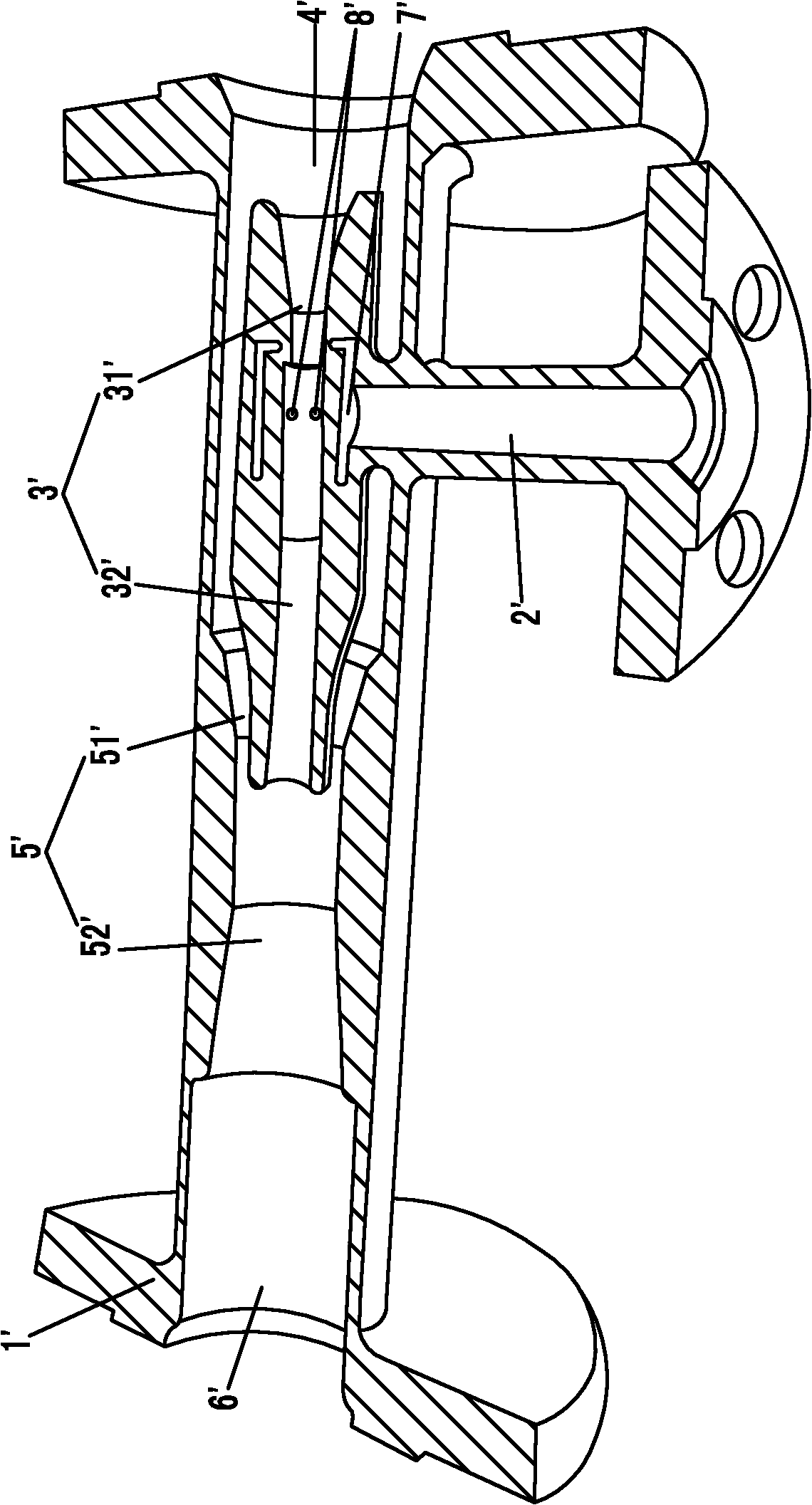
superheated steam, that is, spraying water for desuperheating, such as figure 1 The
structure diagram of the existing desuperheater is shown, which is composed of a horizontally placed desuperheating water
pipe 1', a first-stage venturi tube 3' placed in the inner cavity of the desuperheating water
pipe 1', and a vertically placed cooling water pipe 2'. , the cooling water pipe 2' vertically passes through the desuperheating water pipe 1' and the first-stage Venturi pipe 3', and the desuperheating water pipe 1' is successively connected by the superheated steam inlet port 4', the second-stage Venturi pipe 5' and The superheated steam outlet port 6' is formed, and the flaring section 32' on the left part of the first-stage Venturi tube 3' is arranged between the flaring section 52' and the constricting section 51' of the inner cavity of the second-stage Venturi tube 5' At the
throat of the first-stage Venturi tube 3', the
necking section 31' on the right part is set in the inner cavity of the superheated steam inlet port 4', the first-stage Venturi tube 3' and the second-stage Venturi tube 5' The inner cavity of the first-stage Venturi tube 3' is connected with the
necking section 31' and the flaring section 32' at the junction of the first-stage Venturi tube 3'. ' communicates with the inner cavity of the cooling water pipe 2', the desuperheater adopts a two-stage Venturi tube, and the cooling water flows from the cooling water pipe 2' through the first-stage Venturi tube 3' through the groove 7' and the outlet hole 8' Flowing into the inner cavity of the first-stage Venturi tube 3', after the superheated steam enters the first-stage Venturi tube 3', the gas flow changes from thick to thin, and the gas flow speed is accelerated, so that the gas flows through the throat of the first-stage Venturi tube 3'. A negative pressure area is formed below the mouth, and the cooling water outlet hole 8' is in this negative pressure area, and the negative pressure produces a certain suction effect on the cooling water, so that the negative pressure area below the throat of the first-stage Venturi tube 3' The cooling water flows into the inner cavity of the first-stage Venturi tube 3', the cooling water is atomized for the first time, and mixed with the superheated steam coming in from the superheated steam inlet port 4' at the right end, and the first-stage Venturi tube 3' The mixed steam that comes out directly enters the throat of the second-stage Venturi tube 5', and uses the high-speed gas at the throat of the second-stage Venturi tube 5' to perform a second Secondary atomization, mixed with superheated steam again, then flows out of desuperheater from superheated steam outlet 6'
[0004] The
disadvantage of this structure is that the manufacturing process is complicated and the pressure and flow of the superheated steam flowing into the desuperheater must be stable enough. If the pressure and flow of the superheated steam are small, the two-stage venturi tube cannot form sufficient
suction force, and the desuperheater The
cooling effect of the desuperheater is poor, and the
cooling effect of the desuperheater is related to the load change, that is, when the pressure and flow of the superheated steam are unstable, the jet atomization effect of the Venturi tube is poor, and the
temperature and pressure of the steam after the desuperheater is cooled are also unstable.


 Login to View More
  Login to View More