
Electric control radiation directional diagram reconfigurable antenna
A technology of radiating direction and reconstructing antenna, applied in antennas, electrical components and other directions, can solve the problem of narrow application bandwidth of negative refractive index artificial materials, and achieve the effect of low loss, simple antenna structure and high gain
- Summary
- Abstract
- Description
- Claims
- Application Information
AI Technical Summary
Problems solved by technology
Method used
Image

Examples
Embodiment 1
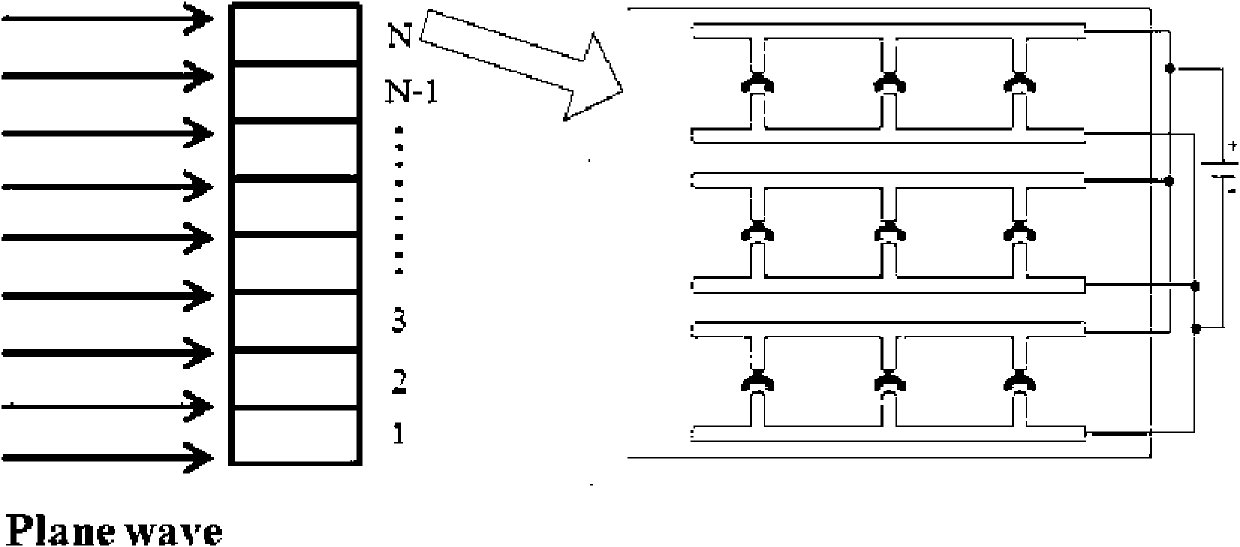
[0032] Such as figure 1 As shown, the implementation process of Embodiment 1 of the present invention is as follows:
[0033] (1) The working frequency is selected as 15GHz, and the corresponding wavelength is 20mm.
[0034] (2) Determine the "I"-shaped artificial structural material unit p x =p y =p z = 2 mm. equal to one-tenth of the wavelength.
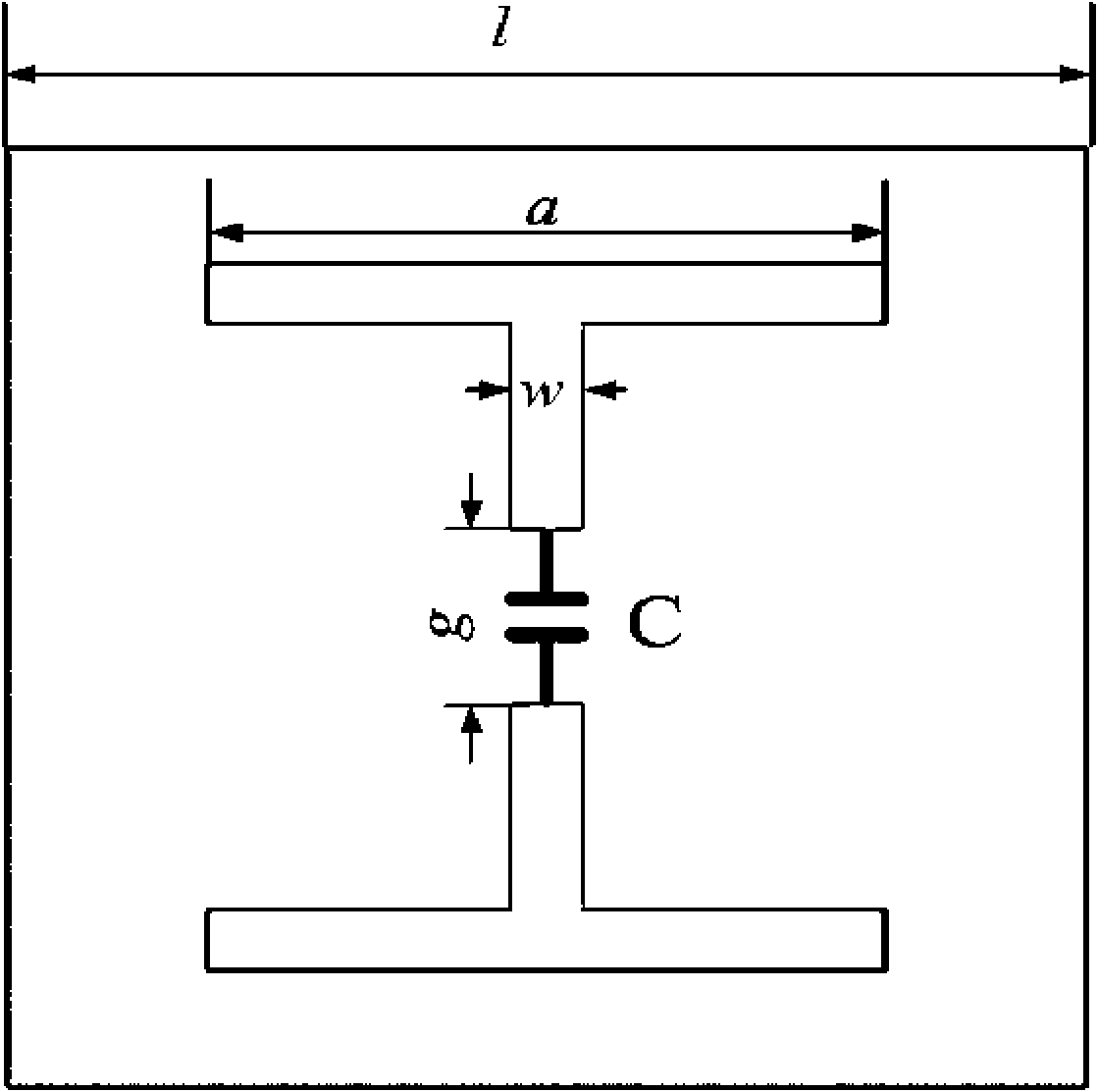
[0035] (3) The selected metal material is copper, and the base material is FR-4.( r =4.9, r =1), metal structure parameters such as figure 2 , Each parameter is l=2mm, w=0.2mm, a=1.8mm, g=0.3mm, FR-4 thickness d=0.25mm, copper thickness t=0.051mm.
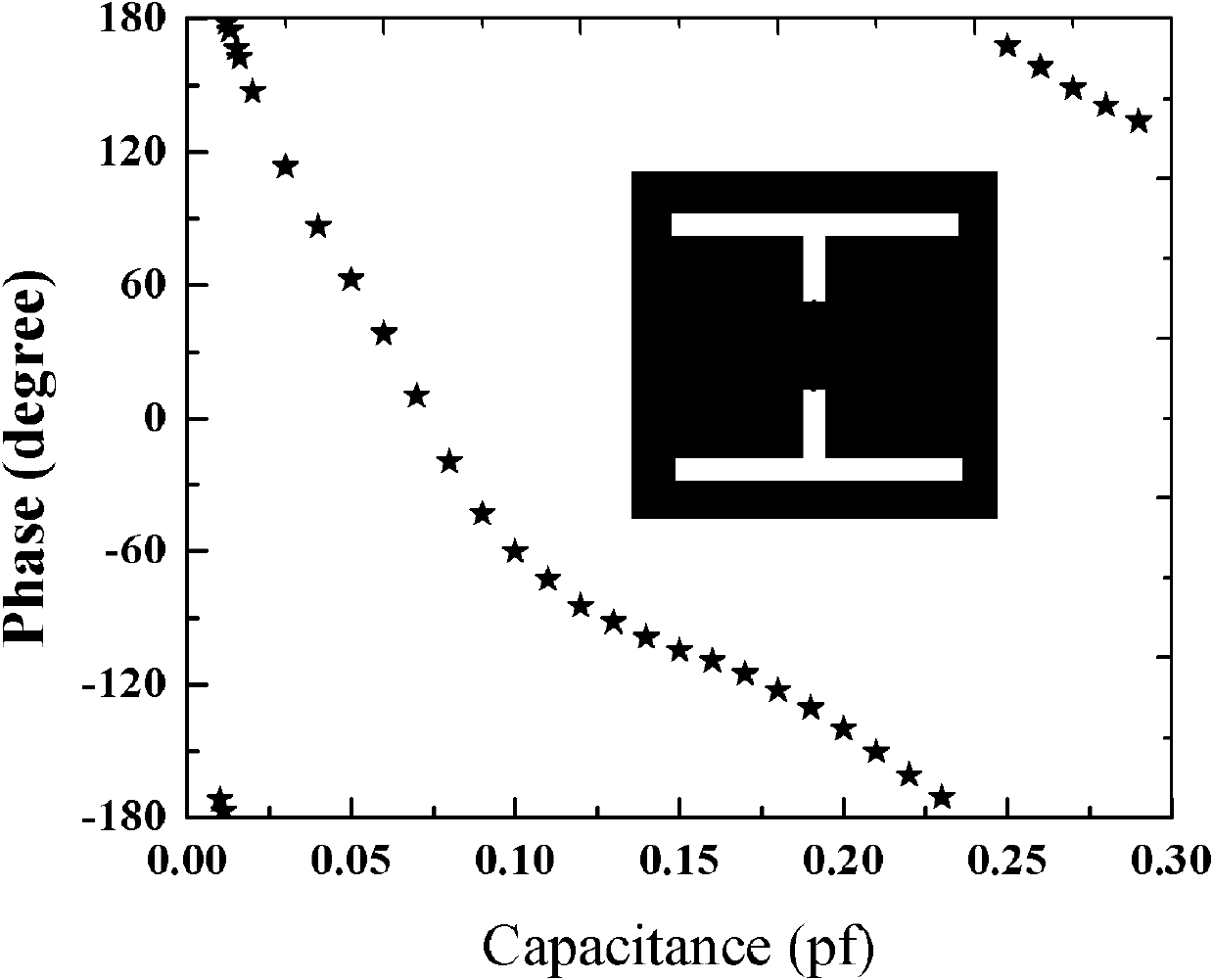
[0036] (4) Since the operating frequency is 15GHz, the type of varactor diode selected here is BB910. When the loading voltage is 0.5V, the capacitance is 38p. When the loading voltage is 8V, the capacitance value is 2.3p. Its capacitance value becomes smaller as the applied voltage becomes larger. (5) Select CST software to simulate and calculate the phase of stacked 10-la...
Embodiment 2
[0041] (1) Select the working frequency as 1.5GHz and the corresponding wavelength as 200mm.
[0042] (2) Determine the "I"-shaped artificial structural material unit p x =p y =p z =20mm, equal to one-tenth of the wavelength.
[0043] (3) The selected metal material is copper, and the base material is Rogers RT / duroid 5880.( r = 2.2, r =1), metal structure parameters such as figure 2 , the parameters are l=20mm, w=0.5mm, a=19mm, g=4mm, the thickness of the base material d=0.5mm, and the copper thickness t=0.051mm.
[0044] (4) The working frequency is 1.5GHz, and the selected variable capacitance diode model is BB134. When the loading voltage is 0.5V, the capacitance is 27.5p. When the loading voltage is 10V, the capacitance value is 1.7p. Its capacitance value becomes smaller as the applied voltage becomes larger.
[0045] (5) Select CST software to simulate and calculate the phase of stacked 10-layer units - Capacitance C curve.
[0046] (6) Similarly, the numbe...
PUM
 Login to View More
 Abstract
Description
Claims
Application Information
 Login to View More