
New method for synthesizing patterned single-crystal tungsten oxide nanowire arrays with catalyst localization technology
A tungsten oxide nanowire, patterning technology, applied in gaseous chemical plating, metal material coating process, coating and other directions, can solve the problems of poor morphology and structure controllability, high reaction temperature, high production cost, etc. Achieving the effect of high field emission uniformity
- Summary
- Abstract
- Description
- Claims
- Application Information
AI Technical Summary
Problems solved by technology
Method used
Image

Examples
Embodiment 1
[0043] Example 1: Preparation of patterned single crystal W0 by catalyst localization technology at low temperature 2 nanowire array
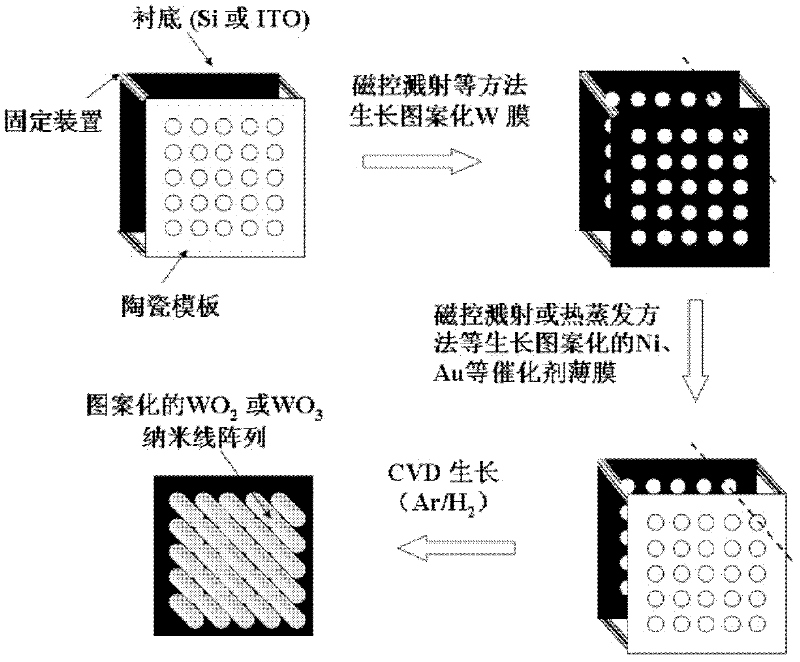
[0044] Using magnetron sputtering technology, using self-made ceramic template device or exposure technology of micro-processing technology, firstly, in the environment of Ar gas, the sputtering power is 300W, the sputtering time is 30min, and a layer of W with a thickness of about 400nm is grown. film, and then sputter-grow a layer of Ni nanoparticle film with a thickness of about 5 nm patterned on the W film.
[0045] The samples with W film and patterned Ni nanoparticle film grown sequentially were put into the CVD system, and the temperature was raised to 400 °C under the protection of Ar gas, and the 2 Insulated in an atmosphere of Ar gas for 1 h, then rapidly heated to 450 °C under the protection of Ar gas, and the growth pressure was 400 Pa. After 2 h of heat preservation, patterned WO was grown on the Si substrate. 2 array of nanowire...
Embodiment 2
[0047] Example 2: Preparation of patterned single crystal WO by catalyst localization technology at low temperature 3 nanowire array
[0048] Using magnetron sputtering technology, using self-made ceramic template device or exposure technology of micro-processing technology, firstly, in the environment of Ar gas, the sputtering power is 300W, the sputtering time is 30min, and a layer of W film with a thickness of about 400nm is grown. , and then a patterned Au nanoparticle film with a thickness of about 3 nm was vacuum evaporated on top of the W film.
[0049] The samples with W thin film and patterned Au nanoparticle thin film grown sequentially were placed in the CVD system, and the temperature was raised to 500 °C under the protection of Ar gas. 2 Insulated in an atmosphere of Ar gas for 1 h, then rapidly heated to 550 °C under the protection of Ar gas, the growth pressure was 8000 Pa, and after 2 h of growth, patterned WO could be grown on the Si substrate. 3 array of na...
Embodiment 3
[0051] Example 3: Using Catalyst Localization Technology to Prepare WO at Different Growth Temperatures 2 Nanowires
[0052] Keeping the argon (Ar) carrier gas flow rate as 200sccm, the reaction pressure as 400Pa, and the reaction time of 2h under the reaction conditions, change the reaction temperature to prepare WO 2 Nanowire array:
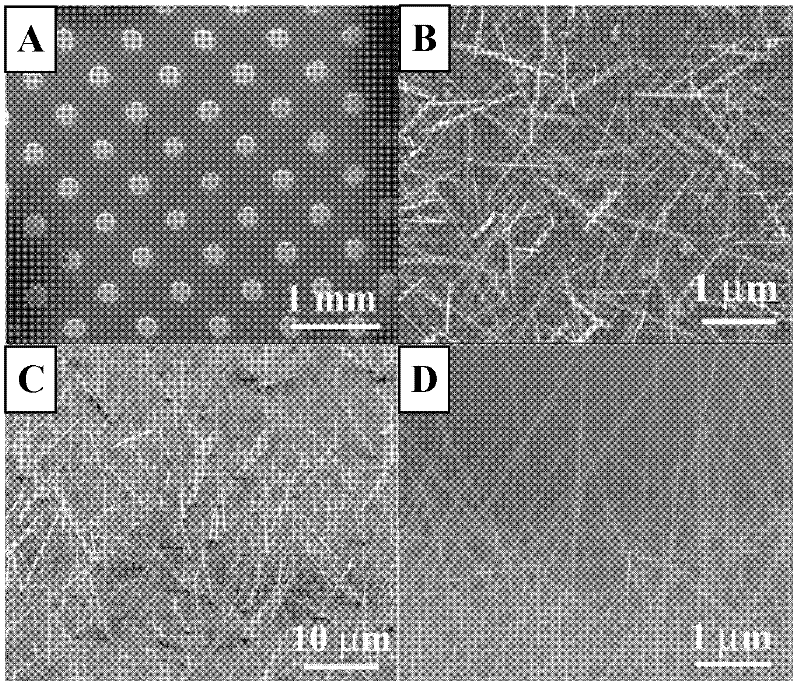
[0053] (1) When the reaction temperature is 550 °C, a higher density WO can be prepared on the Si substrate 2 The nanowire has a length of 2-3μm and a diameter of 40nm, and the shape and diameter of the nanowire are relatively uniform, such as Figure 8 As shown in A
[0054] (2) When the reaction temperature is 600°C, WO 2 The density of the nanowires decreased while the diameter increased to about 60nm, as shown in Figure 8 Shown in B.
[0055] (3) When the reaction temperature is 700°C, WO 2 The diameter of the nanowire increases significantly, and the diameter distribution range is large. Between 40-100nm, the density of the nanowir...
PUM
| Property | Measurement | Unit |
|---|---|---|
| thickness | aaaaa | aaaaa |
| length | aaaaa | aaaaa |
| diameter | aaaaa | aaaaa |
Abstract
Description
Claims
Application Information
 Login to View More