
Geomechanical model simulating material for simulating rock mass and preparation method thereof
A technology similar to geomechanics and models, applied in the field of materials and preparations for geomechanics model tests, can solve the problems of not being able to meet the simulation requirements and the inability to prepare similar materials, and achieve non-toxic and side effects, stable physical and mechanical properties, and a wide range of sources Effect
Patent Information
- Authority / Receiving Office
- CN · China
- Current Assignee / Owner
- Publication Date
- 2012-03-28
- Estimated Expiration
- Not applicable · inactive patent
Smart Images
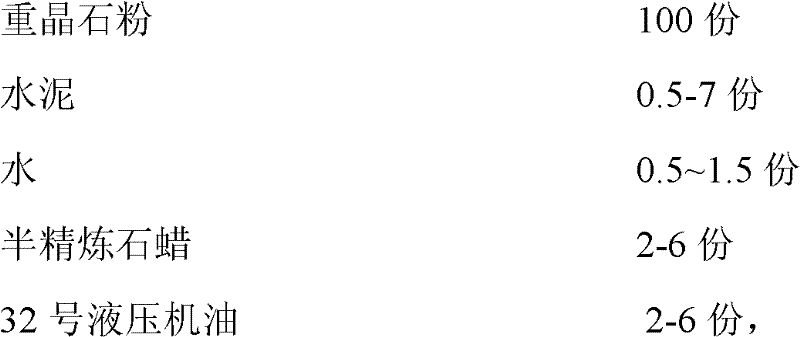
Figure 1 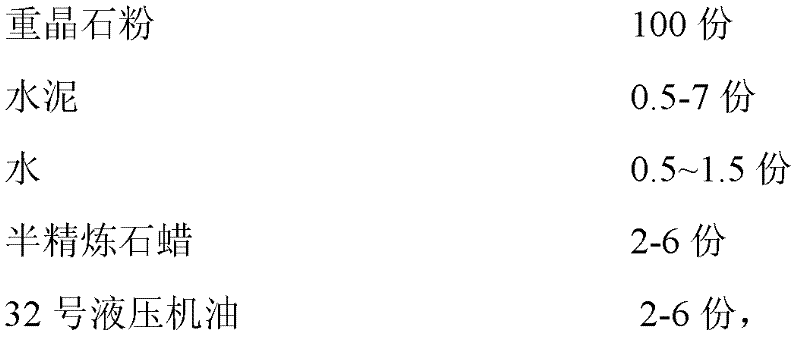
Figure 2
Abstract
Description
technical field
[0001] The invention belongs to the technical field of materials for geomechanical model tests and their preparation, and in particular relates to a geomechanical model-like material for simulating rock masses and a preparation method thereof. Background technique
[0002] Due to the development of modern production and construction and science and technology, more and more buildings, such as dams, factory buildings, tunnels, underground power stations, etc., need to be built on rock foundations or rock bodies with complex geological structures. The anti-sliding stability of buildings and the influence of foundation deformation on building structures have become the main contents of the study of geomechanics model tests.
[0003] The geomechanics model test is a method of scaled-down research on specific engineering geological problems based on a certain similarity principle. The main purpose of the test is to study the ultimate bearing capacity, failure form...
Examples
Embodiment 1
[0032] First mix 100 parts of barite powder with a particle size of 200 mesh and 4 parts of semi-refined paraffin wax with a melting point of 54°C, then dry at 90°C for 3 hours to remove water, take it out and cool to room temperature; add 4 parts of No. 32 hydraulic oil Put it into the dried barite powder and semi-refined paraffin mixture and mix evenly, then crush the mixed material until its particle size is ≤1mm; add 7 parts of cement marked 425 to the barite powder, semi-refined paraffin and 32 No. hydraulic oil mixture, continue to mix evenly; finally add 1 part of water to the above mixture, and then mix evenly.
[0033] The material has a compressive strength of 1.17MPa and a modulus of deformation of 108.2MPa.
Embodiment 2
[0035]First mix 100 parts of barite powder with a particle size of 200 mesh and 2 parts of semi-refined paraffin wax with a melting point of 54°C, then bake at 90°C for 3 hours to remove water, take it out and cool to room temperature; add 4 parts of No. 32 hydraulic oil Put it into the dried barite powder and semi-refined paraffin mixture and mix evenly, then crush the mixed material until its particle size is ≤1mm; add 1 part of cement marked 425 to the barite powder, semi-refined paraffin and 32 No. hydraulic oil mixture, continue to mix evenly; finally add 1.5 parts of water to the above mixture, and then mix evenly.
[0036] The material has a compressive strength of 0.33MPa and a modulus of deformation of 29.5MPa.
Embodiment 3
[0038] First mix 100 parts of barite powder with a particle size of 200 mesh and 6 parts of semi-refined paraffin wax with a melting point of 54°C, then dry at 90°C for 3 hours to remove water, take it out and cool to room temperature; add 4 parts of No. 32 hydraulic oil Put it into the dried barite powder and semi-refined paraffin mixture and mix evenly, then crush the mixed material until its particle size is ≤1mm; add 1 part of cement marked 425 to the barite powder, semi-refined paraffin and 32 No. hydraulic oil mixture, continue to mix evenly; finally add 0.5 parts of water to the above mixture, and then mix evenly.
[0039] The material has a compressive strength of 0.79MPa and a modulus of deformation of 52.2MPa.