Processing method of antistatic warm keeping fabric
What is AI technical title?
AI technical title is built by PatSnap AI team. It summarizes the technical point description of the patent document.
A processing method and antistatic technology, applied in the field of fabric processing
Inactive Publication Date: 2012-05-30
CHANGSHU JINDE KNITTING
View PDF0 Cites 6 Cited by
Summary
Abstract
Description
Claims
Application Information
AI Technical Summary
This helps you quickly interpret patents by identifying the three key elements:
Problems solved by technology
Method used
Benefits of technology
Problems solved by technology
[0005]1) Surfactant-added fiber: the method of blending and spinning by adding surfactant to the spinning solution, using the surfactant from the inside to the outside Continuous migration and diffusion, so that the surface of the fiber contains surfactant, but its use effect is relatively weak;
[0006]2) Blending, copolymerization and grafting modified antistatic fibers require high processing technology and high cost;
Method used
the structure of the environmentally friendly knitted fabric provided by the present invention; figure 2 Flow chart of the yarn wrapping machine for environmentally friendly knitted fabrics and storage devices; image 3 Is the parameter map of the yarn covering machine
View more
Image
Smart Image Click on the blue labels to locate them in the text.
Viewing Examples
Smart Image
Click on the blue label to locate the original text in one second.
Reading with bidirectional positioning of images and text.
Smart Image
Examples
Experimental program
Comparison scheme
Effect test
Embodiment 1
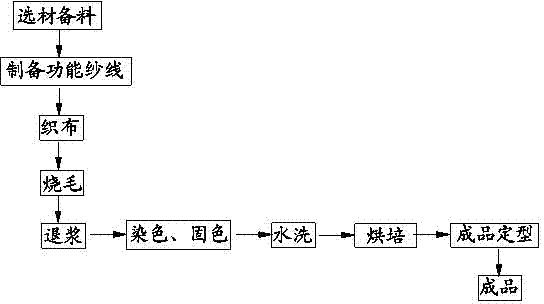
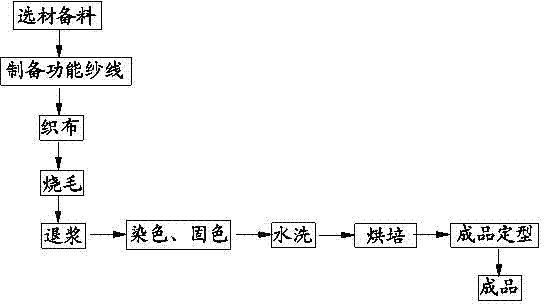
[0026] The specific implementation steps are as follows:
[0027] a) Material selection and preparation, the fiber composition and mass percentage of the fabric are: conductive fiber 6%, polyester fiber 50%, spandex fiber 10%, cotton or other fiber 34%;
[0028] b) Preparation of functional yarns. The fabric is woven with warp and weft. The warp is made of conductive fiber, cotton fiber and cashmere and processed into low-twist composite yarn through drawing, roving, spun yarn and winding processes. The silk is made of polyester fiber, spandex fiber and natural silk are processed into low-twisted composite yarn through drawing, roving, spun yarn and winding processes;
[0029] c) Weaving, making functional cloth from the wound yarn on the loom;
[0030] d) singeing, the temperature is controlled at 900°C, and the speed is 2m / s;
[0031] e) Desizing and washing, the cloth is piled up in 0.8 / L amylase for 40 minutes, the temperature is controlled at 85°C, and then washed with ...
Embodiment 2
[0037] The specific implementation steps are as follows:
[0038] a) Material selection and preparation, the fiber composition and mass percentage of the fabric are: 4% conductive fiber, 45% polyester fiber, 15% spandex fiber, 36% cotton or other fiber;
[0039] b) Preparation of functional yarns. The fabric is woven with warp and weft. The warp is made of conductive fiber, cotton fiber and cashmere and processed into low-twist composite yarn through drawing, roving, spun yarn and winding processes. The silk is made of polyester fiber, spandex fiber and natural silk are processed into low-twisted composite yarn through drawing, roving, spun yarn and winding processes;
[0040] c) Weaving, making functional cloth from the wound yarn on the loom;
[0041] d) singeing, the temperature is controlled at 900°C, and the speed is 3m / s;
[0042] e) Desizing and washing, the cloth is piled up in 1.2G / L amylase for 45 minutes, the temperature is controlled at 90°C, and then washed with...
the structure of the environmentally friendly knitted fabric provided by the present invention; figure 2 Flow chart of the yarn wrapping machine for environmentally friendly knitted fabrics and storage devices; image 3 Is the parameter map of the yarn covering machine
Login to View More
PUM
Login to View More
Abstract
The invention relates to a processing method of an antistatic warm keeping fabric. The processing process comprises the following steps: a) material selecting and preparing, b) functional yarn preparing, c) weaving, d) singeing, e) desizing and washing, f) dyeing and color fixing, g) washing, h) baking and I) finished product sizing. In the processing method of the antistatic warm keeping fabric disclosed by the invention, through reasonable material selection and scientific processing technology, the fabric is soft and elastic and simultaneously can effectively eliminate electrostatic hazards and guarantee a good warm keeping effect to the fabric, the raw materials are natural and environment-friendly, the manufacturing cost is low, and fabric is widely applied.
Description
technical field [0001] The invention relates to a fabric processing method, in particular to a fabric processing method with an antistatic function and a good heat-retaining effect, belonging to the technical field of fabric fabrics. Background technique [0002] With the improvement of living standards, modern people pay more and more attention to their health. When choosing personal clothing, they not only consider the color and style, but also consider the safety, environmental protection and functionality of the clothing. On the basis that the basic functions of clothing remain unchanged, people pay more and more attention to the safety of clothing, constantly research and develop new clothing fabrics, use new technology to reduce the troubles that clothing may bring to people, reduce safety hazards, and improve clothing fabrics. functionality. [0003] Static electricity is the charge generated by the frictional electrification phenomenon first recognized by human bein...
Claims
the structure of the environmentally friendly knitted fabric provided by the present invention; figure 2 Flow chart of the yarn wrapping machine for environmentally friendly knitted fabrics and storage devices; image 3 Is the parameter map of the yarn covering machine
Login to View More
Application Information
Patent Timeline
Application Date:The date an application was filed.
Publication Date:The date a patent or application was officially published.
First Publication Date:The earliest publication date of a patent with the same application number.
Issue Date:Publication date of the patent grant document.
PCT Entry Date:The Entry date of PCT National Phase.
Estimated Expiry Date:The statutory expiry date of a patent right according to the Patent Law, and it is the longest term of protection that the patent right can achieve without the termination of the patent right due to other reasons(Term extension factor has been taken into account ).
Invalid Date:Actual expiry date is based on effective date or publication date of legal transaction data of invalid patent.



 Login to View More
  Login to View More