Totally-closed rigidity adjustable type vibration isolator

An adjustable vibration isolator technology, applied in the field of buffer devices and airborne equipment vibration isolation, can solve the problems of high cost, long time period, inability to meet the use requirements, etc., to expand the scope of use, improve energy consumption, improve Vibration isolation effect

CN102518727AActive Publication Date: 2012-06-27CHINA AIRPLANT STRENGTH RES INST
6 Cites 15 Cited by

Patent Information

Authority / Receiving Office
CN · China
Current Assignee / Owner
Publication Date
2012-06-27

Smart Images

  • Figure 1
    Figure 1
  • Figure 2
    Figure 2
  • Figure 3
    Figure 3
Patent Text Reader

Abstract

The invention relates to a vibration isolation and buffer device for machine-born equipment, in particular to a totally-closed rigidity adjustable type vibration isolator, which comprises a casing, an installation core shaft, a protective rubber cover, an upper rubber ring, a spherical vibration isolation part and a lower rubber ring. The casing is of a sealed structure, the top of the casing is provided with an installation hole where the installation core shaft is arranged, and the spherical vibration isolation part is arranged in the sealed casing and is connected with the bottom of the installation core shaft together. The upper rubber ring is sleeved at the upper portion of a damp rubber ball, and the lower rubber ring is sleeved at the lower portion of the damp rubber ball which is sealed in the casing. The totally-closed rigidity adjustable type vibration isolator adopts a totally-closed structure to have small environment influence, utilizes a combination structure combining the spherical surface and the cylindrical surface to improve vibration isolation and retarding effects, utilizes the structures of the upper rubber ring and the lower rubber ring to limit the swinging of the head of the installation core shaft and improve using safety, and can be suitable for different frequency ranges by rotating the upper cover to adjust the rigidity of the vibration isolator.
Need to check novelty before this filing date? Find Prior Art

Description

technical field

[0001] The invention relates to a device for vibration isolation and buffering of airborne equipment, in particular to a fully enclosed vibration isolator with adjustable stiffness. Background technique

[0002] Existing vibration isolators are usually open structures, made of rubber and damping rubber materials and skeleton materials (metal, fiber, engineering plastics, etc.), using the attenuation characteristics of molecular friction inside the rubber to slow down and isolate The vibration and shock generated by the vibration source protect the normal operation of the vibration-isolated equipment. Rubber vibration isolators have good damping characteristics and three-way vibration isolation effects. When airborne equipment is not allowed to be used in oily, dusty and other environments, rubber vibration isolators with open structures will not be able to meet the use of such environments Require.

[0003] In addition, for ordinary rubber vibration isolato...

Examples

Embodiment Construction

[0021] The present invention will be described in further detail below by means of specific embodiments:

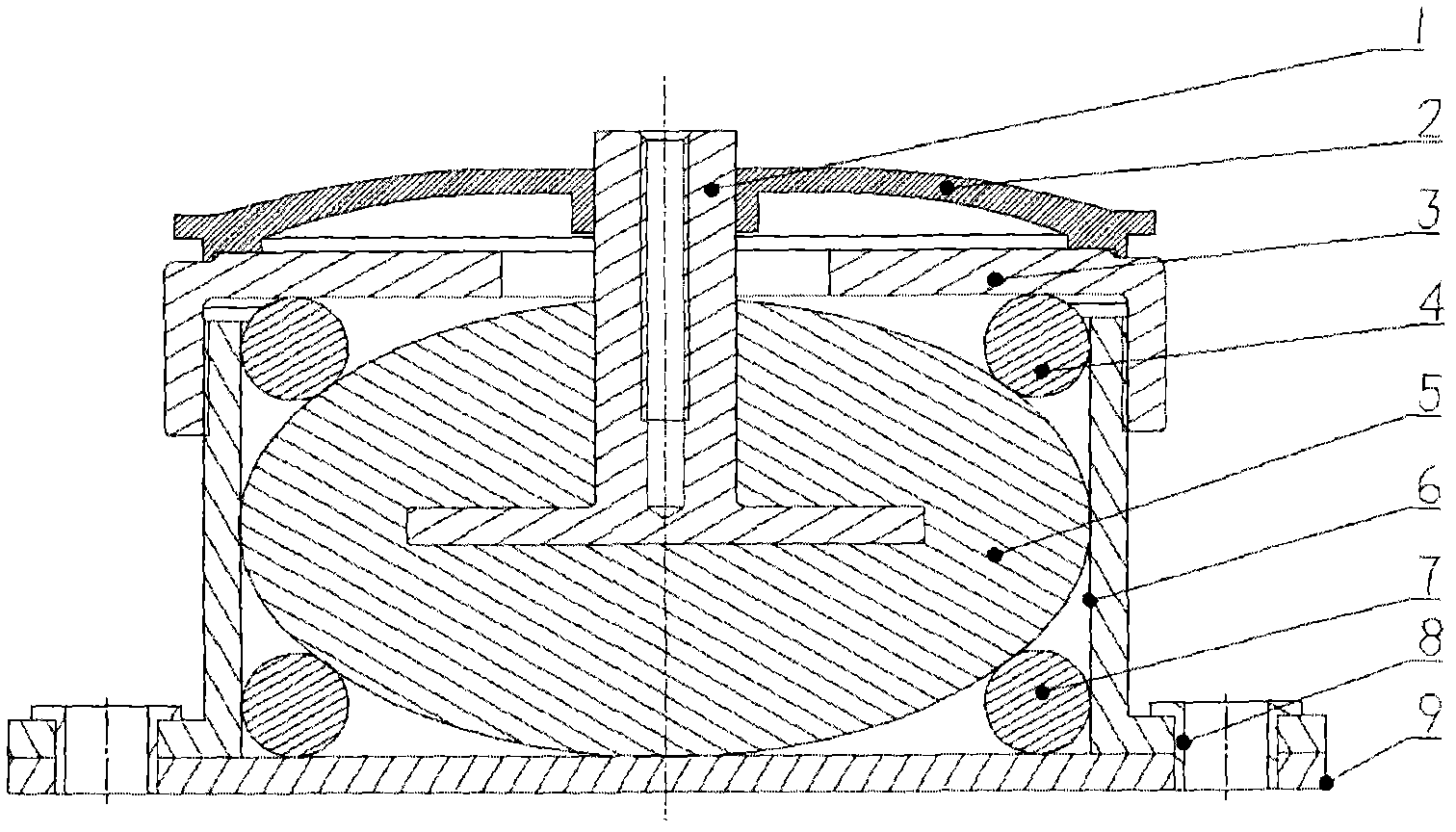
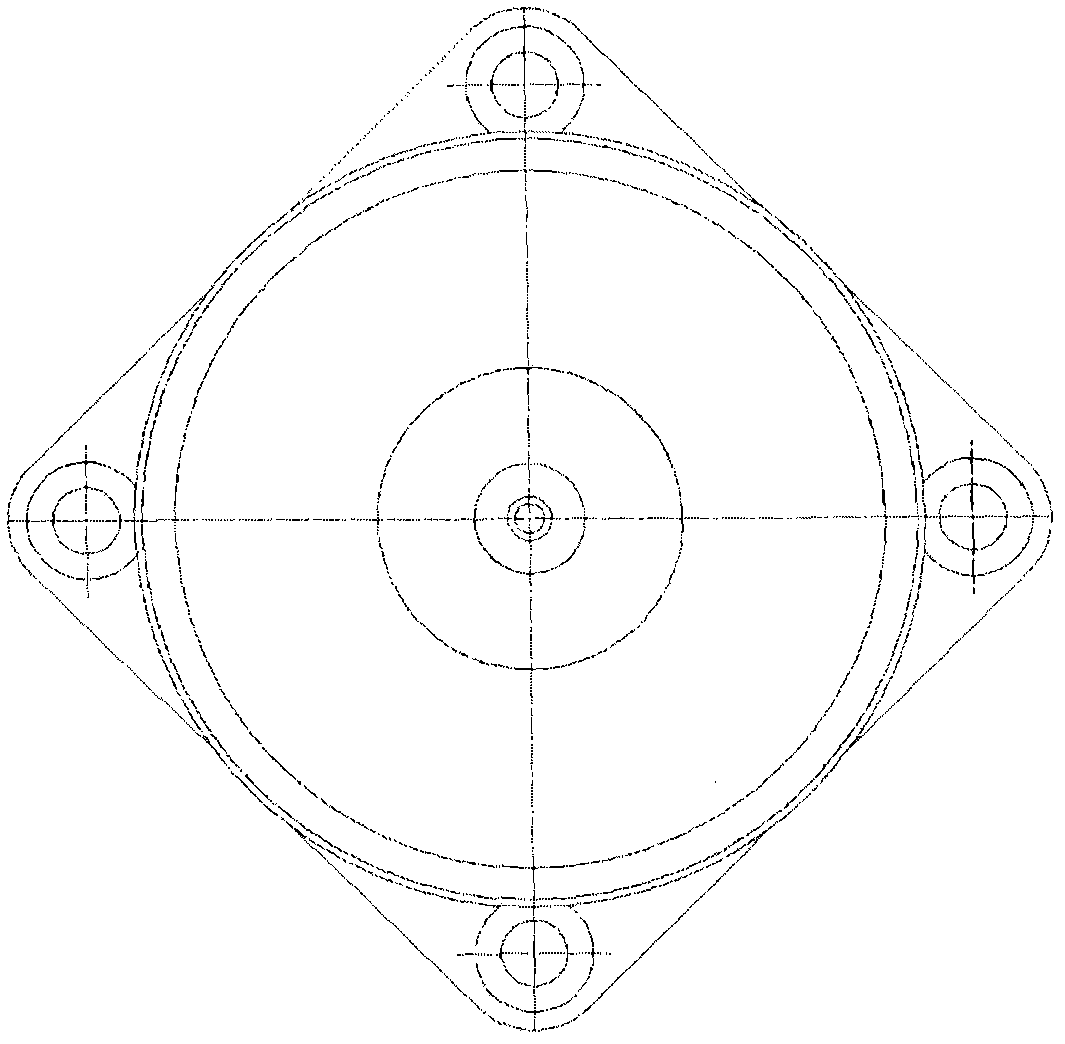
[0022] Please also see figure 1 and figure 2 ,in, figure 1 It is a structural schematic diagram of the fully enclosed stiffness-adjustable vibration isolator of the present invention, figure 2 yes figure 1 top view. The fully enclosed vibration isolator with adjustable stiffness includes a mounting mandrel 1, a protective rubber cover 2, an upper cover 3, an upper rubber ring 4, a damping rubber ball 5, a shell 6, a lower rubber ring 7, a hollow rivet 8, and a bottom plate 9. The upper cover 3 is arranged on the casing 6 and is threadedly connected with the casing, and the top has a mounting hole for placing the installation mandrel 1, and the bottom edge of the casing 6 is connected with the bottom plate 9 through a hollow rivet 8 to form an integral sealed casing. The bottom of the installation mandrel 1 is deep inside the housing and has a transverse boss struct...