Friction-based state of health indicator for electric power steering system

An electric power, steering torque technology, applied in the field of healthy systems, can solve problems such as difficult steering

CN102730055AActive Publication Date: 2012-10-17GM GLOBAL TECH OPERATIONS LLC
4 Cites 22 Cited by

Patent Information

Authority / Receiving Office
CN · China
Patent Type
Applications(China)
Current Assignee / Owner
Publication Date
2012-10-17

Smart Images

  • Figure 1
    Figure 1
  • Figure 2
    Figure 2
  • Figure 3
    Figure 3
Patent Text Reader

Abstract

A method for determining a state of health (SOH) value for an electric power steering (EPS) system in a vehicle includes estimating a first Self-Aligning Torque (SAT) value using a tire dynamics model, which includes modeled dynamics in the linear region of a lateral force acting on the vehicle tires. The method also includes estimating a second SAT value using an extended state observer and nominal parameters for the EPS system, and calculating a variance between the first and second SAT values. The controller monitors a progression of the calculated variance over a calibrated interval using the controller to thereby determine the SOH value, and automatically executes a control action using the SOH value. An EPS system for a vehicle includes a steering wheel, torque and angle sensors, a rack and pinion assembly, a steering motor, and the controller. A vehicle is also disclosed having the same controller.
Need to check novelty before this filing date? Find Prior Art

Description

technical field

[0001] The present disclosure relates to systems and methods for determining the state of health of an electric power steering system. Background technique

[0002] Electric power steering (EPS) is a direct replacement for hydraulic power steering, but consumes significantly less energy during operation. Hydraulic power steering uses a mechanical torque sensor to measure the torque applied to the steering wheel by the driver. A torque sensor is coupled to the valve, which directs hydraulic fluid to amplify the applied torque. EPS works in a similar way, but an electronic torque sensor is used to measure steering wheel torque, and an electric motor is used to apply additional torque to the steering rack. Failure of either system can make the vehicle relatively difficult to steer.

[0003] EPS capability may be particularly attractive when used on a hybrid vehicle having an internal combustion engine and one or more electric traction motors. Hybrid vehicles...

Examples

Embodiment Construction

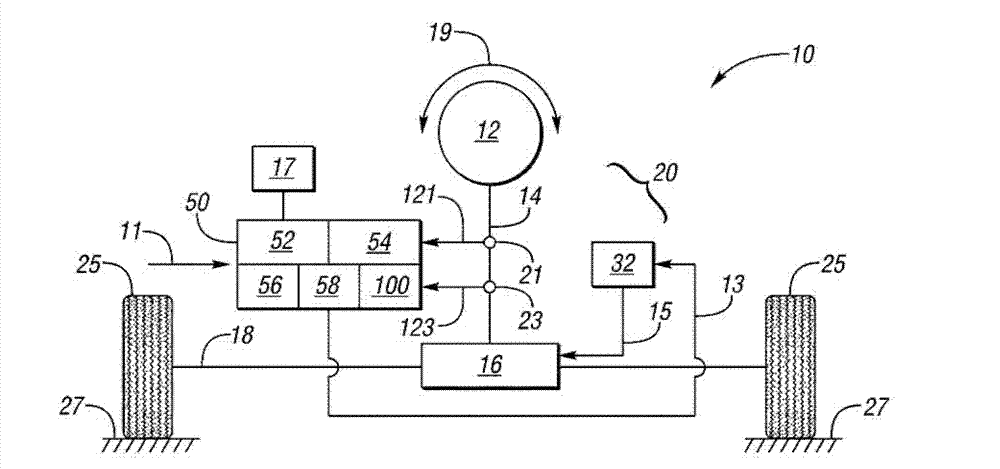
[0012] Referring to the drawings, wherein like reference numerals correspond to the same or similar parts throughout the several drawings, to figure 1 Initially, the vehicle 10 includes a steering column mounted electric power steering (EPS) system 20 and a controller 50 . Controller 50 is shown schematically as a single unit, but various elements of controller 50 may be distributed among multiple special purpose controllers or electronic control units (ECUs), such as motor control units, steering control units, and the like.

[0013] The present controller 50 is configured to determine a state of health (SOH) value of the EPS system 20 . As used herein, the term "SOH" value refers to a numerical value describing the relative health of the EPS system 20 relative to calibrated, normally functioning standards. The controller 50 is also configured to perform control actions that are appropriate for the determined SOH value, such as by recording diagnostic codes and / or displaying...