
Preparation method of low-alloy high-wear-resistance cast steel
A high wear-resistant, low-alloy technology, applied in the field of wear-resistant cast steel manufacturing, can solve the problems of high production cost, difficult control, complex process, etc., and achieve the effect of good strength and toughness, simple composition, and simplified process
- Summary
- Abstract
- Description
- Claims
- Application Information
AI Technical Summary
Problems solved by technology
Method used
Image

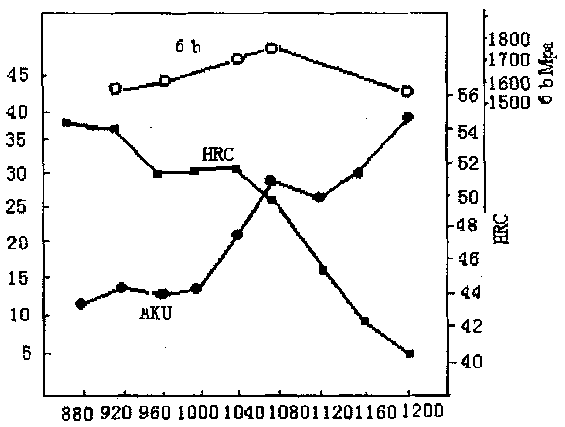
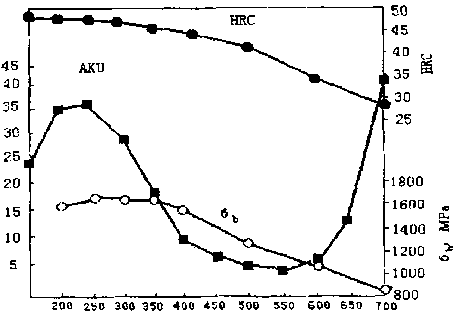
Examples
Embodiment 1
[0048] 1) Use scrap steel, ferrosilicon, ferromanganese, ferrosilicon, ferromolybdenum, ferrochrome, ferrotitanium, ferrovanadium, ferroniobium, and rare earth silicon as raw materials for smelting, and make ingredients according to the following components: C: 0.25 wt.%;
[0049] Si: 0.9 wt.%;
[0050] Mn: 0.3 wt.%;
[0051] Cr: 0.7 wt.%;
[0052] Mo: 0.15 wt.%;
[0053] Ti: 0.05 wt.%;
[0054] Nb: 0.01 wt.%;
[0055] V: 0.05 wt.%;
[0056] RE: 0.01 wt.%;
[0057] P, S≤0.01 wt.%
[0058] The rest is Fe and unavoidable impurities;
[0059] 2) Using medium frequency induction furnace for smelting, first heat and melt ordinary steel scrap and ferrochrome, and conduct pre-furnace analysis;
[0060] 3) Add ferromanganese, ferrosilicon, and ferromolybdenum in turn, wait until all are melted, then add ferrochrome and then further melt, deoxidize with aluminum wire, then pour molten steel into it and place ferrotitanium, ferrosilicon, ferroniobium, and rare earth at the same ...
Embodiment 2
[0066] 1) Use steel scrap, ferrosilicon, ferromanganese, ferrosilicon, ferromolybdenum, ferrochrome, ferrotitanium, ferrovanadium, ferroniobium, and rare earth silicon as raw materials for smelting, and make ingredients according to the following components: C: 0.3 wt.%;
[0067] Si: 1.2 wt.%;
[0068] Mn: 1.0 wt.%;
[0069] Cr: 0.85 wt.%;
[0070] Mo: 0.2 wt.%;
[0071] Ti: 0.25 wt.%;
[0072] Nb: 0.03 wt.%;
[0073] V: 0.15 wt.%;
[0074] RE: 0.06 wt.%;
[0075] P, S≤0.02 wt.%
[0076] The rest is Fe and unavoidable impurities;
[0077] 2) Using medium frequency induction furnace for smelting, first heat and melt ordinary steel scrap and ferrochrome, and conduct pre-furnace analysis;
[0078] 3) Add ferromanganese, ferrosilicon, and ferromolybdenum in turn, wait until all are melted, then add ferrochrome and then further melt, deoxidize with aluminum wire, then pour molten steel into it and place ferrotitanium, ferrosilicon, ferroniobium, and rare earth at the same t...
Embodiment 3
[0084] 1) Use scrap steel, ferrosilicon, ferromanganese, ferrosilicon, ferromolybdenum, ferrochrome, ferrotitanium, ferrovanadium, ferroniobium, and rare earth silicon as raw materials for smelting, and make ingredients according to the following components: C: 0.35 wt.%;
[0085] Si: 1.6 wt.%;
[0086] Mn: 1.8 wt.%;
[0087] Cr: 1.0 wt.%;
[0088] Mo: 0.3 wt.%;
[0089] Ti: 0.35 wt.%;
[0090] Nb: 0.05 wt.%;
[0091] V: 0.25 wt.%;
[0092] RE: 0.1 wt.%;
[0093] P, S≤0.03 wt.%
[0094] The rest is Fe and unavoidable impurities;
[0095] 2) Using medium frequency induction furnace for smelting, first heat and melt ordinary steel scrap and ferrochrome, and conduct pre-furnace analysis;
[0096] 3) Add ferromanganese, ferrosilicon, and ferromolybdenum in turn, wait until all are melted, then add ferrochrome and then further melt, deoxidize with aluminum wire, then pour molten steel into it and place ferrotitanium, ferrosilicon, ferroniobium, and rare earth at the same time...
PUM
| Property | Measurement | Unit |
|---|---|---|
| hardness | aaaaa | aaaaa |
| hardness | aaaaa | aaaaa |
| hardness | aaaaa | aaaaa |
Abstract
Description
Claims
Application Information
 Login to View More