Supercharge Your Innovation With Domain-Expert AI Agents!

A method for thickening biodiesel by in situ formation of organic soil

A biodiesel and organic technology, applied in the direction of chemical instruments and methods, drilling compositions, etc., can solve the problem of high cost and achieve cost saving, cost reduction, and low energy consumption

Active Publication Date: 2016-01-13
SHANDONG UNIV
View PDF3 Cites 2 Cited by
  • Summary
  • Abstract
  • Description
  • Claims
  • Application Information

AI Technical Summary

Problems solved by technology

[0005] Aiming at the high cost of existing white oil dispersed organic soil, the present invention uses biodiesel to disperse organic soil, and can utilize the by-product glycerol in the biodiesel preparation process to provide an in-situ organic soil additive with simple process and low cost. thick biodiesel method

Method used

the structure of the environmentally friendly knitted fabric provided by the present invention; figure 2 Flow chart of the yarn wrapping machine for environmentally friendly knitted fabrics and storage devices; image 3 Is the parameter map of the yarn covering machine
View more

Image

Smart Image Click on the blue labels to locate them in the text.
Viewing Examples
Smart Image
  • A method for thickening biodiesel by in situ formation of organic soil
  • A method for thickening biodiesel by in situ formation of organic soil

Examples

Experimental program
Comparison scheme
Effect test

Embodiment 1

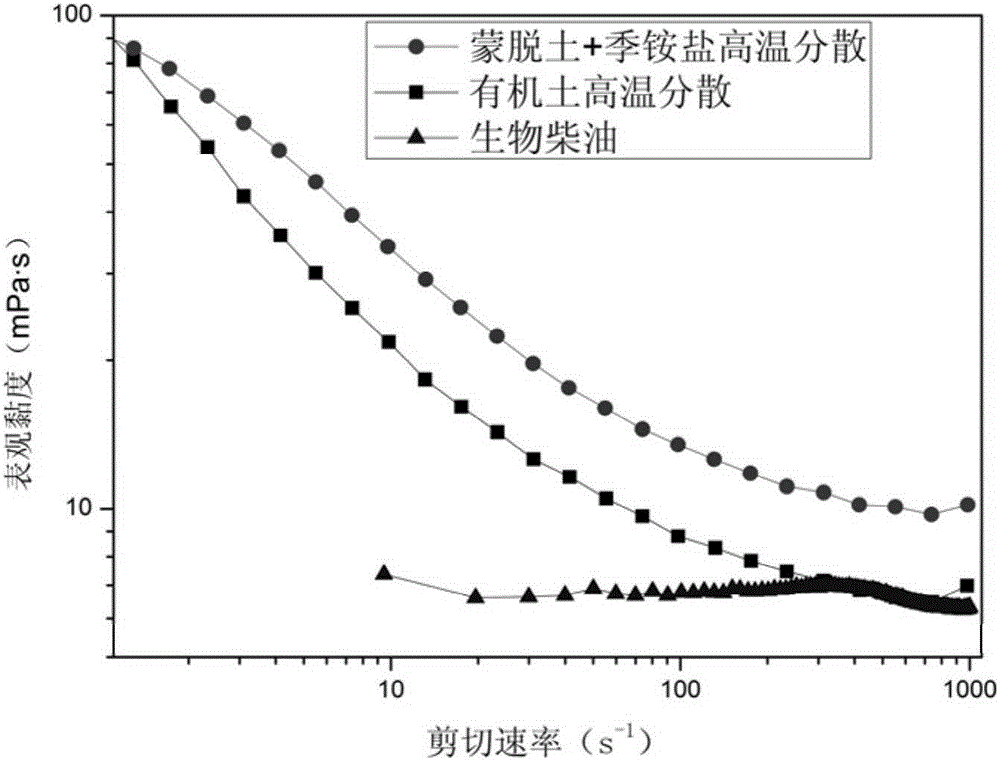
[0017] In this example, a mixed system of quaternary ammonium salt, clay and biodiesel was prepared first, and organic soil was formed in situ through proper heating and shearing, thereby thickening biodiesel, and adding organic soil synthesized in the water phase. The viscous effect was compared. The specific process is as follows:

[0018] Based on 100 parts by mass, 2.1 parts of sodium montmorillonite and 0.9 parts of cetyltrimethylammonium bromide (the amount of quaternary ammonium salt equivalent to 1.0CEC of montmorillonite used) were dispersed in 97 parts of biodiesel to prepare A mixed system with a total mass fraction of montmorillonite and quaternary ammonium salt of 3% was obtained, which was recorded as 1# sample. Weighed 0.6g of commercial organic soil and dispersed it in 19.4g of biodiesel to prepare a mixed system with a mass fraction of organic soil of 3%, which was recorded as 2# sample. These two samples and the biodiesel viscosity curves used are as follow...

Embodiment 2

[0020] This embodiment is to prepare clay and a system in which the mass fraction of single-chain quaternary ammonium salt is 10%, and the specific process is as follows:

[0021] Based on 100 parts by mass, 7 parts of sodium montmorillonite, 3 parts of cetyltrimethylammonium bromide (the amount of quaternary ammonium salt added is approximately equal to 1.0CEC of montmorillonite used), dispersed in 90 parts of biodiesel, and prepared A mixed system with a mass fraction of montmorillonite and quaternary ammonium salts of 10% was obtained, and then the sample was sealed and placed in a water bath at 80°C for 1 hour, then transferred to a colorimetric tube and left to stand at room temperature. It is known that this sample turns into a gel after cooling to room temperature, such as figure 2 shown.

Embodiment 3

[0023] This embodiment is to prepare clay and a double-chain chain quaternary ammonium salt with a mass fraction of 10%, and the specific process is as follows:

[0024] Based on 100 parts by mass, 5.4 parts of sodium montmorillonite, 4.6 parts of dioctadecyl dimethyl ammonium chloride (the amount of quaternary ammonium salt is approximately equal to 1.2CEC of the montmorillonite used) are dispersed in 90 parts of biodiesel, Prepare a mixed system of montmorillonite and quaternary ammonium salt with a mass fraction of 10%, then seal the sample and place it in a water bath at 80°C for 1 hour at constant temperature, then transfer it to a colorimetric tube and let it stand at room temperature. As a result, the sample turned into a gel after cooling to room temperature.

the structure of the environmentally friendly knitted fabric provided by the present invention; figure 2 Flow chart of the yarn wrapping machine for environmentally friendly knitted fabrics and storage devices; image 3 Is the parameter map of the yarn covering machine
Login to View More

PUM

No PUM Login to View More

Abstract

The invention provides a method for thickening biodiesel by utilizing in-situ formed organic soil. The method comprises the steps of (1) taking 1-10 parts of clay according to 100 parts by mass, taking a quaternary ammonium compound according to the amount which is equivalent to 0.8-1.2 times of the cationic exchange capacity of the used clay, and taking the balance of biodiesel, wherein the quaternary ammonium compound is used as a cationic surface active agent; (2) mixing the clay, the quaternary ammonium compound, glycerol and the biodiesel to form a mixed system, and heating and stirring the mixed system in order to dissolve quaternary ammonium salt and evenly disperse the clay, thus obtaining the thickened biodiesel. The method provided by the invention can be used for preparing single / double chain cationic surface active agent modified organic soil; compared with the water phase organic oil, the modified organic soil has the advantages that the preparation is simple, the energy consumption is low and the cost is reduced; for the well drilling field, natural pulping can be realized by high temperature at the bottom of a well without adding and using the organic soil; the relatively cheap biodiesel is used as an oil base, and meanwhile, the by-product glycerol in a biodiesel production process can be used effectively, thus the cost is saved.

Description

technical field [0001] The invention relates to a method for forming organic soil thickened biodiesel in situ, in particular to a method for forming organic soil thickened biodiesel for oil-based drilling fluid in situ, and belongs to the technical field of organic soil thickened biodiesel preparation . Background technique [0002] An important application field of organoclay is as a rheological additive in non-aqueous solvent systems, and oil-based drilling fluid occupies a large share. With the increasing awareness of environmental protection, oil-based drilling fluids for offshore drilling and some land drilling mostly use white oil and other mineral oils as the base oil phase, and the cost is 40% higher than that of biodiesel. The pulping performance in alkane medium is generally poor. Generally, high temperature, high shear and polar activators are used to achieve the desired viscosity and shear force, and the steps are relatively complicated. [0003] At present, or...

Claims

the structure of the environmentally friendly knitted fabric provided by the present invention; figure 2 Flow chart of the yarn wrapping machine for environmentally friendly knitted fabrics and storage devices; image 3 Is the parameter map of the yarn covering machine
Login to View More

Application Information

Patent Timeline
no application Login to View More
Patent Type & Authority Patents(China)
IPC IPC(8): C09K8/32
CPCC09K8/32
Inventor 孙德军张厉徐健李红红赵春花
Owner SHANDONG UNIV
Features
  • R&D
  • Intellectual Property
  • Life Sciences
  • Materials
  • Tech Scout
Why Patsnap Eureka
  • Unparalleled Data Quality
  • Higher Quality Content
  • 60% Fewer Hallucinations
Social media
Patsnap Eureka Blog
Learn More