
PNN ligand-metal complex catalyst as well as preparation method and application thereof
A technology of metal complexes and catalysts, which can be used in the preparation of organic compounds/hydrides/coordination complex catalysts, iron group organic compounds without C-metal bonds, and organic compounds, and can solve problems such as poor regioselectivity , to achieve the effect of high yield, good selectivity and environmental friendliness
Patent Information
- Authority / Receiving Office
- CN · China
- Patent Type
- Applications(China)
- Current Assignee / Owner
- Publication Date
- 2014-08-06
Smart Images
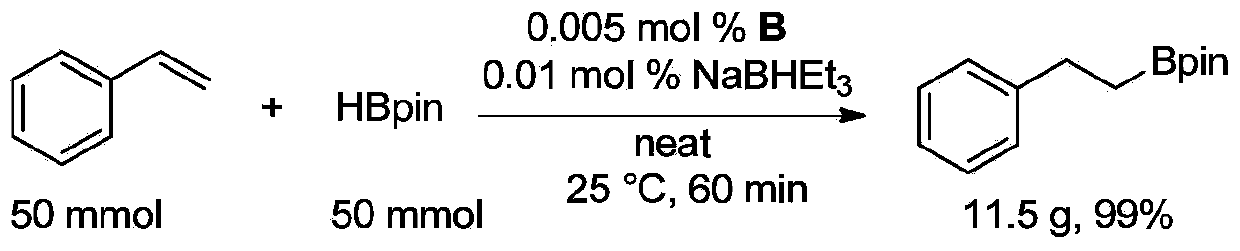
Figure 1 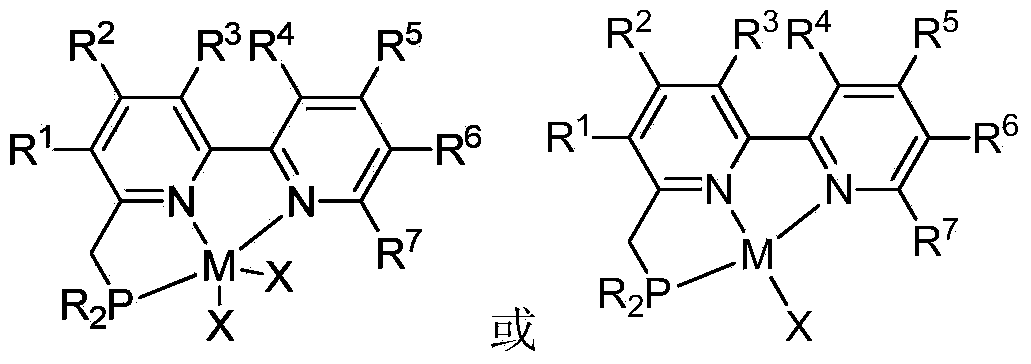
Figure 2 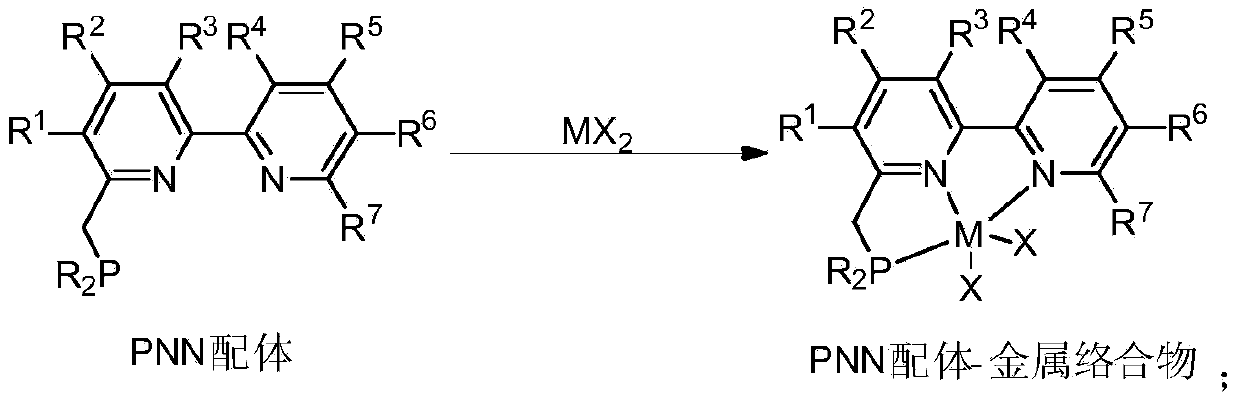
Figure 3
Abstract
Description
technical field
[0001] The present invention relates to a PNN ligand-metal complex catalyst and its preparation method and application, in particular, it relates to a metal complex catalyst containing an electron-donating tridentate PNN ligand, its preparation method and its The application in the hydroboration reaction of monoolefin belongs to the technical field of organic chemistry. Background technique
[0002] Organoboronic acids and their derivatives are often used as intermediates and are widely used in organic synthesis. For example, the Suzuki-Miyaura reaction can convert organoboron compounds C(sp 3 ) is coupled with a halogenated hydrocarbon to form a C-C bond. Compared with other organometallic nucleophiles, organic boronic acid derivatives have unique stability, and many boric acid esters can be separated, purified and stored in air. Scientists have developed a variety of methods for the synthesis of organoborates. One of the commonly used methods is to conve...
Examples
Embodiment 1
[0042] Embodiment 1: prepare PNN ligand-cobalt complex
[0043] ( t Bu-PNN)CoCl 2 (Complex A):
[0044] In the glove box, the CoCl 2 (260mg, 2.0mmol, 1.0equiv) and THF (50mL) were added to a 100mL schlenk tube, and then slowly t A THF solution (10 mL) of Bu-PNN ligand (628 mg, 2.0 mmol, 1.0 equiv) was added dropwise to the above solution, and the color of the reaction solution gradually turned black. After the reaction was stirred at room temperature for 24 h, the reaction solution was concentrated to 10 mL with an oil pump, and then Et 2 O, when the solid precipitated out, it was filtered and washed with ether, and the solvent was drained to obtain a purple powder (826mg, 93%). Then the above powder (50 mg) was dissolved in CH 2 Cl 2 (3mL), add 1mL CH 2 Cl 2 The mixed solvent with n-hexane (1:1) is used as a buffer layer, and a large amount of n-hexane is added to the upper layer of the mixed solvent, and it is left to stand for several days, and the n-hexane slowl...
Embodiment 2
[0051] Embodiment 2: the catalytic activity experiment of complex B described in embodiment 1 to the hydroboration reaction of different single olefins
[0052]
[0053] Taking the hydroboration process of olefin 1a as an example: firstly, in the glove box, complex B (2.1mg), THF (20mL) and NaBEt 3 H (1M) (10uL) was added into a 50ml Erlenmeyer flask to obtain a purple catalyst solution; then olefin 1a (63mg, 0.5mmol, 1equiv) and HBpin (75uL, 0.5mmol, 1equiv) were added to an 8mL reaction vial, and then 1mL of the prepared catalyst solution was added into the above-mentioned reaction vial; after the reaction was stirred at room temperature for 15min, it was exposed to the air and quenched; mixture as eluent) to obtain colorless liquid 3a. The preparation method of 3b~3n, 4b~4m is the same as the preparation method of 3a.
[0054] 4,4,5,5-tetramethyl-2-nonyl-1,3,2-dioxaborolane (3a): Colorless liquid (121.0mg, 95%); 1 H NMR (400MHz, CDCl 3 )δ=1.35-1.43(m,2H,CH 3 CH 2...
Embodiment 3
[0081] Example 3: Hydroboration of olefins carried out under solvent-free conditions
[0082] In the glove box, alkene 2a (5.2g, 50mmol) and HBpin (6.4g, 50mmol, 1equiv), complex B (1.0mg) and NaBEt 3 H(1M) (5 uL) was added to an 8 mL reaction vial. After the reaction was stirred at room temperature for 1 h, it was quenched by exposure to air. Flash column chromatography (silica gel with a height of about 5 cm, a mixture of petroleum ether and ethyl acetate as eluent) gave colorless liquid 4a (m=11.5 g, yield 99%).
[0083] 4,4,5,5-tetramethyl-2-phenethyl-1,3,2-dioxaborolane (4a): Colorless liquid (106.0mg, 91%); 1 H NMR (400MHz, CDCl 3 )δ=7.34-7.24(m,4H,aryl-H),7.23-7.16(m,1H,aryl-H),2.80(t,J=8.0Hz,2H,PhCH 2 ),1.26(s,12H,C(CH 3 ) 2 ),1.20(t,J=8.0Hz,2H,BCH 2 ). 13 C NMR (101MHz, CDCl 3 )δ144.5(aryl-C), 128.3(aryl-C), 128.1(aryl-C), 125.6(aryl-C), 83.2(OC(CH 3 ) 2 ), 30.1 (PhCH 2 ),24.9(C(CH 3 ) 2 ).