
Electric field induces water and co 2 Methods of Conversion to Organic Polymers
An electric field-induced, polymer technology, applied in the fields of electrochemistry and artificial photosynthesis, to achieve the effect of improving efficiency, avoiding enzyme-catalyzed reactions, and huge development potential
- Summary
- Abstract
- Description
- Claims
- Application Information
AI Technical Summary
Problems solved by technology
Method used
Image

Examples
Embodiment 1
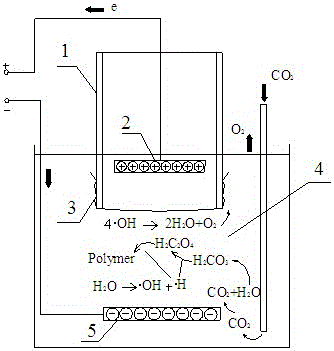
[0042] Assembling an electric field induction reactor such as figure 1 As shown: an anode plate 2 is installed in the anode chamber 1, a cathode plate 5 is installed in the cathode chamber 4, and a diaphragm 3 is used to isolate the anode chamber 1 and the cathode chamber 4. The anode plate 2 is a titanium metal electrode, the cathode plate 5 is a nickel-iron-chromium alloy electrode, and the diaphragm is a cation exchange membrane. Add water to the cathode chamber 4, and adjust the pH value to 7.5 with sodium carbonate, add nickel nitrate as a catalyst; open the cathode chamber 4, and allow the aqueous solution to automatically absorb CO in the atmosphere under normal temperature and pressure conditions. 2 . Insert the anode chamber 1 into the cathode chamber 4, and inject an appropriate amount of sodium carbonate aqueous solution into the anode chamber 4. Through the wire DC power supply, after checking the circuit, select the output voltage to be 5.0V, and control the cur...
Embodiment 2
[0044] Assembling an electric field induction reactor such as figure 1 As shown: an anode plate 2 is installed in the anode chamber 1, a cathode plate 5 is installed in the cathode chamber 4, and a diaphragm 3 is used to isolate the anode chamber 1 and the cathode chamber 4. The anode plate 2 is a graphite electrode, the cathode plate 5 is a nickel electrode, and the diaphragm is a microfiltration membrane. Add water to the cathode chamber 4, and adjust the pH value to 7.2 with sodium hydroxide, add chromium nitrate as a catalyst; open the cathode chamber 4, and allow the aqueous solution to automatically absorb CO in the atmosphere under normal temperature and pressure conditions. 2 . Insert the anode chamber 1 into the cathode chamber 4, and inject an appropriate amount of sodium hydroxide aqueous solution into the anode chamber 4. Through the wire DC power supply, after checking the circuit, select the output voltage as 2.0V, and control the current density to be less tha...
Embodiment 3
[0046] Assembling an electric field induction reactor such as figure 1 As shown: an anode plate 2 is installed in the anode chamber 1, a cathode plate 5 is installed in the cathode chamber 4, and a diaphragm 3 is used to isolate the anode chamber 1 and the cathode chamber 4. The anode plate 2 is a ruthenium oxide electrode, the cathode plate 5 is a nickel-chromium alloy electrode, and the diaphragm is a nanofiltration membrane. Add water to the cathode chamber 4, and adjust the pH value to 8.0 with sodium hydroxide, add ferric nitrate as a catalyst; open the cathode chamber 4, and allow the aqueous solution to automatically absorb CO in the atmosphere under normal temperature and pressure conditions. 2 . Insert the anode chamber 1 into the cathode chamber 4, and inject an appropriate amount of sodium hydroxide aqueous solution into the anode chamber 4. Through the wire DC power supply, after checking the circuit, select the output voltage as 12.0V, and control the current de...
PUM
 Login to View More
 Abstract
Description
Claims
Application Information
 Login to View More