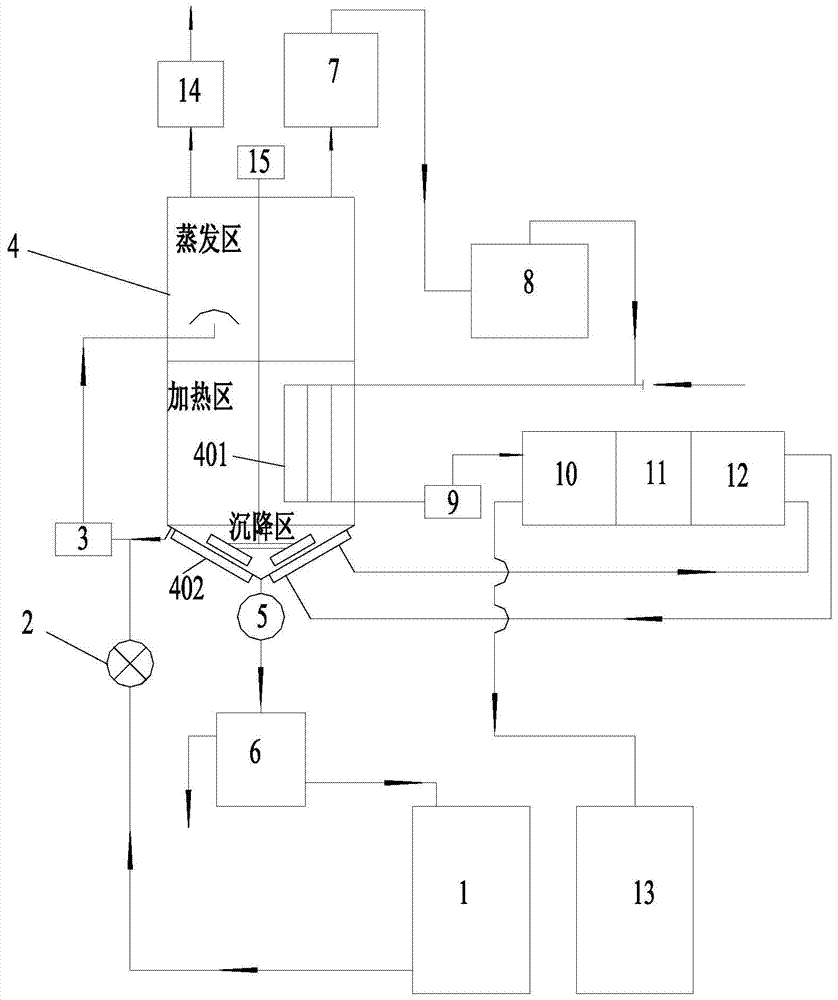
An industrial sewage treatment system

A technology for industrial sewage and treatment systems, applied in the direction of heating water/sewage treatment, heat recovery systems, energy-saving heating/cooling, etc., can solve the problems of sewage with high COD content, such as ineffective effects, non-continuous production, and energy waste. Achieve the effect of maximizing energy utilization, harmless sewage treatment, and reducing equipment investment

CN104761009BActive Publication Date: 2017-06-27南通宝正环保科技有限公司
3 Cites 0 Cited by

Patent Information

Authority / Receiving Office
CN · China
Patent Type
Patents(China)
Current Assignee / Owner
Publication Date
2017-06-27

Smart Images

  • Figure 1
    Figure 1
Patent Text Reader

Abstract

The invention discloses an industrial waste water processing system. The industrial waste water processing system comprises a waste water storage tank, a waste water pipeline, a control valve, a chemical pump, a MVR evaporation system, and a recycled water storage tank; the MVR evaporation system comprises an evaporator and a compressor; heat pump technology is adopted to transform heat energy of condensed water to soft water in a hot water tank as an auxiliary heat source of the evaporator; an evaporation zone is connected with a vacuum pump; a discharge port of the evaporator is connected with a negative pressure discharging mechanism so as to guarantee system continuous feeding and continuous discharging. The industrial waste water processing system is capable of reducing the size of the evaporator and the size of a heat exchanger; the evaporator is connected with a chemical pump forced circulation via external connection, so that stirring power is reduced greatly; and at the same time, sinking and crystallization of concentrated waste water are realized, and continuous waste material discharging is realized; latent heat of condensed water is fully used; maximum energy utilization is realized; waste water harmless treatment is realized, and at the same time treatment cost is reduced as far as possible; and the processing process is automatic, continuous, and controllable.
Need to check novelty before this filing date? Find Prior Art

Description

technical field

[0001] The invention belongs to the field of environmental protection, and in particular relates to an industrial sewage treatment system. Background technique

[0002] There are many kinds of existing industrial sewage treatment technologies, 1, chemical neutralization method, this method is easy to produce new pollution, and the effect on a large amount of sewage with high COD content is not obvious. 2. Biodegradation method, this method is a better method, but this treatment method takes up too much land, and it is difficult to be promoted in the case of Chinese cities or suburbs where every inch of land is very expensive. 3. Sewage evaporation and solidification method. This method is a relatively new process. By evaporating sewage, solidifying the concentrated sewage, separating useful salt, and incinerating useless solid waste at high temperature or deep burial, this One category of processing methods is further divided into the following categories: ...

Examples

Embodiment

[0022] Such as figure 1 As shown, an industrial sewage treatment system includes a sewage storage tank 1, a sewage pipeline, a control valve 2, a chemical pump 3, an MVR evaporation system and a reclaimed water storage tank 13, and industrial sewage flows through the sewage pipeline from the sewage storage tank 1 After the flow is controlled by the control valve 2, the industrial sewage is pumped to the MVR evaporation system by the chemical pump 3;

[0023] The MVR evaporation system includes an evaporator 4 and a compressor 8. The evaporator 4 is composed of an evaporation zone, a heating zone and a settling zone. The evaporation zone receives the industrial sewage transported by the chemical pump 3, and the sewage is negatively charged in the evaporation zone. Pressure evaporation to obtain steam and concentrated liquid, the steam enters the compressor 8 after steam-water separation by the steam-water separator 7, and circulates into the shell-and-tube heat exchanger 401 lo...