Bee colony optimization based network traffic scheduling method under multiple QoS (quality of service) constraints

A quality constraint, network traffic technology, applied in the field of computer networks, can solve the problems of traffic jitter, high-speed bandwidth, high traffic congestion, etc., and achieve the effect of improving diversity and global search ability.

CN104954278AActive Publication Date: 2015-09-30INST OF BIG DATA RES AT YANCHENG OF NANJING UNIV OF POSTS & TELECOMM
5 Cites 9 Cited by

Patent Information

Authority / Receiving Office
CN · China
Current Assignee / Owner
Publication Date
2015-09-30

Smart Images

  • Figure 1
    Figure 1
  • Figure 2
    Figure 2
  • Figure 3
    Figure 3
Patent Text Reader

Abstract

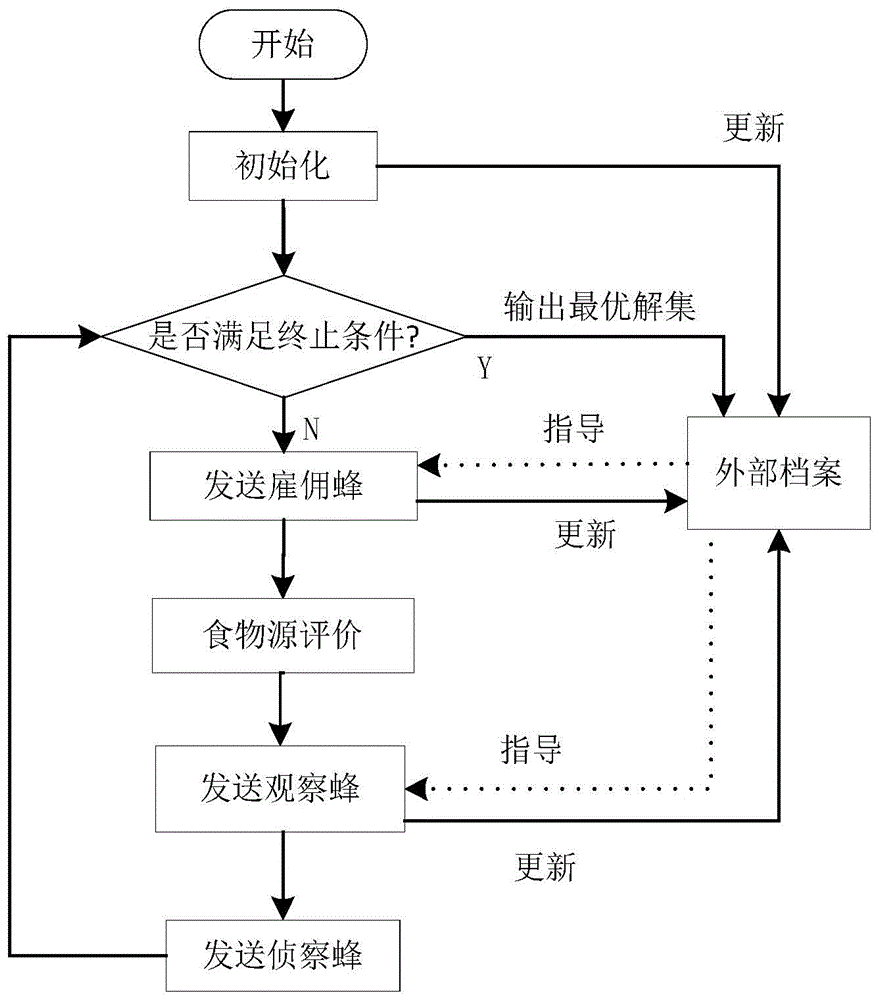
The invention provides a bee colony optimization based network traffic scheduling method under multiple QoS (quality of service) constraints. According to the method, a multi-objective optimization problem is solved with a multi-objective artificial bee colony optimization algorithm, a fitness function is improved in combination of the algorithm with a Pareto sorting mechanism and a crowding distance, solution selection is performed with a Boltzmann strategy, a found Pareto solution is recorded with an external file, and neighborhood search of the colony is guided according to global information, so that the found Pareto optimal solutions are uniformly distributed at the real Pareto optimal front end. The degree of importance of each objective is analyzed according to actual conditions, an optimal traffic scheduling scheme is determined, so that after traffic scheduling, the network traffic is scheduled as required, the service level for users is improved, the utilization rate of network resources is increased, the load balancing purpose is achieved, and the traffic scheduling effect is optimal. With the application of the method, the high-utilization and low-consumption traffic scheduling of the network traffic under the multiple QoS constraints can be realized.
Need to check novelty before this filing date? Find Prior Art

Description

technical field

[0001] The present invention is a network traffic scheduling scheme designed based on a multi-objective Artificial Bee Colony Algorithm (Multi-objective Artificial Bee Colony Algorithm), which is applicable to multi-QoS (Quality of Service, quality of service) constraints, and realizes network traffic under multi-QoS constraints. Traffic load balancing. The technology belongs to the field of computer network. Background technique

[0002] With the rapid development of the Internet in the world and the rapid popularization of various Internet applications, the number of network users is increasing day by day, and the needs of users for various network information resources and the information generated are increasing. The increase in traffic, the rapid growth of visits and data traffic, resulting in a substantial increase in network traffic. The traffic in the network is unevenly distributed. Some links in the network are congested due to overload, while oth...

Examples

Embodiment Construction

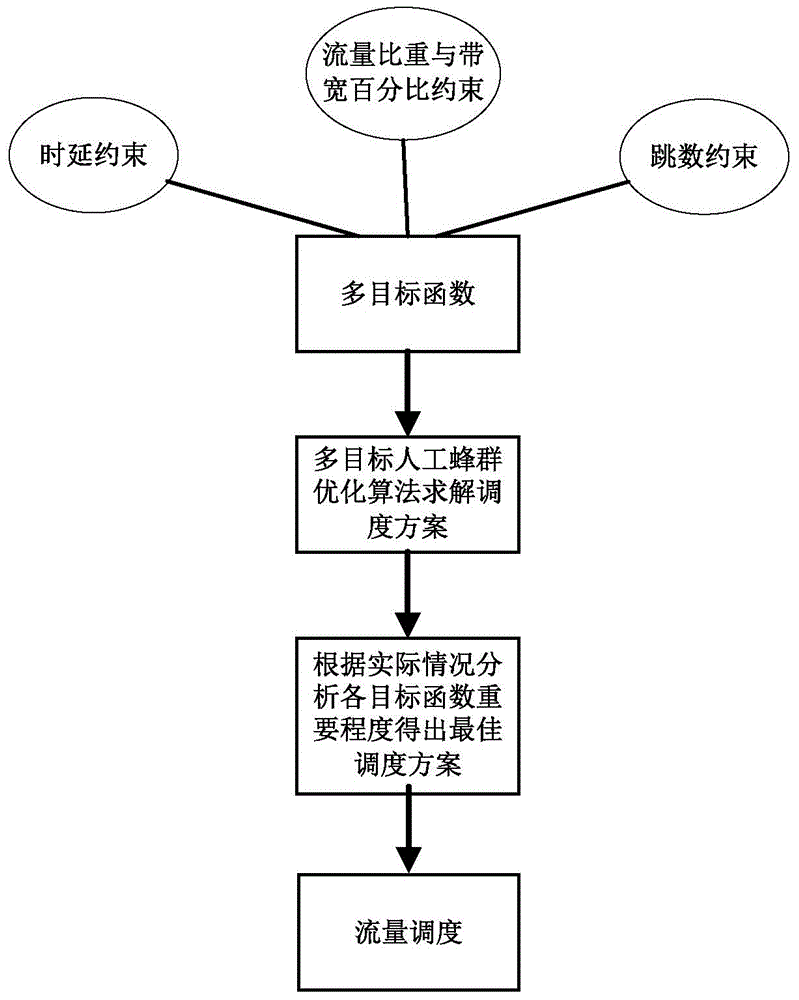
[0037] figure 1 Through the collection and analysis of traffic, the impact of multiple QoS constraints on traffic scheduling is obtained. The main considerations of multiple QoS constraints include host-to-server delay, traffic proportion, bandwidth percentage, and hop count. A multi-objective optimization function for traffic scheduling is established. Multi-objective optimization is used to design the mathematical model of traffic scheduling. The main goal of traffic scheduling is to make the delay in scheduling the shortest, the flow the most balanced, and the number of hops to be the least.

[0038] For the decision space x=(x 1 ,x 2 ,x 3 ) respectively correspond to (delay, traffic proportion and bandwidth percentage, hops) then the objective function f 1 (x), f 2 (x), f 3 (x) respectively represent the delay function, traffic balance function and hop function in scheduling.

[0039] Record n ​​as the number of network hosts, m as the number of accessible servers, v...