
Substituted pyrrolopyrimidine compounds, compositions thereof, and methods of treatment therewith
A technology of compounds and alkyl groups, applied in the direction of drug combination, medical preparations containing active ingredients, organic chemistry, etc.
Patent Information
- Authority / Receiving Office
- CN · China
- Patent Type
- Applications(China)
- Current Assignee / Owner
- Publication Date
- 2015-12-23
- Estimated Expiration
- Not applicable · inactive patent
Smart Images
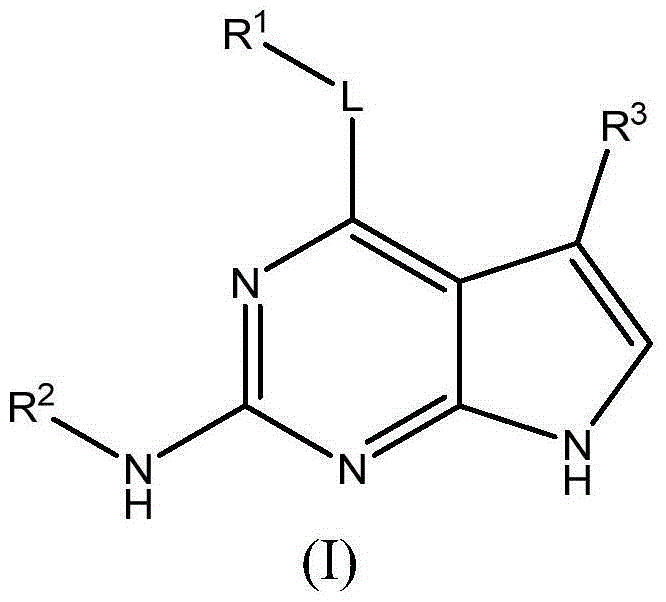
Figure 1 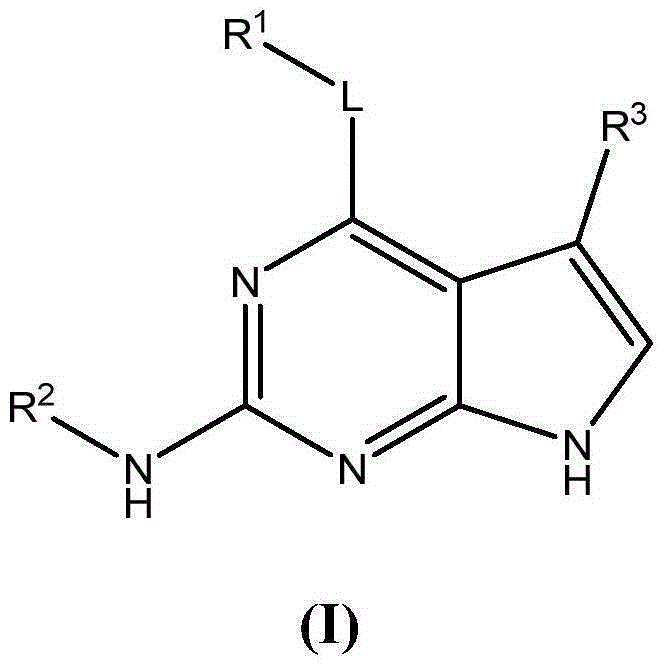
Figure 2 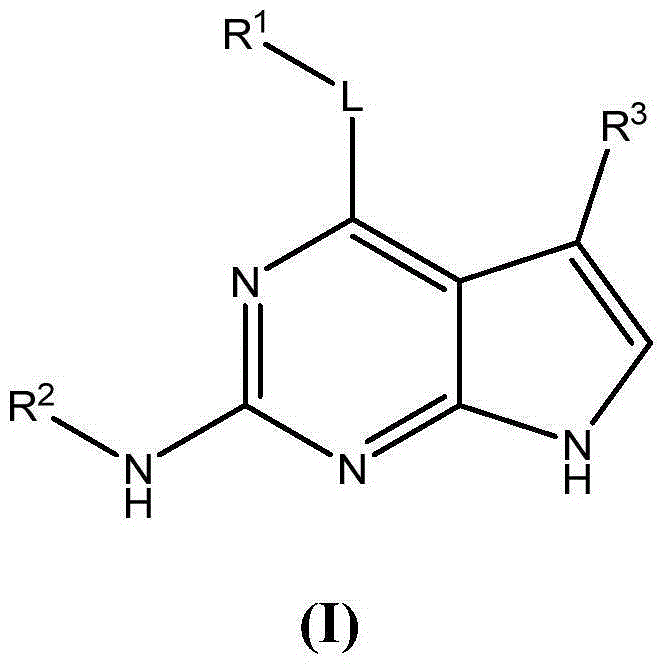
Figure 3
Abstract
Description
[0001] This application claims the benefit of US Provisional Application No. 61 / 753,259, filed January 16, 2013, which is hereby incorporated by reference in its entirety. technical field
[0002] Provided herein are certain pyrrolopyrimidine compounds; compositions comprising effective amounts of such compounds; and methods for treating or preventing breast cancer, especially triple negative breast cancer, comprising administering to a subject in need thereof an effective amount of such pyrrolopyrimidine compounds. Background of the invention
[0003] Every year, more than 1.3 million new cases of breast cancer are diagnosed around the world. Despite advances in prevention, surgical resection, chemotherapy, and targeted therapy over the past decade, it is estimated that approximately 450,000 women worldwide will die from the disease each year. Triple-negative breast cancer (TNBC) is a subtype encompassing a heterogeneous subgroup of tumors sharing three defining features: ...
Examples
Embodiment 1
[0266] Example 1: 2,4-dichloro-5-iodo-7-((2-(trimethylsilyl)ethoxy)methyl)-7H-pyrrolo[2,3-d]pyrimidine
[0267]
[0268] 2,4-dichloro-5-iodo-7H-pyrrolo[2,3-d]pyrimidine. With 2,4-dichloro-7H-pyrrolo[2,3-d]pyrimidine (950g, 5053mmol) and DCM (16 L) to fill a 50-L jacketed reactor. The resulting tan suspension was cooled to 16°C and N-iodosuccinimide (1598 g, 7104 mmol) was added portionwise over 20 minutes. The reaction mixture was stirred at room temperature for 16 hours, after which time TLC analysis (2:1 hexane / ethyl acetate) indicated that the reaction was complete. The resulting precipitate was filtered, washed with DCM (3x1.5L), and dried under reduced pressure at 40°C for 64 hours to afford 1447g (yield: 91%) of the title compound as a beige solid. MS(ESI)m / z314.0[M+1] + .
[0269] 2,4-Dichloro-5-iodo-7-((2-(trimethylsilyl)ethoxy)methyl)-7H-pyrrolo[2,3-d]pyrimidine. Flush with nitrogen and wash with 2, 4-Dichloro-5-iodo-7H-pyrrolo[2,3-d]pyrimidine (1437g, 4578mmo...
Embodiment 2
[0270] Example 2: 4-(4-(cyclopentylamino)-5-(4-hydroxyphenyl)-7h-pyrrolo[2,3-d]pyrimidin-2-ylamino)-3-methoxy -n-methylbenzamide
[0271]
[0272] 2-Chloro-N-cyclopentyl-5-iodo-7-((2-(trimethylsilyl)ethoxy)methyl)-7H-pyrrolo[2,3-d]pyrimidine-4- Amine. 2,4-dichloro-5-iodo-7-((2-(trimethylsilyl)ethoxy)methyl)-7H-pyrrolo[2,3-d]pyrimidine (1 equivalent) , cyclopentylamine (1 equiv), sodium tert-butoxide (7.5 equiv) and 1,4-dioxane (0.28M) were combined in a sealable container with a stir bar. The resulting mixture was placed under a nitrogen atmosphere, sealed, stirred vigorously, and heated at 70°C. After cooling to room temperature, the reaction mixture was directly loaded onto a silica gel column and purified by flash chromatography (Biotage) (0-20% ethyl acetate in hexanes) to give the title compound as a yellow solid (94% yield ). MS(ESI)m / z459.3[M+1] + .
[0273] 4-(2-Chloro-4-(cyclopentylamino)-7-((2-(trimethylsilyl)ethoxy)methyl)-7H-pyrrolo[2,3-d]pyrimidine-5 -yl...
Embodiment 3
[0276]Example 3: 4-((4-(cyclopentyloxy)-5-(2-methylbenzo[d]oxazol-6-yl)-7H-pyrrolo[2,3-d]pyrimidine -2-yl)amino)-3-methoxy-N-methylbenzamide
[0277]
[0278] 2-Methyl-6-(4,4,5,5-tetramethyl-1,3,2-dioxaborolan-2-yl)benzo[d]oxazole. Will be contained in 1,4- A suspension of 6-bromo-2-methylbenzo[d]oxazole (1 eq), bis(pinacolate) diboron (2 eq), potassium acetate (3 eq) in dioxane was treated with argon Degas for 10 minutes. Then, 1,1'-bis(diphenylphosphino)ferrocenepalladium(II) chloride dichloromethane adduct (0.05 equiv) was added and the solution was further degassed with argon for 10 minutes. The reaction mixture was heated at 110°C overnight. The reaction mixture was cooled to room temperature, the solvent was removed under reduced pressure and the crude product was purified by column chromatography (100-200 mesh silica gel; 0-10% ethyl acetate in n-hexane as eluent) to afford the title compound. (Yield: 34%), MS (ESI) m / z 260 [M+1] + .
[0279] 4-Amino-3-methoxy-...