Unlock instant, AI-driven research and patent intelligence for your innovation.

Passively mode-locked self-Raman laser

A Raman laser and passive mode-locking technology, applied in the laser field, can solve the problems of reduced pulse stability, increased pulse width, and intensity attenuation, achieving high stability, low intracavity loss, and simple structure

Active Publication Date: 2018-06-15
FUJIAN INST OF RES ON THE STRUCTURE OF MATTER CHINESE ACAD OF SCI
View PDF6 Cites 0 Cited by
  • Summary
  • Abstract
  • Description
  • Claims
  • Application Information

AI Technical Summary

Problems solved by technology

However, in related technologies, when the mode-locking process and the resonant stimulated Raman scattering process occur simultaneously, the Raman conversion and pulse stabilization interact with each other.
The number of photons consumed by Raman conversion will greatly reduce the intensity of the fundamental frequency light, resulting in a decrease in the pulse stability of the mode-locking process
In addition, when the Raman conversion occurs in the center of the fundamental frequency optical pulse, the intensity of the pulse center will be greatly attenuated relative to the pulse wings, which will lead to an increase in the pulse width and further affect the generation of the mode-locked pulse and the Raman conversion efficiency.

Method used

the structure of the environmentally friendly knitted fabric provided by the present invention; figure 2 Flow chart of the yarn wrapping machine for environmentally friendly knitted fabrics and storage devices; image 3 Is the parameter map of the yarn covering machine
View more

Image

Smart Image Click on the blue labels to locate them in the text.
Viewing Examples
Smart Image
  • Passively mode-locked self-Raman laser
  • Passively mode-locked self-Raman laser
  • Passively mode-locked self-Raman laser

Examples

Experimental program
Comparison scheme
Effect test

Embodiment Construction

[0021] The present invention will be described in further detail below through specific implementation examples and in conjunction with the accompanying drawings.

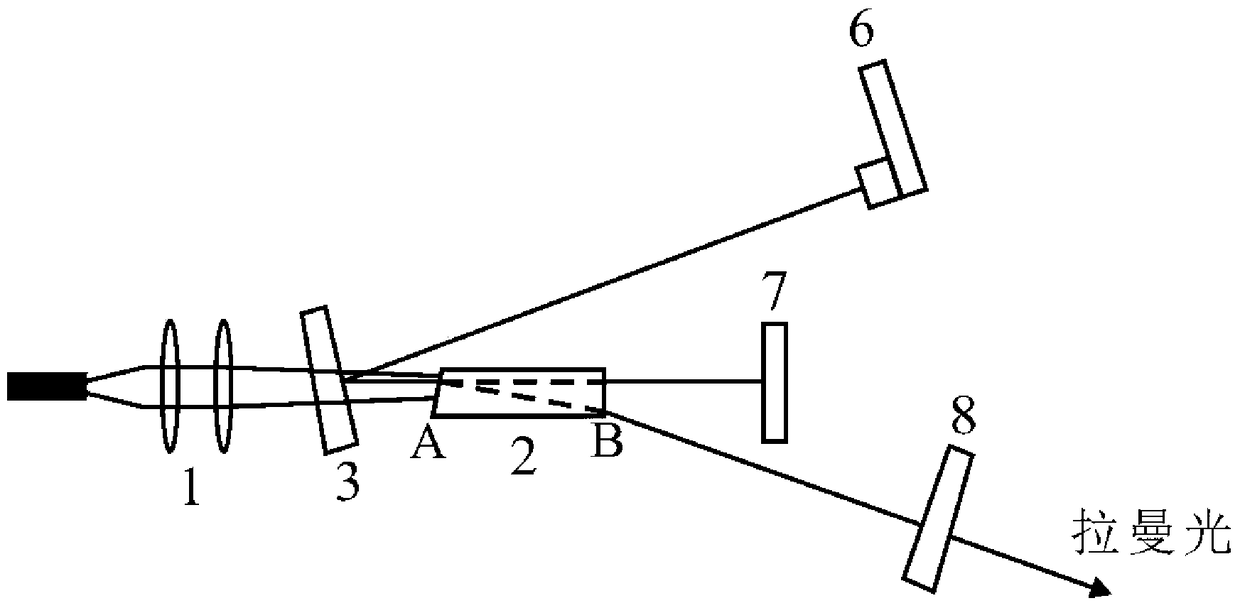
[0022] figure 1 A schematic diagram of a mode-locked self-Raman laser according to an embodiment of the present invention is shown, including: a pump source coupling system 1, a pump coupling cavity mirror 3, a laser gain medium 2, a passive mode-locking device 6, and a reflective cavity mirror 7 and the Raman light output mirror 8; the optical path is: the pump light is emitted from the pump source coupling system 1, focused by the pump coupling cavity mirror 3, incident on the A surface of the laser gain medium 2, and exiting the B surface of the laser gain medium 2, After the laser gain medium 2 absorbs the pump light, the number of particles reverses to generate stimulated radiation, and the stimulated radiation forms an oscillation in the resonant cavity composed of the reflective cavity mirror 7, the pump cou...

the structure of the environmentally friendly knitted fabric provided by the present invention; figure 2 Flow chart of the yarn wrapping machine for environmentally friendly knitted fabrics and storage devices; image 3 Is the parameter map of the yarn covering machine
Login to View More

PUM

No PUM Login to View More

Abstract

The invention provides a passive mode-locked self-Raman laser comprising a pump source coupling system, a pump coupling cavity mirror, a laser gain medium, a passive mode-locked device, a reflective cavity mirror and a Raman light output mirror. The light path is as follows: pump light emitted from the pump source coupling system is focused through the pump coupling cavity mirror, goes into a side A of the laser gain medium and goes out of a side B of the laser gain medium, and after the laser gain medium absorbs the pump light, the particle population is inverted, stimulated radiation is produced, and the stimulated radiation oscillates in a resonant cavity formed by the reflective cavity mirror, the pump coupling cavity mirror and the passive mode-locked device and is non-linearly absorbed and amplified by the passive mode-locked device to form fundamental-frequency light with ultra-short pulse; and on the other hand, the fundamental-frequency light produces a stimulated Raman scattering effect when passing through the laser gain medium, Raman light is generated, and the Raman light passes through the side B, is oscillated and amplified in a Raman coupling cavity formed by the reflective cavity mirror, the side A and the Raman light output mirror and is output by the Raman light output mirror.

Description

technical field [0001] The field of the invention is the field of lasers, in particular, passively mode-locked self-Raman lasers. Background technique [0002] As an effective tool to expand the output spectrum of lasers, the stimulated Raman scattering technology of Raman media has the advantages of high conversion efficiency and wide range of wavelength selection. The wavelength range covers ultraviolet to near infrared, which greatly broadens the application prospects of lasers. The rare earth-doped vanadate crystal can be used as a laser crystal and a Raman crystal at the same time to realize self-Raman stimulated oscillation. Such a Raman laser reduces the optical components in the cavity, has a simple structure and high conversion efficiency, but due to the use of a Crystal, so the optimization of the cavity mode is more difficult. [0003] At the same time, due to the high threshold of stimulated Raman scattering, the ultrashort pulse laser with the characteristics o...

Claims

the structure of the environmentally friendly knitted fabric provided by the present invention; figure 2 Flow chart of the yarn wrapping machine for environmentally friendly knitted fabrics and storage devices; image 3 Is the parameter map of the yarn covering machine
Login to View More

Application Information

Patent Timeline
no application Login to View More
Patent Type & Authority Patents(China)
IPC IPC(8): H01S3/08H01S3/098H01S3/30
Inventor 葛燕黄见洪邓晶翁文刘华刚李锦辉
Owner FUJIAN INST OF RES ON THE STRUCTURE OF MATTER CHINESE ACAD OF SCI