
A kind of thioether oxidation method
A technology of thioether oxidation and thioether, which is applied in chemical instruments and methods, chemical recovery, organic chemistry, etc., can solve the problems of reduced catalytic activity of titanium-silicon molecular sieves, increased device operating costs, and large fluctuations in catalyst activity. The effect of industrial production application, prolonging the service life of one way and prolonging the stable operation time
- Summary
- Abstract
- Description
- Claims
- Application Information
AI Technical Summary
Problems solved by technology
Method used
Image

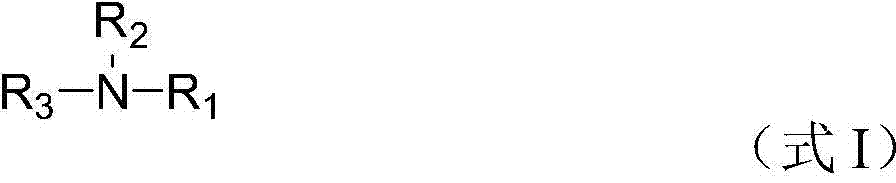
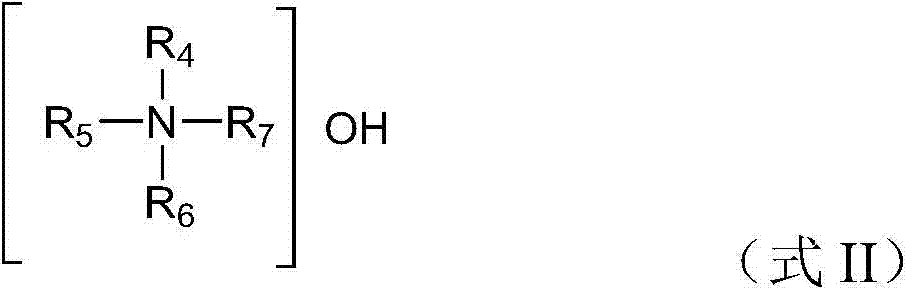
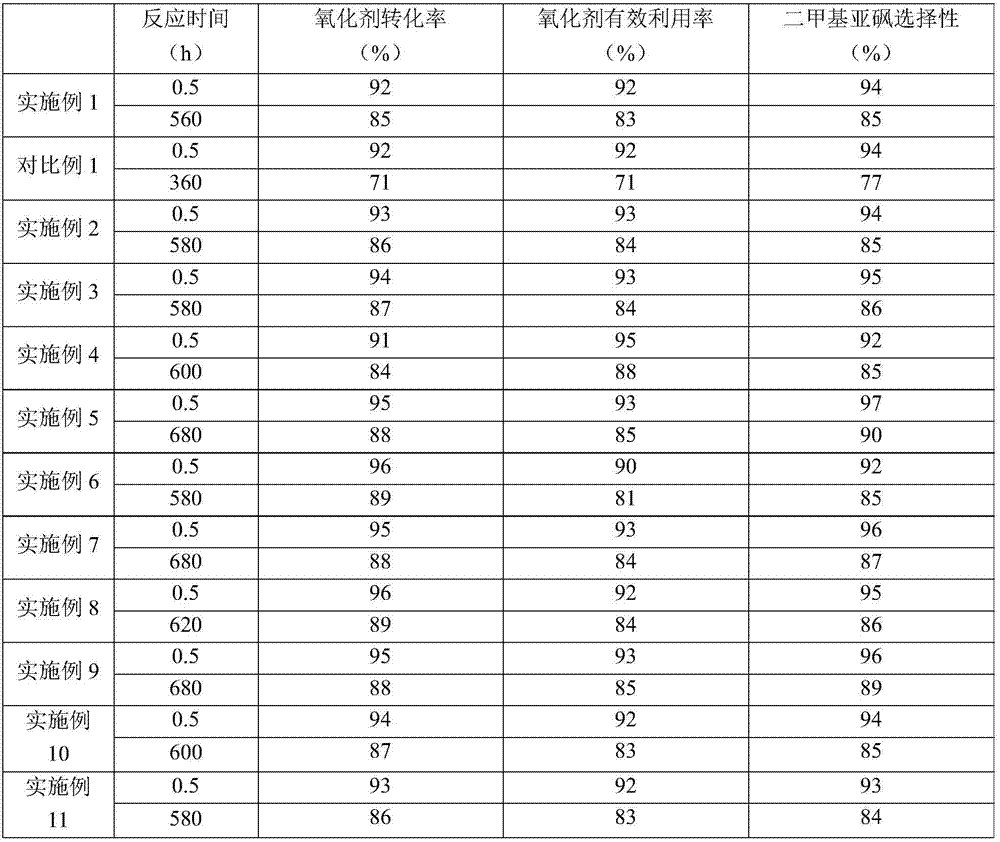
Examples
Embodiment 4、12-15 and 17
[0087] Following examples 4, 12-15 and 17 adopt the following method to measure the activity of catalyst:
[0088] Catalyst, 36% by weight of ammonia water (as NH 3 meter), 30% by weight of hydrogen peroxide (as H 2 o 2 ), tert-butanol and cyclohexanone by mass ratio = 1:7.5:10:7.5:10 and then stirred and reacted at 80°C under atmospheric pressure for 2h, filtered the reactant, and analyzed the obtained liquid phase by gas chromatography The composition of the catalyst is analyzed, and the conversion rate of cyclohexanone is calculated by the following formula and used as the activity of the catalyst,
[0089] The conversion rate (%) of cyclohexanone=[(the molar amount of cyclohexanone added−the molar amount of unreacted cyclohexanone) / the molar amount of cyclohexanone added]×100%.
Embodiment 1
[0092] The catalyst (being a spherical catalyst with a volume average particle diameter of 500 μm, the content of titanium-silicon molecular sieve TS-1 in the catalyst is 85% by weight, the content of silicon oxide is 15% by weight, and the density is 0.79g / cm 3 ) is packed in a fixed-bed reactor to form a catalyst bed, wherein the number of the catalyst bed is 1 layer, and the aspect ratio of the catalyst bed is 10.
[0093] Dimethyl sulfide, hydrogen peroxide (provided in the form of 40% by weight hydrogen peroxide) as an oxidizing agent and acetone as a solvent were mixed to form a liquid mixture which was fed from the bottom into a fixed bed reactor in parallel flow over the catalyst bed. Among them, the initial molar ratio of dimethyl sulfide to hydrogen peroxide is 2:1, the initial molar ratio of dimethyl sulfide to acetone is 1:10, and the initial weight hourly space velocity of dimethyl sulfide is 0.5h -1 . The temperature in the catalyst bed was 35° C., and the pres...
Embodiment 2
[0099] Adopt the method identical with embodiment 1 to oxidize dimethyl sulfide, difference is, also send into the ammoniacal liquor (concentration is 25% by weight) in the fixed-bed reactor, to form by dimethyl sulfide, hydrogen peroxide and acetone The pH of the liquid mixture was adjusted to 7.0. Carry out the reaction for 580 hours, and the weight hourly space velocity of dimethyl sulfide at the end of the reaction is 2.1h -1 . The results obtained for 0.5 hours and 580 hours of reaction are listed in Table 1.
PUM
| Property | Measurement | Unit |
|---|---|---|
| length | aaaaa | aaaaa |
| adsorption capacity | aaaaa | aaaaa |
| particle size | aaaaa | aaaaa |
Abstract
Description
Claims
Application Information
 Login to View More