Silicon, phosphorus and nitrogen synergistic flame retardant type epoxy resin
What is AI technical title?
AI technical title is built by Patsnap AI team. It summarizes the technical point description of the patent document.
An epoxy resin, synergistic flame retardant technology, applied in the field of epoxy resin, can solve the problems of the decline of epoxy resin matrix performance and the large amount of use, and achieve the effect of avoiding migration, toughening effect and increasing effective service life.
Inactive Publication Date: 2016-04-20
HUBEI UNIV OF SCI & TECH
View PDF8 Cites 0 Cited by
Summary
Abstract
Description
Claims
Application Information
AI Technical Summary
This helps you quickly interpret patents by identifying the three key elements:
Problems solved by technology
Method used
Benefits of technology
Problems solved by technology
[0004] However, in order to achieve sufficient flame retardant efficiency, traditional additive flame retardants are used in large amounts, and are incompatible with the matrix resin, resulting in an overall decline in the performance of the epoxy resin matrix
Method used
the structure of the environmentally friendly knitted fabric provided by the present invention; figure 2 Flow chart of the yarn wrapping machine for environmentally friendly knitted fabrics and storage devices; image 3 Is the parameter map of the yarn covering machine
View more
Image
Smart Image Click on the blue labels to locate them in the text.
Viewing Examples
Smart Image
Click on the blue label to locate the original text in one second.
Reading with bidirectional positioning of images and text.
Smart Image
Examples
Experimental program
Comparison scheme
Effect test
Embodiment 1
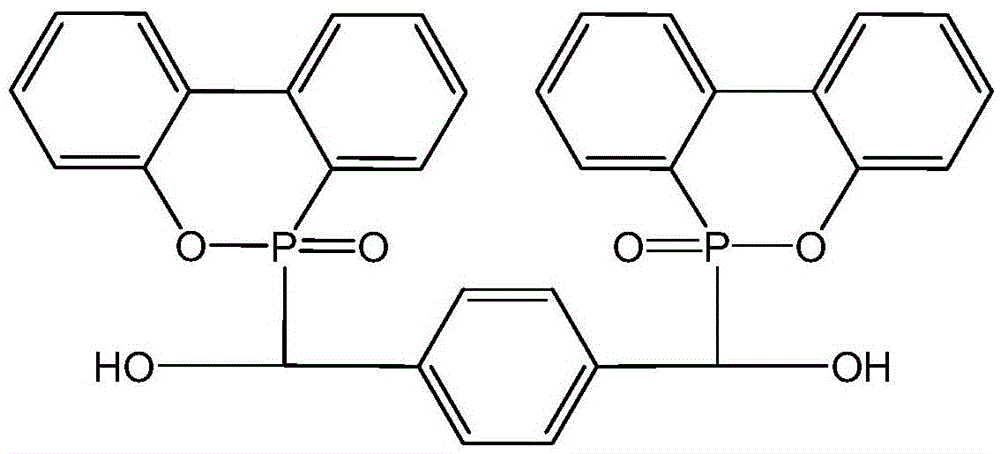
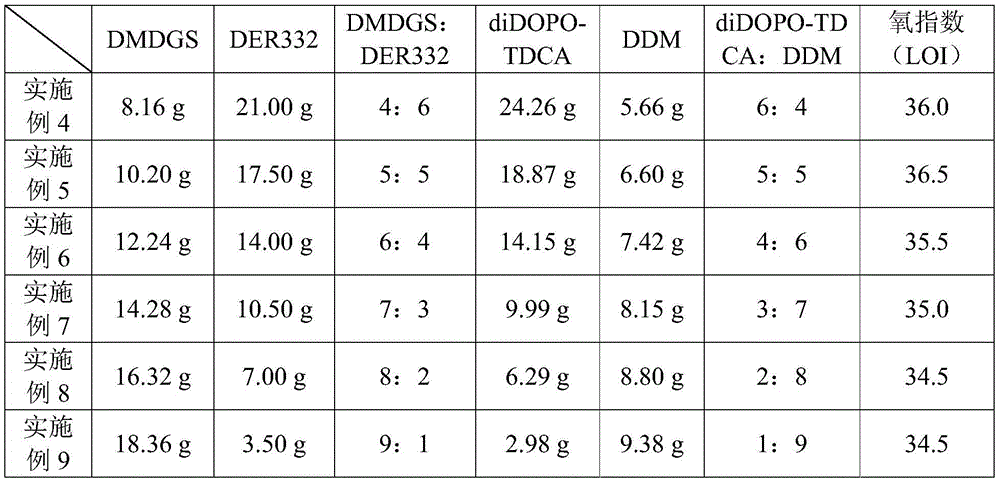
[0020] Dissolve 2.04g of DMDGS, 31.50g of DER332 (DMDGS:DER332=1:9, molar ratio) in 50ml of toluene, add 46.31g of diDOPO-TDCA, 1.80g of DDM (diDOPO-TDCA:DDM=9:1, molar ratio) , mix evenly, drain the toluene under vacuum at 40°C, then put it in an oven, cure at 135°C for 12 hours, then rise to 160°C for 2 hours, 190°C for 2 hours, and 220°C for 2 hours to prepare a silicon, phosphorus and nitrogen content resist Burn epoxy resin. After testing, its oxygen index is 35.0 (GB / T2406.1-2008).
Embodiment 2
[0022] Dissolve 4.08g of DMDGS, 36.36gE44 (DMDGS:E44=2:8, molar ratio) in 50ml of toluene, add 37.73g of diDOPO-TDCA, 3.30gDDM (diDOPO-TDCA:DDM=8:2, molar ratio) , mix evenly, drain the toluene under vacuum at 40°C, then put it in an oven, cure at 135°C for 12 hours, then rise to 160°C for 2 hours, 190°C for 2 hours, and 220°C for 2 hours to prepare a silicon, phosphorus and nitrogen content resist Burn epoxy resin. After testing, its oxygen index is 35.5 (GB / T2406.1-2008).
Embodiment 3
[0024] Dissolve 6.12g of DMDGS, 27.45g of E51 (DMDGS:E51=3:7, molar ratio) in 50ml of toluene, add 28.30g of diDOPO-TDCA, 4.24g of DDM (diDOPO-TDCA:DDM=7:3, molar ratio) , mix evenly, drain the toluene under vacuum at 40°C, then put it in an oven, cure at 135°C for 12 hours, then rise to 160°C for 2 hours, 190°C for 2 hours, and 220°C for 2 hours to prepare a silicon, phosphorus and nitrogen content resist Burn epoxy resin. After testing, its oxygen index is 36.0 (GB / T2406.1-2008).
the structure of the environmentally friendly knitted fabric provided by the present invention; figure 2 Flow chart of the yarn wrapping machine for environmentally friendly knitted fabrics and storage devices; image 3 Is the parameter map of the yarn covering machine
Login to View More
PUM
Property
Measurement
Unit
oxygen index
aaaaa
aaaaa
oxygen index
aaaaa
aaaaa
oxygen index
aaaaa
aaaaa
Login to View More
Abstract
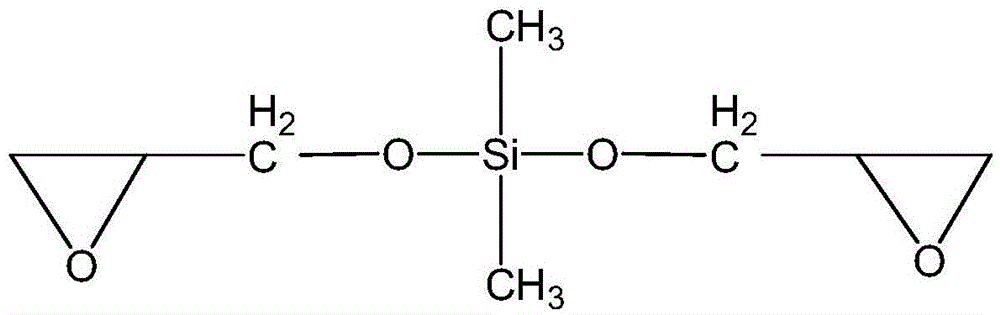
The invention discloses silicon, phosphorus and nitrogen synergistic flame retardant type epoxy resin. The epoxy resin is prepared from a silicon-containing epoxymonomer, epoxy resin, a phosphorus-containing curing agent and a nitrogen-containing curing agent, wherein the silicon-containing epoxy monomer is dimethyl diglycidyl ether oxysilane; the mole ratio of the silicon-containing epoxy monomer to the epoxy resin is (1:9) to (9:1); the mole ratio of the phosphorus-containing curing agent to the nitrogen-containing curing agent is (1:9) to (9:1); the mole number of epoxy groups in an epoxy resin system is equal to the sum of the mole numbers of hydroxyl and amino groups in the curing agents. The epoxy resin provided by the invention has good flame retardant performance and is green, and can be applied to a coating field, a composite material field, an adhesive field and a micro-electronic field; particularly, application to high-end fields including electric products and the like can be expanded.
Description
technical field [0001] The invention relates to an epoxy resin, in particular to an epoxy resin with synergistic flame retardancy of silicon, phosphorus and nitrogen. Background technique [0002] Epoxy resin, as a thermosetting polymer material with excellent performance, is widely used in coatings, adhesives, composite materials and other fields, and has a history of 60 years. Recent research has focused on the diversification and high-performance applications of epoxy resins, but the lack of flame retardancy has limited the development of epoxy resins in high-end fields such as electronic appliances. [0003] The use of traditional additive flame retardants is an efficient and convenient method for flame retardant modification of epoxy resins. Chinese patent CN1429251A discloses a red phosphorus-based flame retardant for epoxy resins that can inhibit the leaching of red phosphorus from oxyacids and impart excellent flame retardancy to epoxy resins for semiconductor seali...
Claims
the structure of the environmentally friendly knitted fabric provided by the present invention; figure 2 Flow chart of the yarn wrapping machine for environmentally friendly knitted fabrics and storage devices; image 3 Is the parameter map of the yarn covering machine
Login to View More
Application Information
Patent Timeline
Application Date:The date an application was filed.
Publication Date:The date a patent or application was officially published.
First Publication Date:The earliest publication date of a patent with the same application number.
Issue Date:Publication date of the patent grant document.
PCT Entry Date:The Entry date of PCT National Phase.
Estimated Expiry Date:The statutory expiry date of a patent right according to the Patent Law, and it is the longest term of protection that the patent right can achieve without the termination of the patent right due to other reasons(Term extension factor has been taken into account ).
Invalid Date:Actual expiry date is based on effective date or publication date of legal transaction data of invalid patent.



 Login to View More