Unlock instant, AI-driven research and patent intelligence for your innovation.

Method for predicting cutting defects of carbon fiber reinforced composites

A technology for enhancing composite materials and cutting processing, which is applied in the direction of analyzing materials, using sonic emission technology for material analysis, and using sonic/ultrasonic/infrasonic waves for material analysis. It can solve problems such as high cost and achieve high reliability and simple operation. handy effect

Inactive Publication Date: 2016-07-06
SHANGHAI JIAO TONG UNIV
View PDF3 Cites 3 Cited by
  • Summary
  • Abstract
  • Description
  • Claims
  • Application Information

AI Technical Summary

Problems solved by technology

Cutting is generally a finishing process after CFRP material structural parts are formed and before assembly, so cutting defects will make expensive CFRP material components waste before final assembly

Method used

the structure of the environmentally friendly knitted fabric provided by the present invention; figure 2 Flow chart of the yarn wrapping machine for environmentally friendly knitted fabrics and storage devices; image 3 Is the parameter map of the yarn covering machine
View more

Image

Smart Image Click on the blue labels to locate them in the text.
Viewing Examples
Smart Image
  • Method for predicting cutting defects of carbon fiber reinforced composites
  • Method for predicting cutting defects of carbon fiber reinforced composites
  • Method for predicting cutting defects of carbon fiber reinforced composites

Examples

Experimental program
Comparison scheme
Effect test

Embodiment

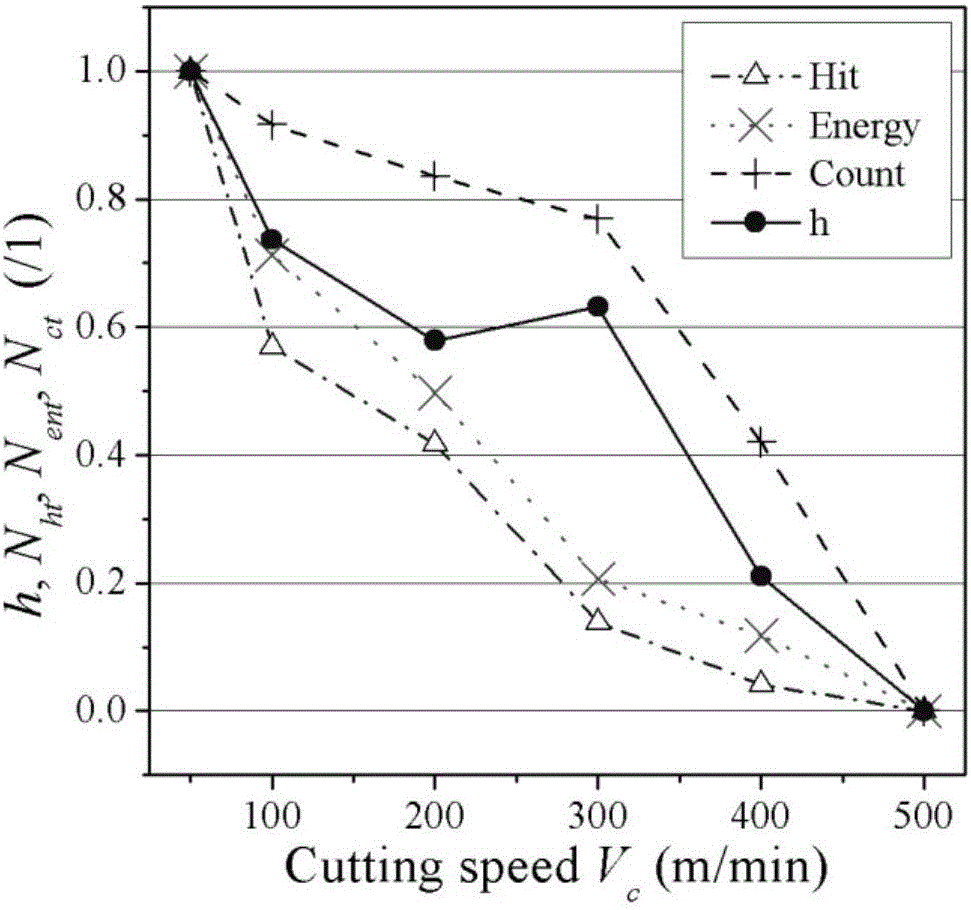
[0034] The collected signals of T800 / X850 carbon fiber reinforced composites are shown in Table 1.

[0035] Substitute the data in Table 1 into Equation (1), and solve the overdetermined linear equation to obtain the linear relationship equation between the tearing depth h and the three AE meter quantitative parameters during cutting of T800 / X850 carbon fiber reinforced composites. Linear coefficients a, b, c. From this, the prediction model of the tear defect on the inlet and outlet sides of the T800 / X850CFRP unidirectional laminate based on the AE signal can be obtained:

[0036] h = 136.3584 N h t L - 4.064 N e n t L + 4.2544 N c ...

the structure of the environmentally friendly knitted fabric provided by the present invention; figure 2 Flow chart of the yarn wrapping machine for environmentally friendly knitted fabrics and storage devices; image 3 Is the parameter map of the yarn covering machine
Login to View More

PUM

No PUM Login to View More

Abstract

The invention discloses a method for predicting cutting defects of carbon fiber reinforced composites. The method comprises the steps as follows: first of all, a linear model about the relationship between energy counts, ringing counts and impact counts in acoustic emission signals generated by the carbon fiber reinforced composites in a cutting process and tearing defects of the carbon fiber reinforced composites during cutting is built in an experiment manner; then the generated acoustic emission signals are acquired and analyzed in real time in an actual cutting process of the carbon fiber reinforced composites, and the cutting defects of the carbon fiber reinforced composites are predicted based on the linear model. The method has the advantages that the tearing defect depth can be reliably predicted, and the accuracy is high.

Description

technical field [0001] The invention relates to cutting processing of carbon fiber reinforced composite materials (Carbon Fiber Reinforced Polymer, CFRP for short), in particular to a method for predicting cutting processing defects of carbon fiber reinforced composite materials based on AE signals, belonging to the technical field of machining and manufacturing. Background technique [0002] Carbon Fiber Reinforced Polymer (CFRP) is very prone to machining defects during cutting due to its remarkable property anisotropy. Machining is generally a finishing process after the CFRP material structure is formed and before assembly, so cutting defects will make the expensive CFRP material components waste before final assembly. [0003] Acoustic Emission (AE), also known as stress wave emission, is a phenomenon in which a localized source in a material rapidly releases energy to generate a transient elastic wave. Instruments are used to detect, record and analyze the acoustic emi...

Claims

the structure of the environmentally friendly knitted fabric provided by the present invention; figure 2 Flow chart of the yarn wrapping machine for environmentally friendly knitted fabrics and storage devices; image 3 Is the parameter map of the yarn covering machine
Login to View More

Application Information

Patent Timeline
no application Login to View More
IPC IPC(8): G01N29/14G01N29/44
CPCG01N29/14G01N29/4418G01N2291/023
Inventor 陈明胡蒙贺旭东明伟伟安庆龙
Owner SHANGHAI JIAO TONG UNIV
Features
  • R&D
  • Intellectual Property
  • Life Sciences
  • Materials
  • Tech Scout
Why Patsnap Eureka
  • Unparalleled Data Quality
  • Higher Quality Content
  • 60% Fewer Hallucinations
Social media
Patsnap Eureka Blog
Learn More