
Novel coupling network based planar CQ diplexer
A matching network and duplexer technology, applied to waveguide devices, electrical components, circuits, etc., can solve the problems of difficult tuning, large volume, large insertion loss, etc., and achieve low manufacturing cost, improved selectivity, and simple structure Effect
- Summary
- Abstract
- Description
- Claims
- Application Information
AI Technical Summary
Problems solved by technology
Method used
Image

Examples
Embodiment
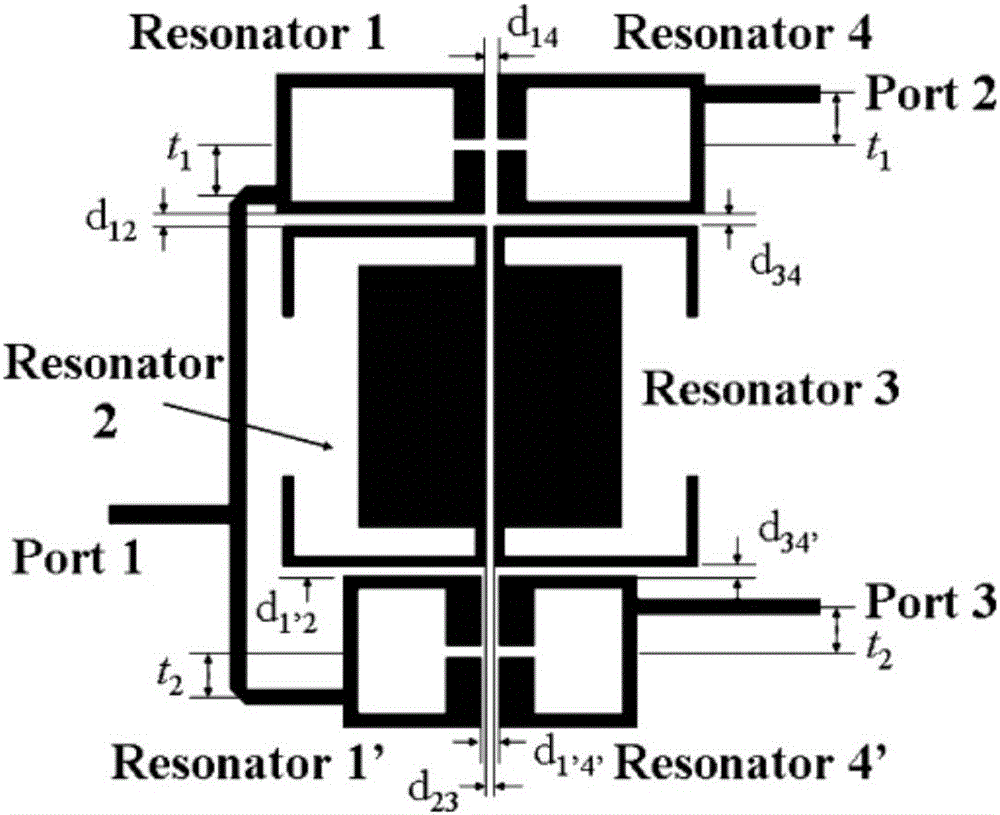
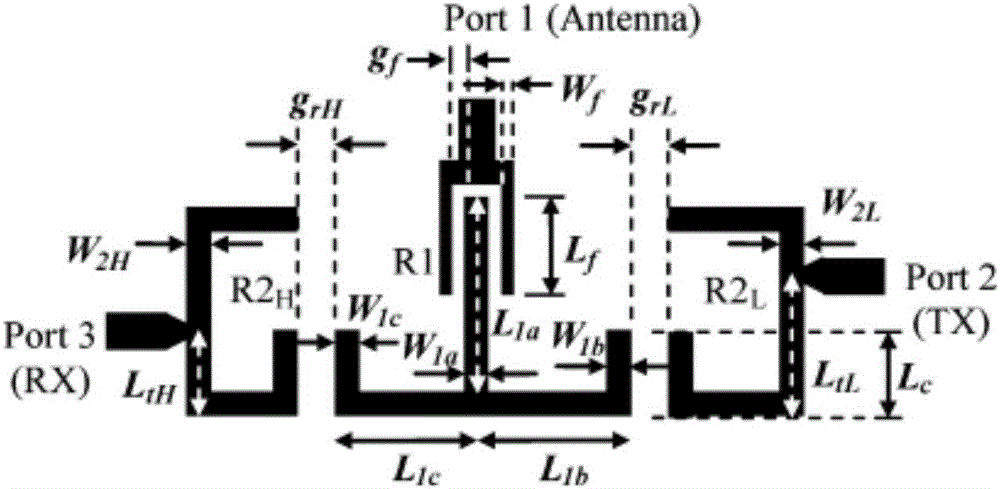
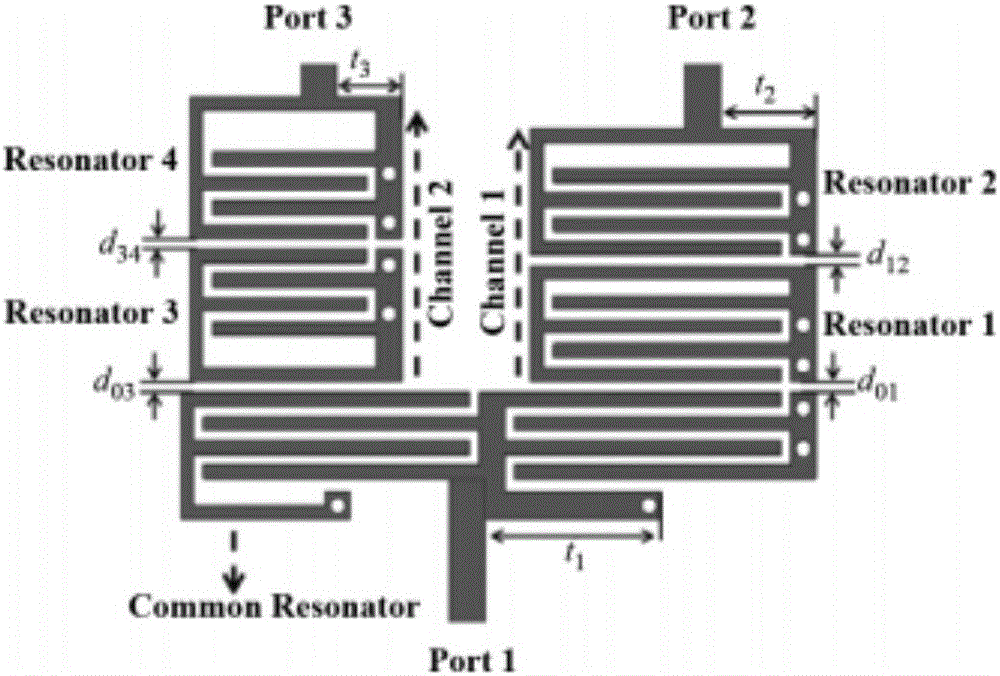
[0037] This embodiment discloses a planar CQ duplexer based on a novel matching network such as Figure 4 As shown, the microstrip duplexer is fabricated on a double-sided copper-clad microstrip board 1 in the form of a printed circuit board, and the other side of the microstrip board is a copper-clad ground plane. In the structure diagram of the duplexer in the present invention.
[0038] A planar CQ duplexer based on a novel matching network, fabricated on a dielectric substrate 1 in the form of a printed circuit board,
[0039] On the same surface of the dielectric substrate, a first input end feeder P1 for inputting electromagnetic wave signals, a first output end feeder P2 and a second output end feeder P3 for outputting electromagnetic wave signals, and the second output end feeder P3 are respectively fabricated. The first input port feeder 2 of the CQ structure on the left, the second input port feeder 3 of the CQ structure on the right, and the short-circuit transmissio...
PUM
 Login to View More
 Abstract
Description
Claims
Application Information
 Login to View More