

Brain function rehabilitation assisting device based on bioelectrical feedback
An auxiliary device and brain function technology, applied in the field of biomedicine, can solve the problem of not being able to change and switch electrode polarity in real time
- Summary
- Abstract
- Description
- Claims
- Application Information
AI Technical Summary
Problems solved by technology
Method used
Image

Examples
Embodiment Construction
[0027] The present invention will be described in detail below in conjunction with the accompanying drawings and specific embodiments.
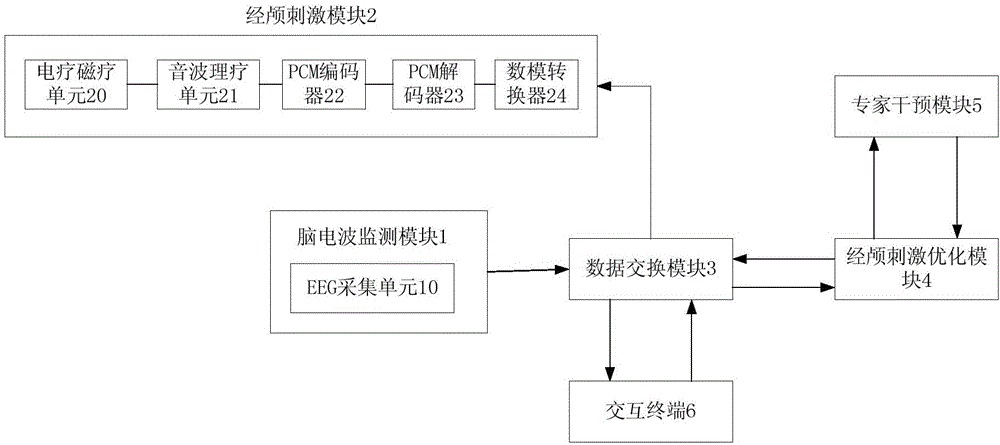
[0028] The embodiment of the present invention provides a bioelectrical feedback brain function rehabilitation auxiliary device, such as figure 1 shown, including:
[0029] The brainwave monitoring module 1 collects bioelectrical signals through the user's skin, separates the 0.5-100 Hz brainwave signal representing the state of brain activity from the bioelectrical signal through the analysis chip and amplification filtering, and extracts the characteristics of the brainwave signal, Monitor whether the brain wave signal is abnormal;
[0030] The brainwave monitoring module 1 includes an EEG acquisition unit 10, and the EEG acquisition unit 10 is composed of a main electrode, a reference electrode and a ground wire;
[0031] Transcranial stimulation module 2, which sends out electromagnetic stimulation signals according to abnormal brain wa...
PUM
 Login to View More
 Abstract
Description
Claims
Application Information
 Login to View More