
Regenerated silicon material as well as preparation method and application thereof
A technology of silicon materials and silicon atoms, which is applied in the field of regenerated silicon materials and its preparation, can solve problems such as unfavorable solid state, unordered distribution of calcium ions and phosphorus ions, unfavorable medical carriers, etc.
- Summary
- Abstract
- Description
- Claims
- Application Information
AI Technical Summary
Problems solved by technology
Method used
Image

Examples
preparation example Construction
[0032] In the present invention, the preparation method of regenerated silicon material comprises the following steps:
[0033] React the silicon precursor with polyols to break the silicon bond in the silicon precursor, and rearrange the silicon atoms at a temperature below 650°C and under normal pressure to form pentavalent or hexavalent silicon, wherein during the reaction The phosphorus content is controlled to be below 2-5wt%. The reaction temperature is generally 650°C or lower, for example, 600°C, 550°C or lower. As the polyol-containing substance, any polyol can be used as a purified single substance as long as it has a plurality of hydroxyl groups in its molecule, and a mixture containing polyols can also be used. Preferably, the present invention uses a polyol-rich soybean extract.
[0034] The preparation method of the soybean extract of the present invention comprises crushing of soybean hulls → acid leaching of crushed material, filtration → alkali neutralizatio...
Embodiment 1
[0066] Preparation method of silicon material
[0067] According to the content of the following components, the corresponding content of the precursor is prepared into a gel precursor solution (replacing calcium nitrate tetrahydrate with calcium chloride or calcium nitrate does not affect the result).
[0068] Silicon material 1
[0069]
[0070] Silicon material 2
[0071]
[0072] Silicon material 3
[0073]
[0074]First, get 30ml of soybean extract of the present invention (preparation method is as above) in a 50ml sample bottle, then add tetraethyl orthosilicate (TEOS), ethanol and water (volume ratio is about 1: 1, adding amount Just enough to dissolve the aforementioned precursor), stir for 30min, add Ca(NO 3 ) 2 4H 2 O (or calcium chloride, or calcium nitrate), to obtain the gel precursor sol solution. Place the prepared gel precursor sol solution at room temperature until it gels (usually takes 2-10 days, depending on the ratio between the precursors),...
Embodiment 2
[0076] Research on properties of silicon materials
[0077] 1 Physical and chemical properties:
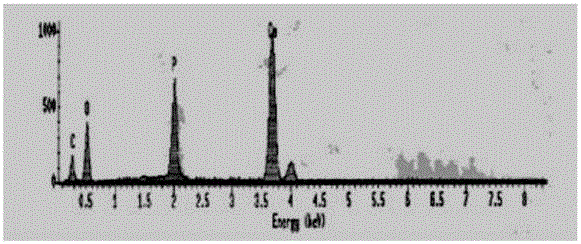
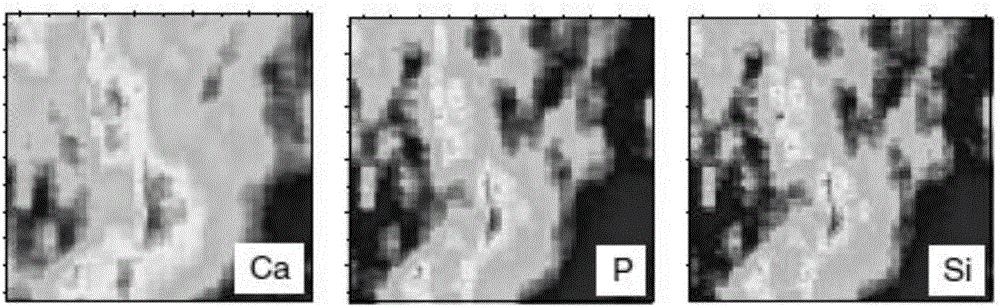
[0078] The chemical composition of silicon material 1 was analyzed by X-ray fluorescence spectroscopy (XRF), and the research showed that the chemical composition (Ca, P, and Si) of the material was uniformly distributed on the microscopic scale, such as figure 1 shown. It should be noted that silicon materials 2 and 3 have similar spectra, which are not shown here. It can be seen from this figure that in the three-dimensional network structure formed by highly coordinated silicon atoms, the Ca, P, and Si ions in it will quickly attach to the cell surface, with strong biological activity and strong cell adhesion. , representing strong cell proliferation ability and strong cell regeneration ability, which is beneficial to the regeneration of bone tissue and soft tissue and the formation of new tissue.
[0079] The silicon material was immersed in simulated body fluid (SBF) for d...
PUM
 Login to View More
 Abstract
Description
Claims
Application Information
 Login to View More