
Receiving element for pouch cells
A technology for accommodating components and soft-pack batteries, which is applied to electrical components, household components, battery pack components, etc. It can solve the problems of battery embedding, high investment, and ineffective use of battery size, etc., and achieve the effect of weight optimization
- Summary
- Abstract
- Description
- Claims
- Application Information
AI Technical Summary
Problems solved by technology
Method used
Image

Examples
Embodiment Construction
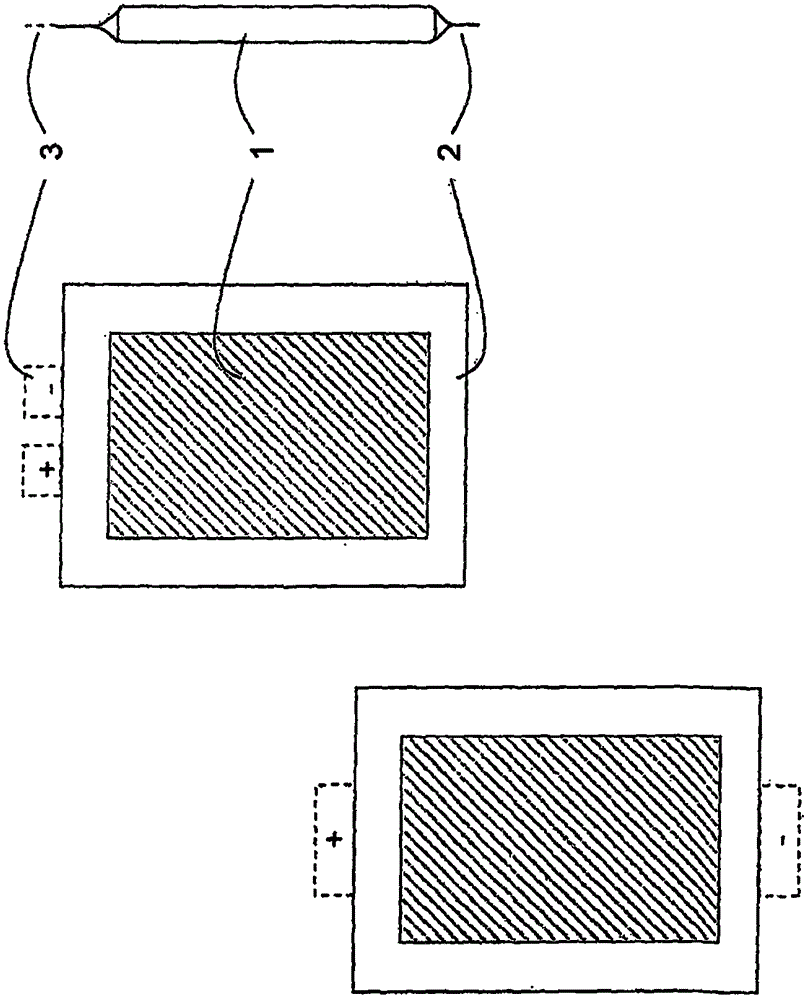
[0067] figure 1 A schematic diagram shows a soft-pack battery, that is, a galvanic battery with a flexible casing. The soft-pack battery includes an actual battery body 1 and a surrounding sealing seam 2. An electrode-separator layer structure is provided on the body of the battery. The upper and lower decorative films in the area of the sealing seam are welded to each other, and include a discharge terminal 3 extending from the battery between the cover films and additionally sealed with a film. Here, the discharge terminals 3 may protrude from the housing on the same side surface, or may also be located on different sides.
[0068] During the operation of the battery, that is, during charging and / or discharging, the thickness of the battery body 1 usually varies between the charged and discharged states by 5% to 10%. In addition, aging batteries are about 5% thicker than new batteries. Therefore, an aged and charged battery is about 10% to 15% thicker than a new and uncharge...
PUM
| Property | Measurement | Unit |
|---|---|---|
| area | aaaaa | aaaaa |
| thickness | aaaaa | aaaaa |
Abstract
Description
Claims
Application Information
 Login to View More