
A kind of method for preparing cyclopentadiene by gas phase depolymerization of dicyclopentadiene
A technology of dicyclopentadiene and cyclopentadiene, which is applied in the direction of depolymerization, hydrocarbon production, organic chemistry, etc., can solve problems such as depolymerization cannot be carried out, coking, clogging of reaction tubes, etc., so as to reduce entrainment loss, reduce costs, and save energy Effect of N2
- Summary
- Abstract
- Description
- Claims
- Application Information
AI Technical Summary
Problems solved by technology
Method used
Image

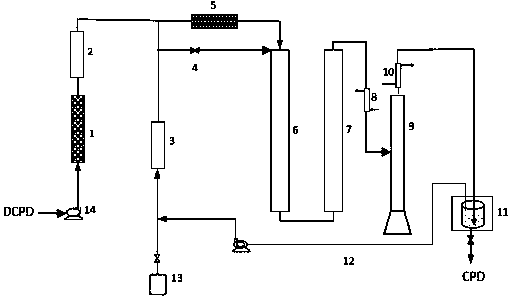
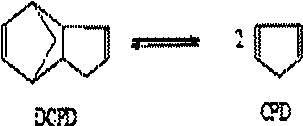
Examples
example 1
[0073] Using carbon ten with a DCPD content of 80% as a raw material, using the process flow of the present invention, the temperature of the first-stage depolymerizer is controlled at 240°C; the temperature of the second-stage depolymerizer is controlled at 300°C, and the residence time is 7s, n(N 2 ) / n(DCPD)=1:1, a 1200h continuous operation experiment was carried out, and the product analysis results showed that the DCPD depolymerization rate was 99.7%, the CPD yield was 99.0%, and no coke was produced.
example 2
[0075] Using carbon ten with a DCPD content of 80% as a raw material, using the process of the present invention, the temperature control of the first-stage depolymerizer is 270°C; the temperature control of the second-stage depolymerizer is 300°C, and the residence time is 7s, n(N 2 ) / n(DCPD)=1:1, a 1200h continuous operation experiment was carried out, and the product analysis results showed that the DCPD depolymerization rate was 99.9%, the CPD yield was 99.5%, and no coke was produced.
example 3
[0077] Using carbon ten with a DCPD content of 80% as raw material, using the process of the present invention, the temperature control of the first-stage depolymerizer is 240°C; the temperature control of the second-stage depolymerizer is 280°C, and the residence time is 5s, n(N 2 ) / n(DCPD)=1:1, a 1200h continuous operation experiment was carried out, and the product analysis results showed that the DCPD depolymerization rate was 99.1%, the CPD yield was 98.4%, and no coke was produced.
PUM
 Login to View More
 Abstract
Description
Claims
Application Information
 Login to View More