Continuous casting billet solidification end single-point and continuous heavy reduction technology

A technology of solidification end and heavy pressure, applied in the field of continuous casting production, can solve the problem of uncontrollable rebound deformation of the slab, and achieve the effect of ensuring high strain rate, avoiding looseness, and improving transfer effect.

CN106735026AActive Publication Date: 2017-05-31NORTHEASTERN UNIV LIAONING
12 Cites 14 Cited by

Patent Information

Authority / Receiving Office
CN · China
Patent Type
Applications(China)
Current Assignee / Owner
Publication Date
2017-05-31

Smart Images

  • Figure 1
    Figure 1
  • Figure 2
    Figure 2
Patent Text Reader

Abstract

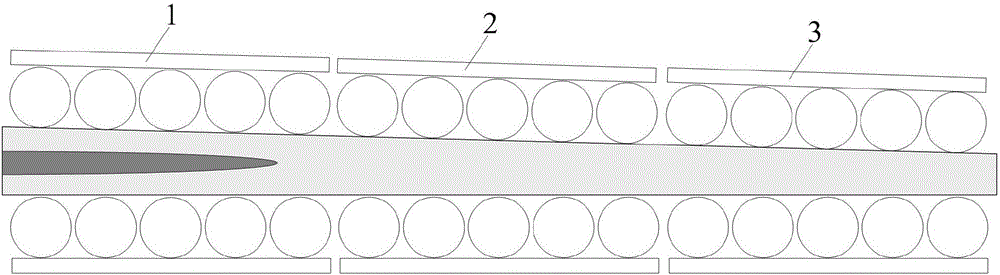
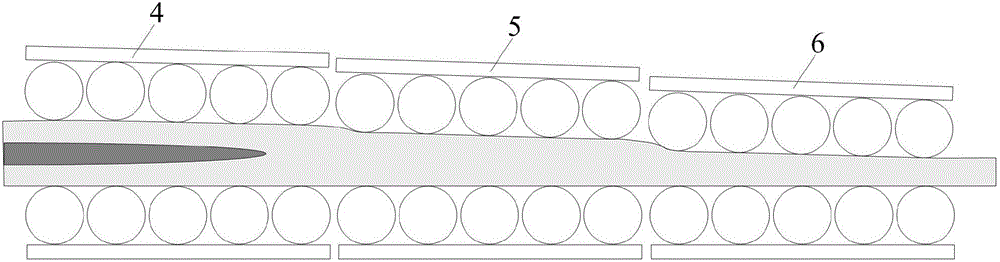
The invention provides a continuous casting billet solidification end single-point and continuous heavy reduction technology and belongs to the field of continuous casting production. The heavy reduction technology is completed through 1-3 fan-shaped sections. Each fan-shaped section comprises 5-7 pairs of pinch rolls, wherein each pair of pinch rolls comprises an upper supporting roll and a lower supporting roll. The single-point reduction of 3-20 mm is exerted on the upper supporting roller at an inlet of each fan-shaped section, so that the single roll reduction effect is achieved; and in this way, the strain rate of the heart portion of a casting billet can be effectively improved, and welding of a central pipe and the improvement on the density of the heart portion of the casting billet are facilitated. Meanwhile, the billet is continuously rolled by the follow-up upper supporting rolls of each fan-shaped section at the reduction rate of 1.5-5.0 mm / m, and it is guaranteed that the casting billet cannot rebound after rolling is conducted. Besides, a billet shell of the casting billet is forced to continuously shrink, and therefore the looseness caused by the difference between the inner shrinkage rate and the outer shrinkage rate of the casting billet is relieved.
Need to check novelty before this filing date? Find Prior Art

Description

technical field

[0001] The invention belongs to the field of continuous casting production, and in particular relates to a single-point and continuous heavy reduction process at the solidification end of a continuous casting slab. Background technique

[0002] The heavy reduction technology at the solidification end of the continuous casting slab is to implement a large amount of reduction at the end of the continuous casting slab solidification and after solidification, and make full use of the characteristics of the large temperature difference between the inside and outside of the slab (the core temperature of the slab is high, and the center temperature is low), so that The reduction amount is fully transmitted to the core of the slab to achieve the process effect of welding solidification shrinkage cavity and even refining the austenite grains in the core.

[0003] According to this concept, researchers at home and abroad have also proposed a corresponding heavy reducti...

Examples

Embodiment

[0019] The invention provides a single-point and continuous heavy reduction process at the solidification end of the continuous casting slab. The reduction process is completed by using 1-3 segments, which include 5-7 pairs of pinch rollers. In this embodiment, each segment Adopt 5 pairs of clamping rods. Utilizing the reduction capacity of the hydraulic cylinder at the entrance of the fan section, each pair of nip rollers includes an upper support roller and a lower support roller, and implement a single-point reduction of 3-20mm for the first upper support roller at the entrance of the fan section, and for other upper support rollers of the fan section. The support roll adopts a reduction rate of 1.0-5.0mm / m to continuously compact the billet. In each sector, except for the first upper support roll, the reduction rate of the other upper support rolls is the same.

[0020] In this embodiment, the heavy reduction process is carried out on the first segment after the solid phas...