
Particle swarm optimization algorithm-based tracking and locating method for multiple moving targets in video
A particle swarm optimization, multi-moving target technology, applied in the field of image processing, can solve problems such as inability to solve multi-target positioning problems, and achieve the effects of solving stagnation, reducing computing costs, and low spatial resolution
- Summary
- Abstract
- Description
- Claims
- Application Information
AI Technical Summary
Problems solved by technology
Method used
Image



Examples
Embodiment Construction
[0033] Below in conjunction with accompanying drawing, technical scheme of the present invention is described in further detail:
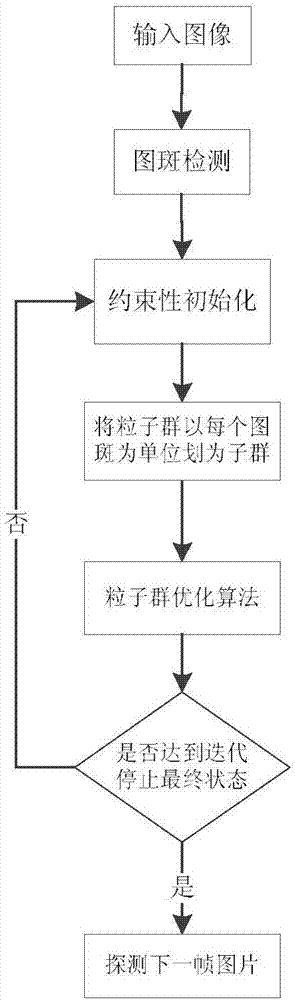
[0034] Such as figure 1 Shown is the flow chart of the video multi-moving target positioning method based on the particle swarm optimization algorithm, as follows:
[0035] Step 1), select a section of 8046-frame video sequence from the vehicle monitoring video, compress the size to 240x320 pixels, and evenly extract 40 frames of the video at the same time interval. Access each pixel of each frame by row, record the color intensity values of the three channels of each pixel, calculate the grayscale value of each pixel, and convert each frame of image into a two-dimensional matrix, The two-dimensional matrix converted from the i-th frame image is denoted as I i , i∈{1,2,…,40};
[0036] Step 2), sequentially divide each frame of image into speckle pixels and background pixels to obtain the number of speckles and their geometric features, the spe...
PUM
 Login to View More
 Abstract
Description
Claims
Application Information
 Login to View More