
Generation method and device for source independent continuous quantum random number
A technology of quantum random numbers and generation methods, applied in the field of quantum random numbers, can solve the problems of complex devices and low efficiency
- Summary
- Abstract
- Description
- Claims
- Application Information
AI Technical Summary
Problems solved by technology
Method used
Image



Examples
Embodiment Construction
[0021] In order to make the above-mentioned features and advantages of the present invention more comprehensible, the following specific embodiments are described in detail together with the accompanying drawings.
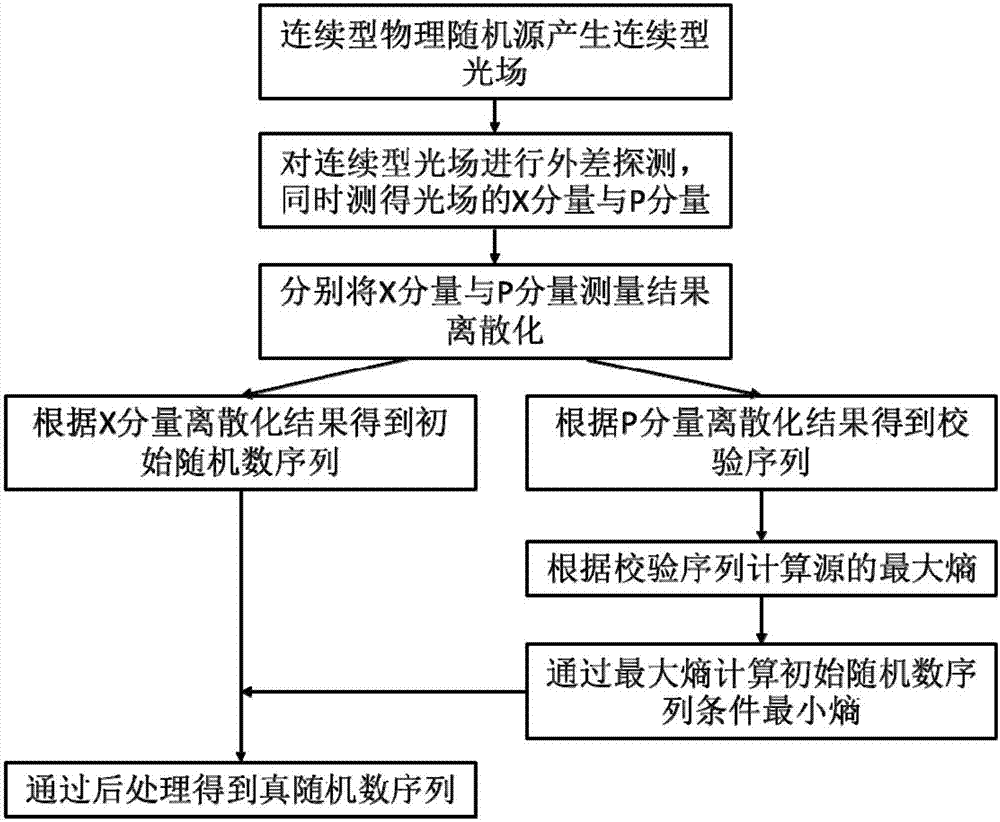
[0022] figure 1 It is a flowchart of a method for generating a source-independent continuous quantum number, and the method specifically includes the following steps:
[0023] 1) Perform heterodyne detection on the continuous physical random source, and simultaneously detect the X component and P component of the continuous physical random source. Among them, the X component and the P component represent the generalized canonical coordinates and canonical momentum of the light field, respectively. It should be noted here that the X component and the P component are equal in status. If the X component is used to generate random numbers, the P component will generate a check sequence, and vice versa. Commonly used continuous random sources are, for example, coheren...
PUM
 Login to View More
 Abstract
Description
Claims
Application Information
 Login to View More