A wireless self-backhaul resource scheduling method based on system stability

A wireless self-backhaul and system stability technology, applied in wireless communication, electrical components, etc., can solve the problems of unsuitable optimization variables, ignoring dynamic resource adjustment and user service quality, etc., to improve resource utilization and avoid resource utilization. wasteful effect

A wireless self-backhaul and system stability technology, applied in wireless communication, electrical components, etc., can solve the problems of unsuitable optimization variables, ignoring dynamic resource adjustment and user service quality, etc., to improve resource utilization and avoid resource utilization. wasteful effect

CN107682935BActive Publication Date: 2020-09-22CHONGQING UNIV OF POSTS & TELECOMM

Image

Smart Image Click on the blue labels to locate them in the text.
Viewing Examples
Smart Image
  • A wireless self-backhaul resource scheduling method based on system stability
  • A wireless self-backhaul resource scheduling method based on system stability
  • A wireless self-backhaul resource scheduling method based on system stability

Examples

Experimental program
Comparison scheme
Effect test

Embodiment Construction

[0043] The preferred embodiments of the present invention will be described in detail below with reference to the accompanying drawings.

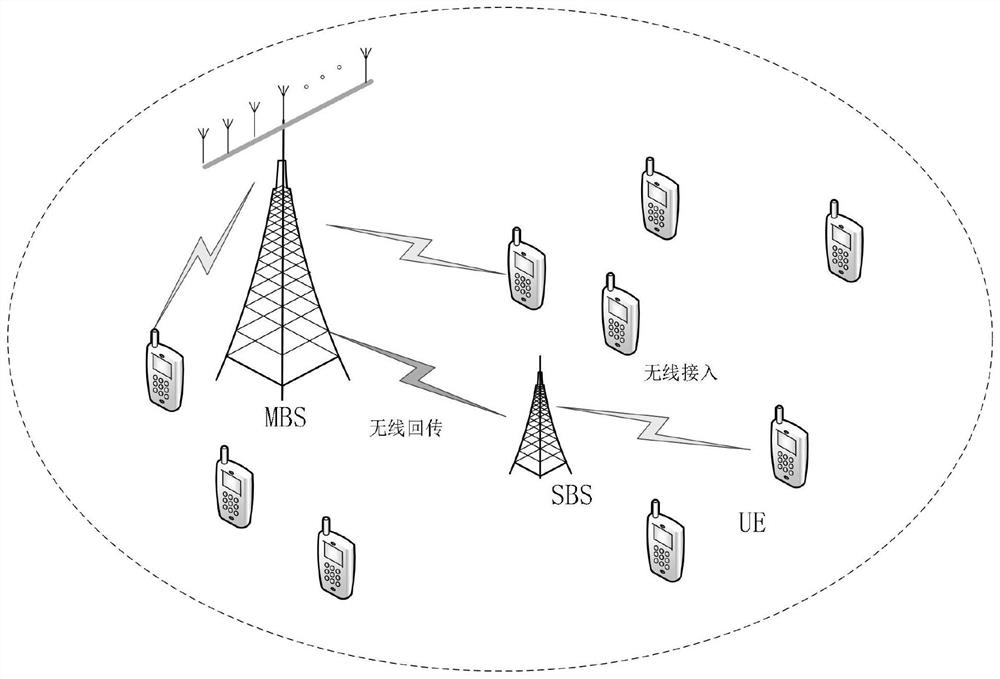
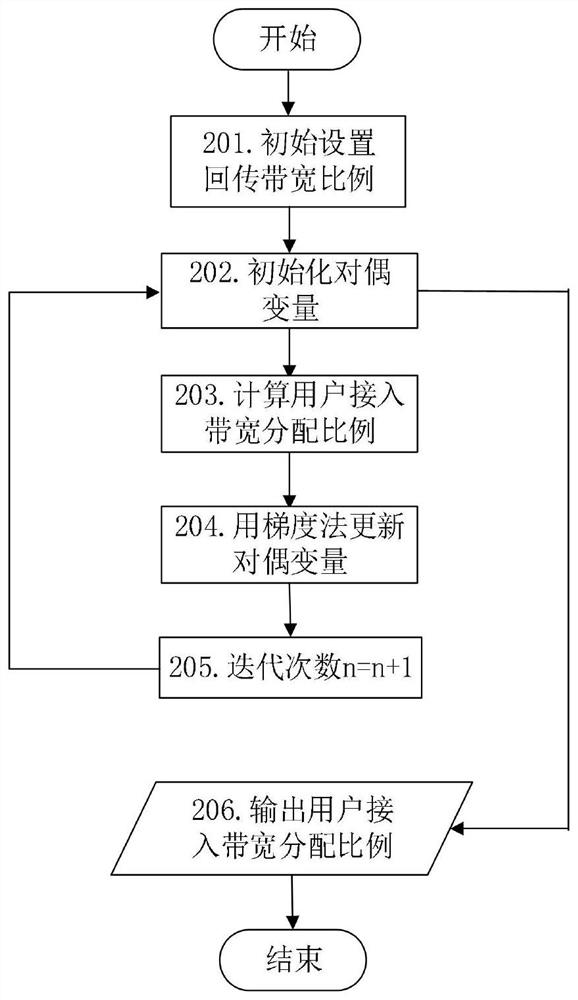
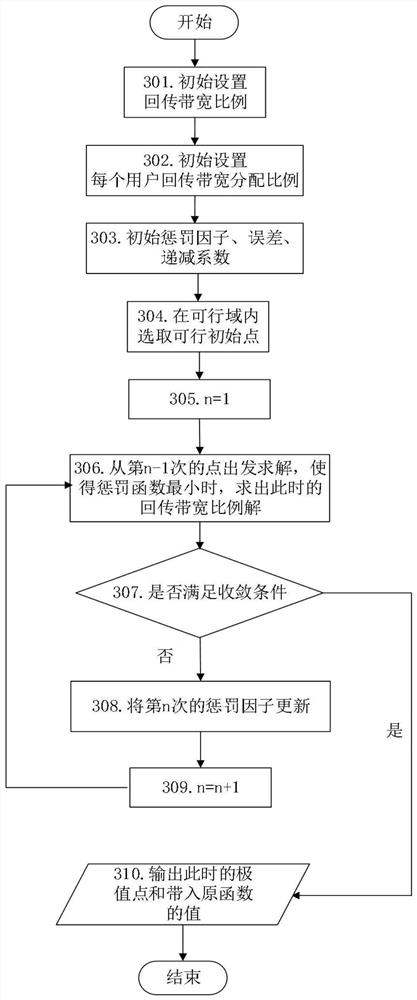
[0044] see figure 1 as shown, figure 1 A double-hop network scene diagram of a macro base station, a small base station and multiple users is described. In this embodiment, the macro cell uses a massive MIMO antenna array in order to reduce interference in the small cell. Assuming that the number of large-scale antenna arrays of the macro base station is K T, within the coverage of the macro base station, there is a small base station, and the backhaul between the small base station and the macro base station uses millimeter wave transmission. There are k users randomly distributed, and multiple users can only connect to one base station at most at any one time, and all adopt single-antenna technology. where the number of users K is much larger than the beamforming group size K g When , by allocating resources in the orthogonal frequenc...

the structure of the environmentally friendly knitted fabric provided by the present invention; figure 2 Flow chart of the yarn wrapping machine for environmentally friendly knitted fabrics and storage devices; image 3 Is the parameter map of the yarn covering machine
Login to View More

PUM

No PUM Login to View More

Abstract

The invention relates to a wireless self-backhaul resource scheduling method based on system stability, which belongs to the field of mobile communication. This method guarantees the system queue stability, wireless backhaul constraints, and the rate matching corresponding to the system achievable rate and the minimum user service quality, that is, the overflow probability satisfies certain constraints, and is carried out with the goal of maximizing the relative user quality satisfaction level. Dynamic resource scheduling. In each discrete time slot, according to the user's channel state information and the queuing conditions jointly considered by the macro base station and the small base station, the appropriate wireless resources are allocated to each user, and the queue length is dynamically adjusted according to the overflow probability in order to change the actual reachability of the system. Rate and joint dynamic adjustment of the wireless self-backhaul small base station and the backhaul and access resource allocation ratio of each user. The wireless self-backhaul resource scheduling method based on system stability proposed by the present invention can maintain system queue stability while maximizing the relative user quality satisfaction level.

Description

technical field [0001] The invention belongs to the field of mobile communication, and relates to a wireless self-backhaul resource scheduling method based on system stability. Background technique [0002] Driven by the rapid development of the mobile Internet and the growing demand for IoT services, 5G connection equipment density is required to increase by 10 to 100 times, and the spectral efficiency is increased by 5 to 10 times to ensure user experience at a speed of 500km / h. In order to meet the above requirements, the network architecture of 5G in the future will be based on ultra-dense heterogeneous networks, cloud computing technologies, etc., and Wireless Self-backhaul Networks (Wireless Self-backhaul Networks) will serve as the core of 5G ultra-dense networks (Ultra DenseNetwork, UDN). basic components. In the coverage area of ​​macro base stations, low-power small base stations are deployed to enhance coverage, and wireless millimeter waves or microwaves are use...

Claims

the structure of the environmentally friendly knitted fabric provided by the present invention; figure 2 Flow chart of the yarn wrapping machine for environmentally friendly knitted fabrics and storage devices; image 3 Is the parameter map of the yarn covering machine
Login to View More

Application Information

Patent Timeline
22 Sep 2020
Publication
CN107682935B
IPC
H04W72/12
CPC
H04W72/1263; H04W72/12; H04W72/542; H04W72/52
Inventors
陈前斌; 刘云龙