Check patentability & draft patents in minutes with Patsnap Eureka AI!

Technique for eliminating influence of spatial position error on remote sensing soft classification accuracy evaluation based on probabilistic position model

A technology of spatial location and classification accuracy, applied in image analysis, character and pattern recognition, image data processing, etc., can solve the problem of low weight, achieve good elimination effect, eliminate uncertainty, and improve practicability

Active Publication Date: 2018-03-23
CHANGZHOU UNIV
View PDF3 Cites 4 Cited by
  • Summary
  • Abstract
  • Description
  • Claims
  • Application Information

AI Technical Summary

Problems solved by technology

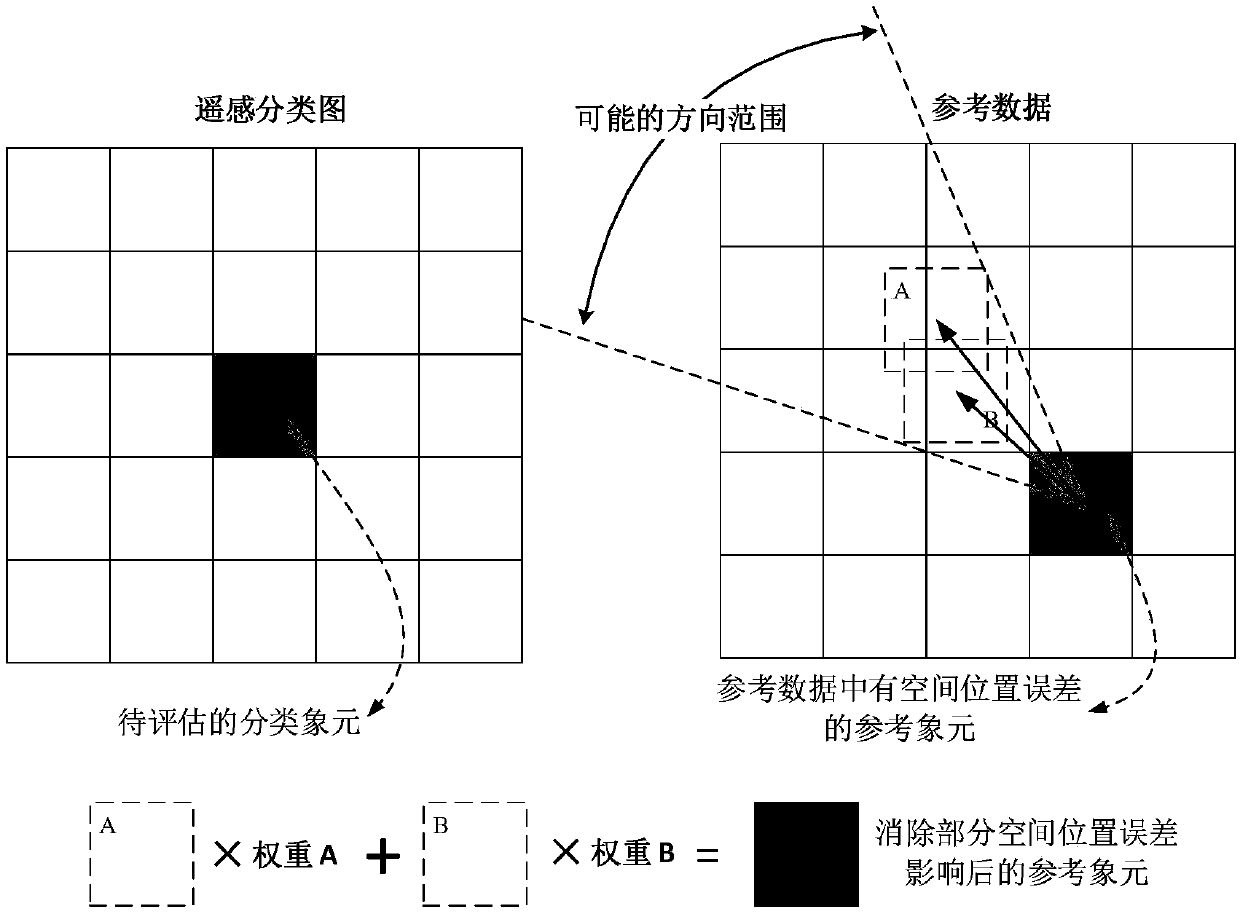
The defects of this model are: (1) the exponential function is used as the distance attenuation function, and the weight is too low when the spatial position error is greater than 1 pixel; (2) the spatial position error is not random, and has directionality in spatial distribution. This is not reflected in the distance decay function

Method used

the structure of the environmentally friendly knitted fabric provided by the present invention; figure 2 Flow chart of the yarn wrapping machine for environmentally friendly knitted fabrics and storage devices; image 3 Is the parameter map of the yarn covering machine
View more

Image

Smart Image Click on the blue labels to locate them in the text.
Viewing Examples
Smart Image
  • Technique for eliminating influence of spatial position error on remote sensing soft classification accuracy evaluation based on probabilistic position model
  • Technique for eliminating influence of spatial position error on remote sensing soft classification accuracy evaluation based on probabilistic position model
  • Technique for eliminating influence of spatial position error on remote sensing soft classification accuracy evaluation based on probabilistic position model

Examples

Experimental program
Comparison scheme
Effect test

Embodiment 1

[0054] A technology based on a probabilistic position model to eliminate the influence of spatial position errors on the evaluation of remote sensing soft classification accuracy, comprising the following steps:

[0055] Step 1): Geometric registration of remote sensing images: Correct a pair of remote sensing images (assuming the total number of pixels is N) using the geometric fine correction algorithm to obtain the corrected root mean square error RMSE and the average direction of error offset during the geometric registration process .

[0056] Step 2): Soft classification of remote sensing images: use a soft classification algorithm (linear decomposition algorithm or SVM soft classification method) for remote sensing images after geometric registration to obtain remote sensing soft classification images, and set the type vector at (x, y) on the image is υ(x,y);

[0057] Step 3): Select a reference image for soft classification accuracy evaluation: select a reference imag...

the structure of the environmentally friendly knitted fabric provided by the present invention; figure 2 Flow chart of the yarn wrapping machine for environmentally friendly knitted fabrics and storage devices; image 3 Is the parameter map of the yarn covering machine
Login to View More

PUM

No PUM Login to View More

Abstract

The invention belongs to the remote sensing uncertainty field and relates to a technique for eliminating the influence of spatial position error on remote sensing soft classification accuracy evaluation based on a probabilistic position model. The technique comprises the following steps of: step 1), remote sensing image geometric registration; step 2), remote sensing image soft classification; step 3), reference image soft classification accuracy evaluation selection; and step 4), spatial position error influence elimination. The best fuzzy location model that eliminates the influence of spatial position error at present can eliminate 13% of kappa-error maximally, however, the probabilistic position model adopted by the technique of the present invention can eliminate 16.5% to 35.2% of kappa-error for images with different spatial resolutions and landscape features, which proves that the probabilistic location model of the technique of the present invention is superior to the fuzzy location model.

Description

technical field [0001] The invention belongs to the field of remote sensing uncertainty, in particular to the influence of space positioning (GPS) error and geometric registration error on remote sensing image soft classification and analysis based on soft classification and a method for eliminating the negative influence. Background technique [0002] Aiming at the transmission and influence of spatial position error in remote sensing analysis, there are currently three methods to eliminate the impact of spatial position error. [0003] (1) Coarse evaluation unit. The main idea of ​​this method is to convert from pixel as evaluation unit to block or polygon as evaluation unit for accuracy evaluation. However, the effect of this method is not obvious in the actual use process. For example. Stehman believes that although blocks and polygons can eliminate the impact of spatial position errors to a certain extent, the impact on the overall accuracy (OA) and kappa coefficient...

Claims

the structure of the environmentally friendly knitted fabric provided by the present invention; figure 2 Flow chart of the yarn wrapping machine for environmentally friendly knitted fabrics and storage devices; image 3 Is the parameter map of the yarn covering machine
Login to View More

Application Information

Patent Timeline
no application Login to View More
IPC IPC(8): G06K9/62G06T7/30
CPCG06T7/30G06T2207/10032G06F18/217G06F18/241
Inventor 顾建宇谭园园卢佩昀徐沁岩
Owner CHANGZHOU UNIV
Features
  • R&D
  • Intellectual Property
  • Life Sciences
  • Materials
  • Tech Scout
Why Patsnap Eureka
  • Unparalleled Data Quality
  • Higher Quality Content
  • 60% Fewer Hallucinations
Social media
Patsnap Eureka Blog
Learn More