
Dynamic mutual inductance detecting method for mobile wireless power transmission system
A technology of wireless energy transmission and detection method, which is applied in the direction of inductance measurement, measurement device, and measurement of electrical variables, etc. It can solve problems that affect system efficiency and power transmission capability, high-frequency AC measurement error, and inaccurate mutual inductance detection, etc., to achieve Easy implementation, constant output voltage and high precision
- Summary
- Abstract
- Description
- Claims
- Application Information
AI Technical Summary
Problems solved by technology
Method used
Image

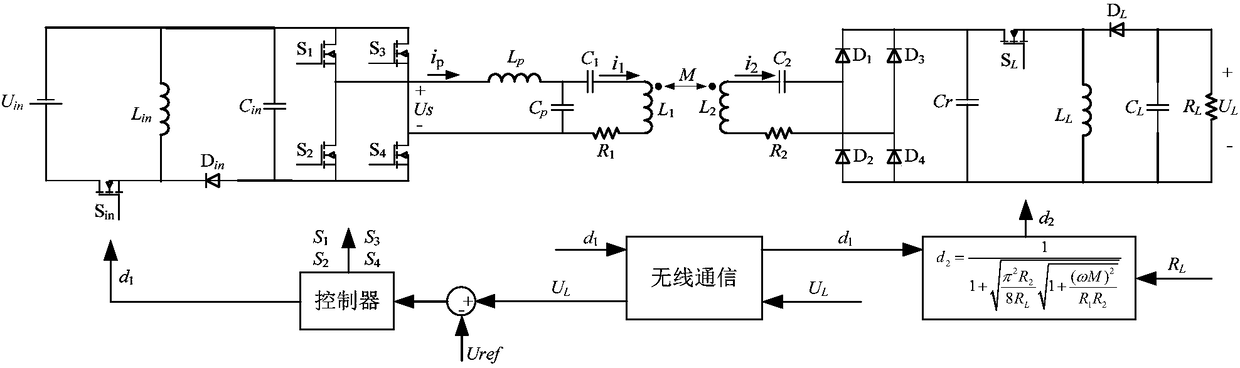
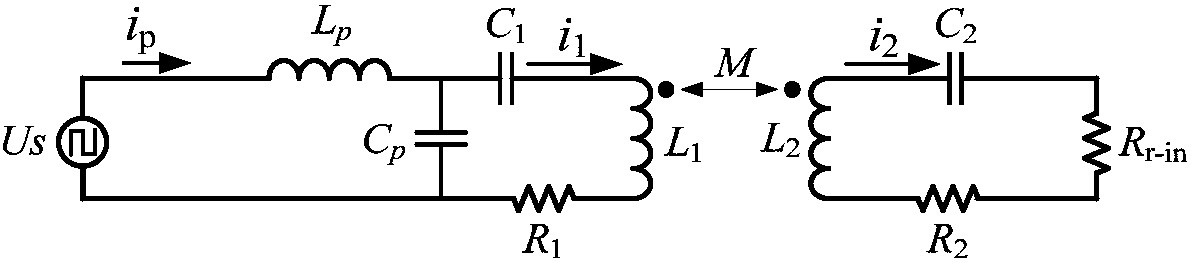
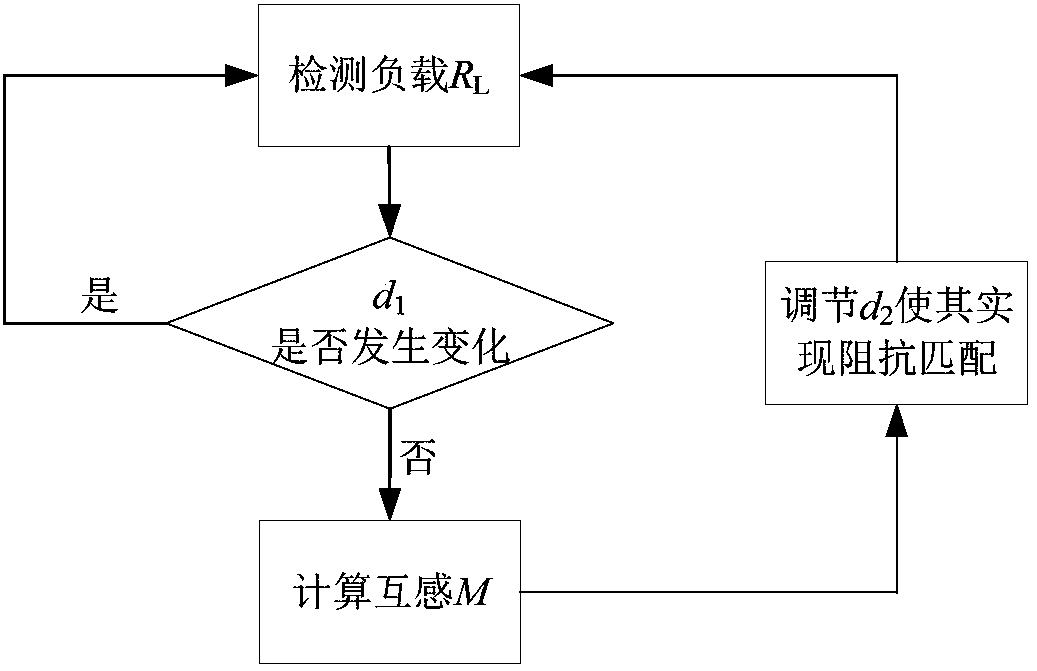
Examples
Embodiment
[0039] Set a set of basic parameters of the mobile wireless power transfer system as shown in Table 1.
[0040] Table 1
[0041]
[0042]
[0043] In the mobile wireless power transfer system, a control strategy with constant output voltage and optimal efficiency is adopted. There are two control variables under this control strategy: the duty cycle d of BUCK-BOOST on the input side 1 and the duty cycle d of BUCK-BOOST on the output side 2 , when M=15μH, R L =10Ω, U ref =45V, for the basic parameters in Table 1, it can be obtained that under this control strategy, the two control variables at steady state are: duty cycle d 1 is 0.346, d 2 is 0.5012.
[0044] Suppose at this time due to the operation of the electric vehicle, the load R L And the mutual inductance M has changed, after the change M=25μH, R L =20Ω, U ref = 45V. Since the new mutual inductance value is unknown, impedance matching cannot be achieved, and system efficiency decreases. Mutual inductanc...
PUM
 Login to View More
 Abstract
Description
Claims
Application Information
 Login to View More