Single-axis two-way loading and split Hopkinson pressure bar and pull bar device and experimental method

A Hopkinson pressure bar, uniaxial bidirectional technology, applied in the direction of measuring devices, analytical materials, instruments, etc., to achieve the effect of symmetrical loading

CN108344648AActive Publication Date: 2018-07-31NORTHWESTERN POLYTECHNICAL UNIV
13 Cites 19 Cited by

Patent Information

Authority / Receiving Office
CN · China
Patent Type
Applications(China)
Current Assignee / Owner
Publication Date
2018-07-31

Smart Images

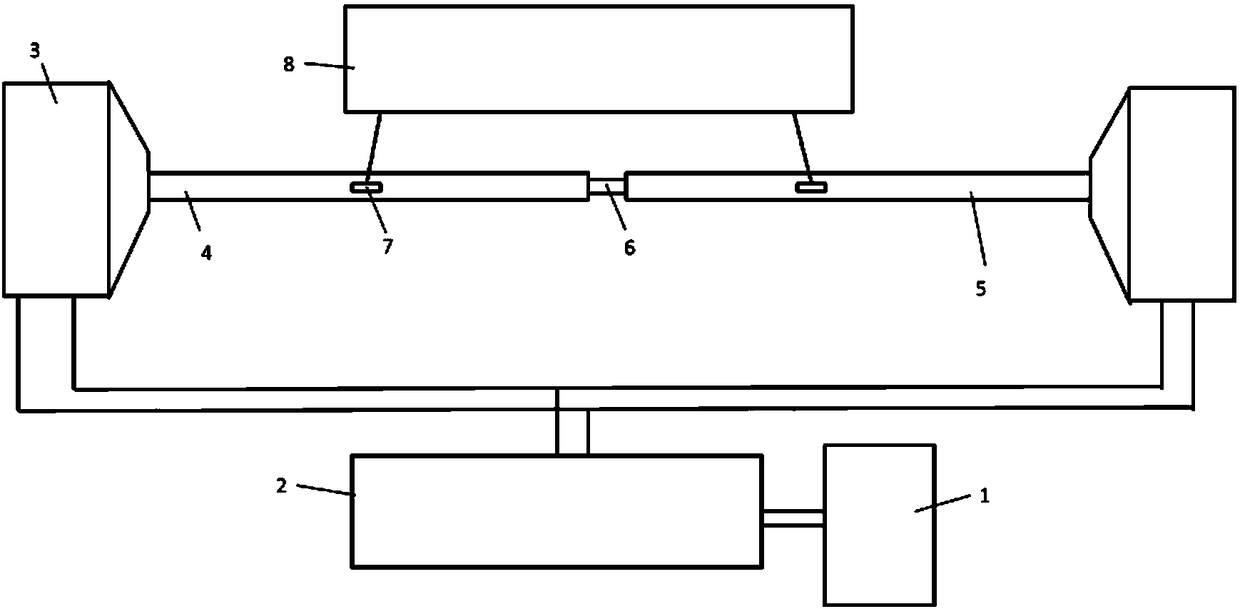
  • Figure 1
    Figure 1
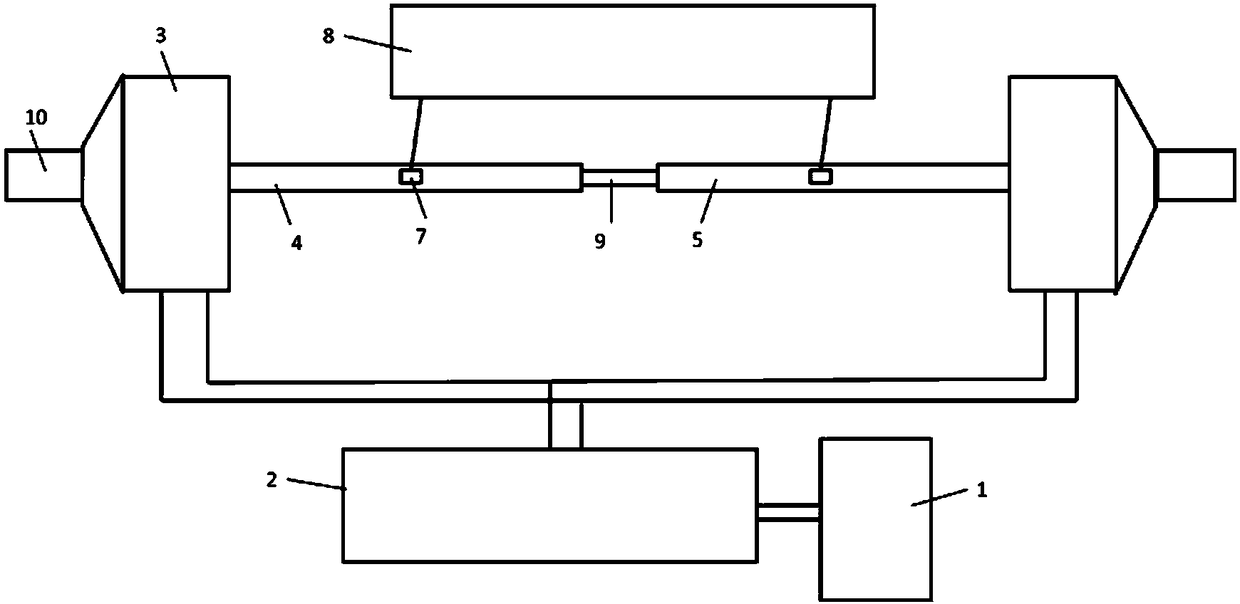
  • Figure 2
    Figure 2
  • Figure 3
    Figure 3
Patent Text Reader

Abstract

The invention relates to an experimental method of dynamic mechanics performance testing of materials, in particular to a single-axis two-way loading and split Hopkinson pressure bar and pull bar device and an experimental method. The device comprises a loading device and two incident bars, the loading device comprises a power source, a capacitor charger and loading guns, a power supply part of existing electromagnetic riveting equipment is adopted for the capacitor charger, and the loading guns with the same parameters are connected into the capacitor charger after being in parallel connection. By means of the single-axis two-way loading and split Hopkinson pressure bar and pull bar device and the experimental method, incident waves at the two sides simultaneously and symmetrically load aspecimen dynamically, symmetric loading of the specimen is achieved to shorten the balancing time of stress inside the specimen, the strain rate of the specimen is increased, and thus the defects ofexisting equipment of being low in strain rate and inaccurate in testing of elastic sections are overcome.
Need to check novelty before this filing date? Find Prior Art

Description

technical field

[0001] The invention relates to an experimental method for testing the dynamic mechanical properties of materials, in particular to a uniaxial bidirectional loading separated Hopkinson pressure bar and pull bar device and an experimental method. Background technique

[0002] Currently, the split Hopkinson rod technique is most widely used in the field of materials science to measure the tensile mechanical properties of materials at high strain rates. The basic principle of this method is: place a short sample between two pull rods, and carry out tensile loading on the sample through the accelerated mass block, the short rod impact or the acceleration pulse generated by the explosion. Simultaneously, the pulse signal is recorded by means of the strain gauge glued on the tie rod at a certain distance from the end of the rod. If the tie rod remains elastic, the stress pulse in the rod will propagate at elastic wave speed without distortion. In this way, the st...

Examples

Embodiment 1

[0061] This embodiment is a uniaxial bidirectional loading separated Hopkinson compression rod and tension rod device and experimental method.

[0062] The device of the present invention includes a loading device and two incident rods, which are respectively the incident rod a (first incident rod) 4 and the incident rod b (second incident rod) 5 .

[0063] The loading device adopts the loading device proposed in the Chinese invention patent No. ZL 201510956545.4, including a power supply 1 , a capacitor charger 2 and a loading gun 3 . The capacitor charger 2 adopts the power supply part of the existing electromagnetic riveting equipment. After connecting two loading guns 3 with identical parameters in parallel, they are connected to the capacitor charger 2 . The power supply 1 adopts 220V three-phase alternating current.

[0064]In this embodiment, the capacitor charger 2 adopts the power supply part of the electromagnetic riveting equipment published in the Chinese patent ...