
Planting method for reducing diseases and insect pests and improving yield of pumpkins
A planting method and technology of pests and diseases, applied in botany equipment and methods, fertilization methods, planting substrates, etc., can solve the problems of soil nutrient ratio imbalance, unreasonable fertilization ratio, and decreased fertilizer utilization rate, and achieve long-lasting, The effect of improving the quality of pumpkin and high utilization rate
- Summary
- Abstract
- Description
- Claims
- Application Information
AI Technical Summary
Problems solved by technology
Method used
Image

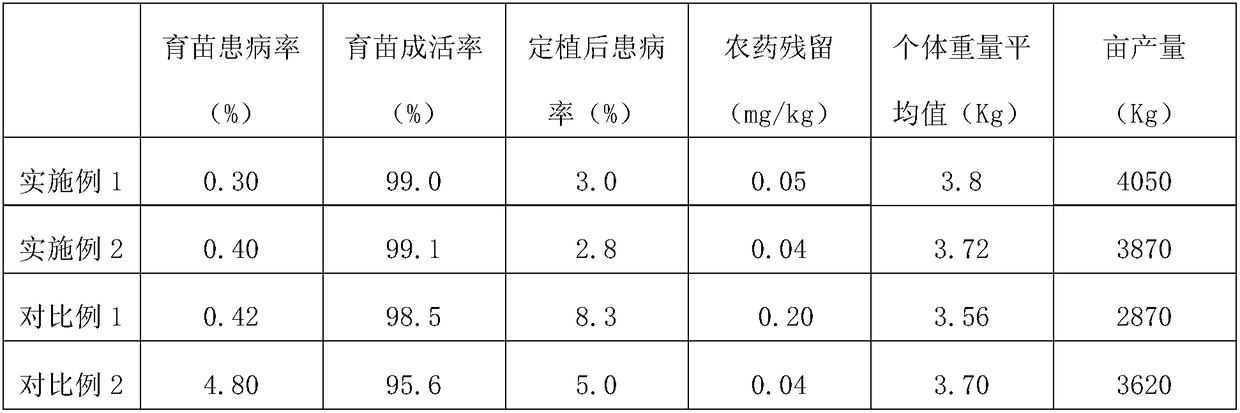
Examples
Embodiment 1
[0039] A planting method for reducing damage by diseases and insect pests and increasing the yield of pumpkins, comprising the following steps:
[0040] S1. Site selection and preparation
[0041]Choose clay loam soil with sufficient light, fertile soil, good drainage, and a pH value of 5.8-6.8 as the planting site; plow 35-40 cm, remove weeds and gravel in the planting site, expose to the sun for 4-5 days, and then plow again for 25-40 cm. 30cm, combined with plowing, apply 70kg of base fertilizer per mu. The base fertilizer includes the following raw materials in parts by weight: 35 parts of pond mud, 25 parts of straw, 32 parts of animal manure, 18 parts of shell powder, 25 parts of oil meal, 6 parts of vinegar residue, 0.04 part of compost starter, 8 parts of ferrous sulfate, 8 parts of magnesium sulfate, 0.8 parts of copper sulfate, 8 parts of superphosphate, and 10 parts of ammonium dihydrogen phosphate.
[0042] S2. Seed selection and germination
[0043] Choose pump...
Embodiment 2
[0058] A planting method for reducing pests and diseases and improving pumpkin yield, comprising the following steps;
[0059] S1. Site selection and preparation
[0060] Choose clay loam soil with sufficient sunlight, fertile soil, good drainage, and a pH value of 5.8-6.8 as the planting site; plow 35-40 cm, remove weeds and gravel in the planting site, expose to the sun for 5 days, and then plow 25-30 cm again. Combined with plowing, apply 60-80kg of base fertilizer per mu. The base fertilizer includes the following raw materials in parts by weight: 40 parts of pond mud, 30 parts of straw, 35 parts of animal manure, 15 parts of shell powder, 20 parts of oil meal, 8 parts of vinegar residue, 0.05 part of compost starter, 5 parts of ferrous sulfate, 10 parts of magnesium sulfate, 0.5 parts of copper sulfate, 5 parts of superphosphate, and 10 parts of ammonium dihydrogen phosphate.
[0061] S2. Seed selection and germination
[0062] Choose pumpkin varieties with good cold r...
PUM
 Login to View More
 Abstract
Description
Claims
Application Information
 Login to View More