PTC (positive temperature coefficient) heating device
A heating device and heater technology, which is applied to heating elements, ohmic resistance heating parts, etc., can solve the problems of damage to safety and reliability of stamping, poor contact between power lines and electrode sheets, and loose crimping, etc. The effect of improving the performance, improving the crimping effect, and ensuring the safety
- Summary
- Abstract
- Description
- Claims
- Application Information
AI Technical Summary
Problems solved by technology
Method used
Image



Examples
Embodiment 1
[0046] A PTC heating device, comprising at least one heat dissipation strip 1 and a PTC heat-sensitive material heating element attached to the heat conduction sheet of the heat dissipation strip 1 as a group, the heat conduction sheet of the heat dissipation strip and the heating of the heat generation sheet There is a temperature-resistant silica gel 2 between the surfaces, and the heater is clamped in a special tooling to completely cure the silica gel. After the tooling is removed, the heat dissipation strip 1 and the heating element of the PTC heat-sensitive material are closely and firmly attached. An integrated PTC heating device, the clamping force of the tooling is 4-10Kg, and the heating sheets are not less than 4 pieces.
Embodiment 2
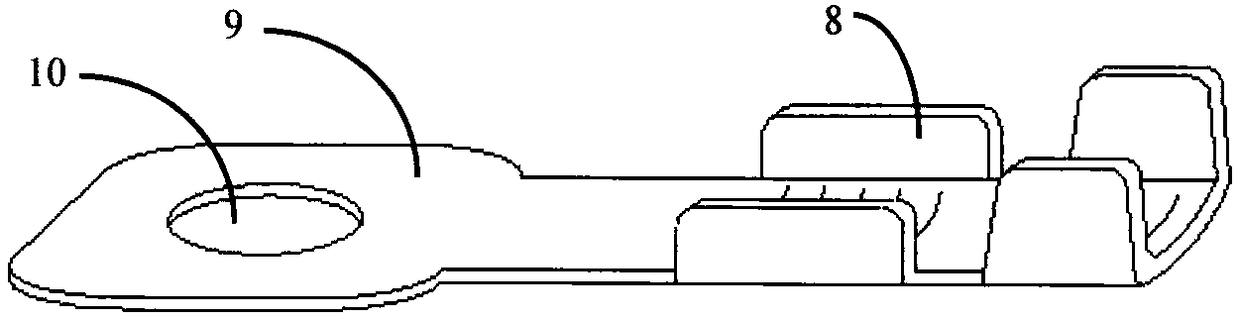
[0048] The heat conduction sheet of the heat dissipation strip 1 is the power input end, there is an extension surface 3 at the introduction end, the angle between the extension surface 3 and the introduction end is 45°, and the end of the introduction end is a connection surface 4, so The end of the connecting surface 4 is a crimping portion 5, and the crimping portion 5 has a through hole 6, the thickness of the crimping portion 5 is 0.25-1.5 mm, and the diameter of the through hole 6 is 1.5 mm. -6.0mm.
[0049] The crimping portion acts as a butt flat piece for riveting the power leads. Generally, the thickness of the lead-out surface is 0.2-0.4mm, the strength is low, and it is easy to deform. The function of the existing through hole is to rivet the insertion piece, and the insertion spring is connected to the insertion piece, and the aperture is also less than 2mm.
[0050] The connection surface 4 and the extension surface 3 are integrated, and the connection surface 4...
Embodiment 3
[0063] The heat conduction sheet of the heat dissipation bar 1 is the power input end, there is an extension surface 3 at the introduction end, the angle between the extension surface 3 and the introduction end is 90°, and the end of the introduction end is a connecting surface 4, so The end of the connecting surface 4 is a crimping portion 5, and the crimping portion 5 has a through hole 6, the thickness of the crimping portion 5 is 0.25-1.5 mm, and the diameter of the through hole 6 is 1.5 mm. -6.0mm.
[0064] The crimping portion acts as a butt flat piece for riveting the power leads. Generally, the thickness of the lead-out surface is 0.2-0.4mm, the strength is low, and it is easy to deform. The function of the existing through hole is to rivet the insertion piece, and the insertion spring is connected to the insertion piece, and the aperture is also less than 2mm.
[0065] The connection surface 4 is vertical and integrated with the extension surface 3 , the connection s...
PUM
 Login to View More
 Abstract
Description
Claims
Application Information
 Login to View More