A cosmetic bottle with its own pressure

A self-contained pressure cosmetic bottle technology, applied in the packaging of cosmetics, cosmetic powder containers, toiletry containers, etc., can solve the problems that the cosmetic bottle cannot be fully used, is not connected to the outside world, and the working efficiency of the pressure pump is low

CN109717598BActive Publication Date: 2021-09-21佛山市上富塑料制品有限公司
9 Cites 0 Cited by

Patent Information

Authority / Receiving Office
CN · China
Patent Type
Patents(China)
Current Assignee / Owner
Publication Date
2021-09-21

Smart Images

  • Figure 1
    Figure 1
  • Figure 2
    Figure 2
Patent Text Reader

Abstract

The invention discloses a self-contained pressure cosmetic bottle, which mainly relates to the field of cosmetics. It is applied to the storage of liquid cosmetics and solves the problem in the prior art that cosmetics are easy to oxidize after opening the bottle. The technical points are as follows: the bottle body, Bottle cap and spray mechanism; the bottle cap is fixed on the bottle body through threaded connection; the spray mechanism is fixed inside the bottle cap through a spring; the bottle cap is divided into an inner bottle cap and an outer bottle cap; the inner bottle cap It is threadedly connected with the outer bottle cap; the inner bottle cap is provided with a pressure chamber; the spray mechanism is provided with a pressing head and a spray head; the pressing head is provided with a pressure channel; the lower end of the spray head is provided with a small single Directional valve; the present invention provides pressure for liquid extrusion by setting a pressure chamber instead of a pressure pump, so that the cosmetics in the cosmetic bottle can be completely pressed out; the present invention also isolates the outside world from the cosmetic bottle in the bottle through a small one-way valve, so that Cosmetics will not be oxidized.
Need to check novelty before this filing date? Find Prior Art

Description

technical field

[0001] The invention relates to the field of cosmetics, in particular to a cosmetic bottle with its own pressure. Background technique

[0002] With the improvement of living standards, cosmetics have increasingly become an indispensable part of life, especially for women. Various cosmetics are piled up on the dressing table, among which bottled cosmetics are mostly used, and lotions, essences, perfumes, etc. are all used Cosmetic bottle storage.

[0003] The traditional cosmetic bottle adopts the pressure pump structure. By pressing the nozzle of the pressure pump to drive the piston rod of the pressure pump, the material in the bottle is squeezed out and discharged from the nozzle. This makes the liquid in the liquid storage chamber in the pressure pump finally separated from the outside. In contact with air, this part of cosmetics will be oxidized by oxygen in the air, thus losing its due effect. For this reason, preservatives must be added to the cosmeti...

Examples

Embodiment 1

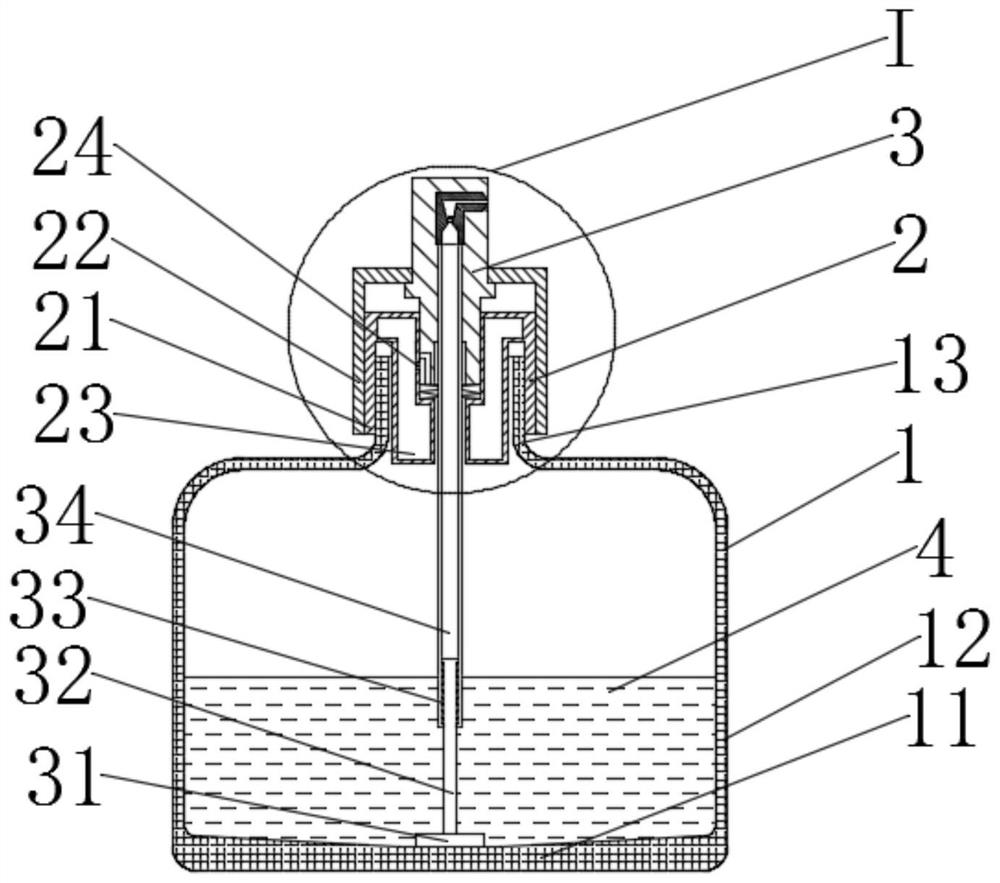
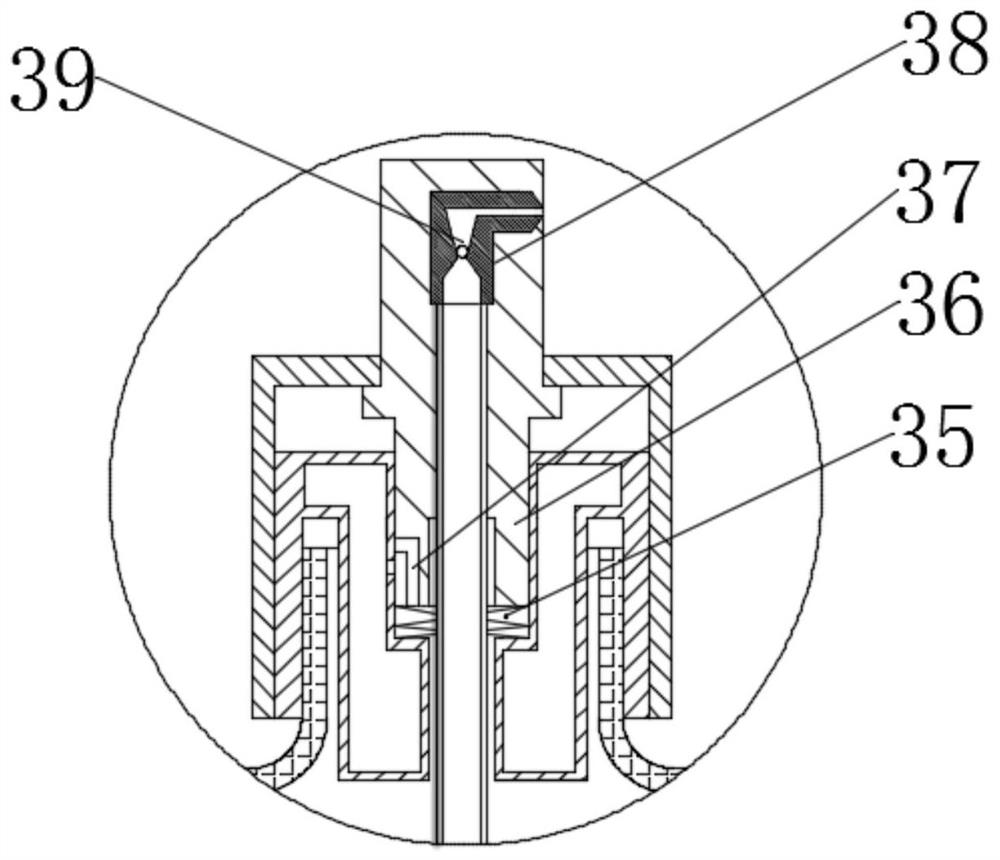
[0023] see Figure 1-2 , a cosmetic bottle with its own pressure, comprising a bottle body 1, a bottle cap 2 and a spray mechanism 3; the bottle cap 2 is fixed on the bottle body 1 through threaded connection; the spray mechanism 3 is fixed on the bottle cap 2 by a spring internal;

[0024] The bottle body 1 includes a bottle bottom 11, a bottle body 12 and a bottleneck 13; the bottle body 1 is made of glass; the bottle bottom 1 and the bottle body 2 enclose a cosmetic storage cavity; the upper end of the bottle bottom 11 is provided with There is a groove; the groove is tapered to prevent residual cosmetics in the bottle; the bottle mouth 13 is provided with threads for installing the bottle cap 2;

[0025] The bottle cap 2 is divided into an inner bottle cap 21 and an outer bottle cap 22; the inner bottle cap 21 is provided with a pressure chamber 23; the pressure chamber 23 is filled with high-pressure nitrogen; the inside of the pressure chamber 23 is provided with a pres...

Embodiment 2

[0032] A bottled cosmetic, comprising the cosmetic bottle with self-pressure described in embodiment 1.