
Method for increasing heat source by semi-steel
A heat source and semi-steel production technology, which is applied in the field of iron and steel smelting, can solve the problems of poor carburization effect and high cost, and achieve good utilization rate, guaranteed utilization rate and cheap price
- Summary
- Abstract
- Description
- Claims
- Application Information
AI Technical Summary
Problems solved by technology
Method used
Image

Examples
Embodiment 1
[0026] In a steel factory, 120 tons of vanadium extracting converter produced semi-steel, semi-steel molten iron was packed with 140t molten iron, and 240kg of the above-mentioned temperature-raising mixture was injected. The composition of semi-steel before and after is compared as shown in Table 1:
[0027] Table 1 Comparison of semi-steel composition and temperature before and after
[0028] semi-steel C / % Si / % Al / % Mn / % temperature / ℃ Before carburization 3.0 0.02 0.03 0.02 1330 After carbonization 3.06 0.07 0.07 0.02 1323
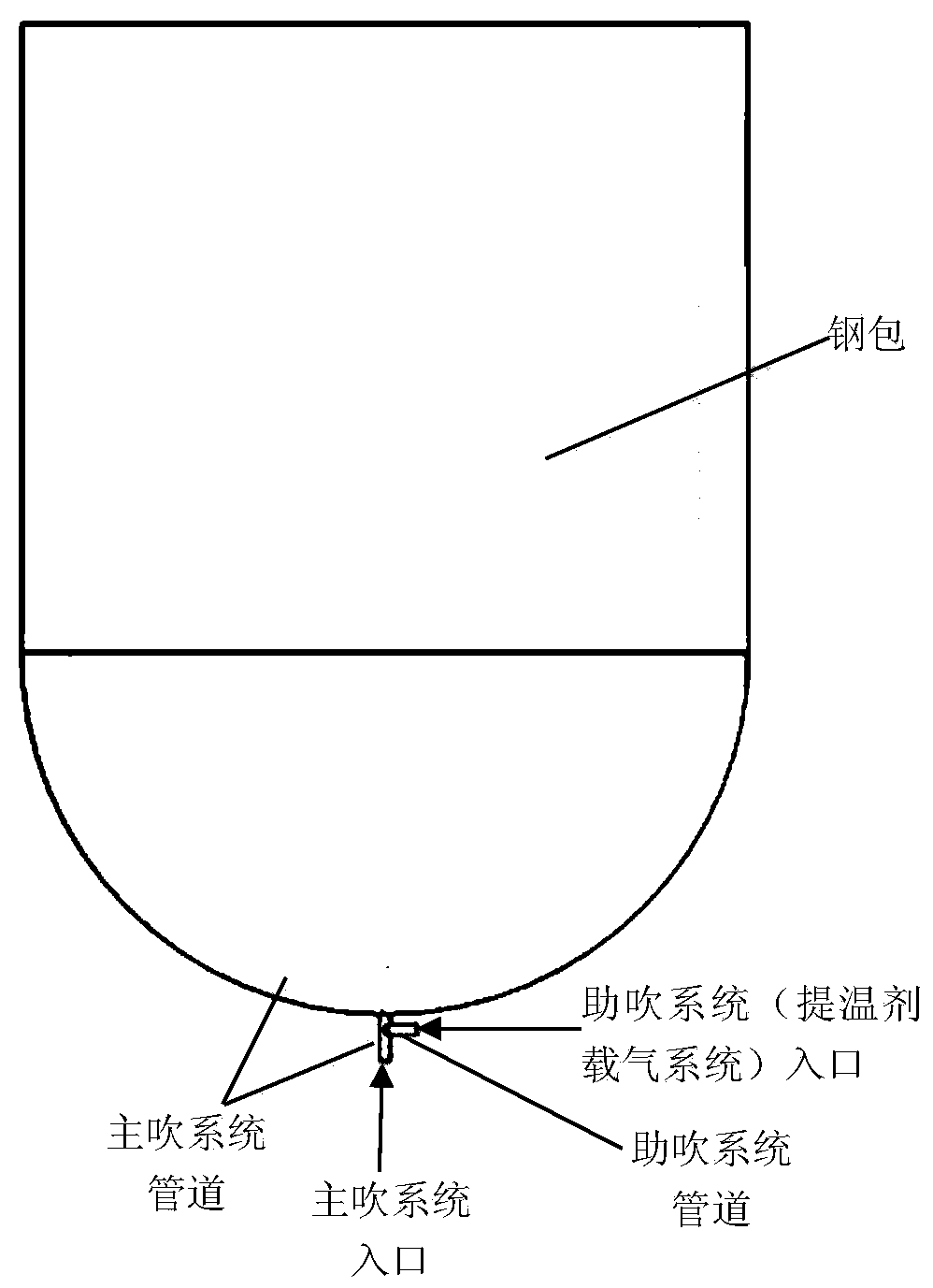
[0029] During the semi-steel process of the vanadium extraction converter, the gas injection pressure of the auxiliary blowing system is 0.3Mpa, and the mixed material can enter the main pipeline smoothly. The injection pressure of the main blowing system is 0.55Mpa, and the injection speed is 50kg / min. The C content is 3.0% before spraying the mixed material. After only injecting 200kg of the mixed material, th...
Embodiment 2
[0031] In a steel plant, semi-steel was produced from a 120-ton vanadium-extracting converter. The semi-steel molten iron was packaged with 140 tons of molten iron, and 240kg of the above-mentioned temperature-raising mixture was injected. The composition of the semi-steel before and after is compared as shown in Table 2:
[0032] Table 2 Comparison of semi-steel composition and temperature before and after
[0033] semi-steel C / % Si / % Al / % Mn / % temperature / ℃ Before carburization 3.02 0.02 0.01 0.02 1328 After carbonization 3.09 0.10 0.07 0.02 1325
[0034] During the semi-steel process of the vanadium extraction converter, the gas injection pressure of the auxiliary blowing system is 0.35Mpa, and the mixed material can enter the main pipeline smoothly. The injection pressure of the main blowing system is 0.57Mpa, and the injection speed is 55kg / min. The C content was 3.02% before the mixed material was injected, and only 300kg of the ...
Embodiment 3
[0036] In a steel factory, 120 tons of vanadium-extracting converter produced semi-steel. The semi-steel molten iron was packaged with 140t of molten iron, and 210kg of the above-mentioned temperature-raising mixture was injected. The composition of the semi-steel before and after is compared as shown in Table 3:
[0037] Table 3 Comparison of semi-steel composition and temperature before and after
[0038] semi-steel C / % Si / % Al / % Mn / % temperature / ℃ Before carburization 3.05 0.012 0.01 0.02 1330 After carbonization 3.11 0.064 0.06 0.02 1325
[0039] During the semi-steel process of the vanadium extraction converter, the gas injection pressure of the auxiliary blowing system is 0.31Mpa, and the mixed material can enter the main pipeline smoothly. The injection pressure of the main blowing system is 0.52Mpa, and the injection speed is 50kg / min. The C content is 3.05% before the mixed material is injected, and only 250kg of the mixed mat...
PUM
| Property | Measurement | Unit |
|---|---|---|
| particle size | aaaaa | aaaaa |
Abstract
Description
Claims
Application Information
 Login to View More