
Lead electrolyte purification process
A purification process and lead electrolyte technology, applied in the field of lead electrolytic refining, to achieve good purification effect and high purification efficiency
Patent Information
- Authority / Receiving Office
- CN · China
- Current Assignee / Owner
- Publication Date
- 2020-08-11
- Estimated Expiration
- Not applicable · inactive patent
Smart Images
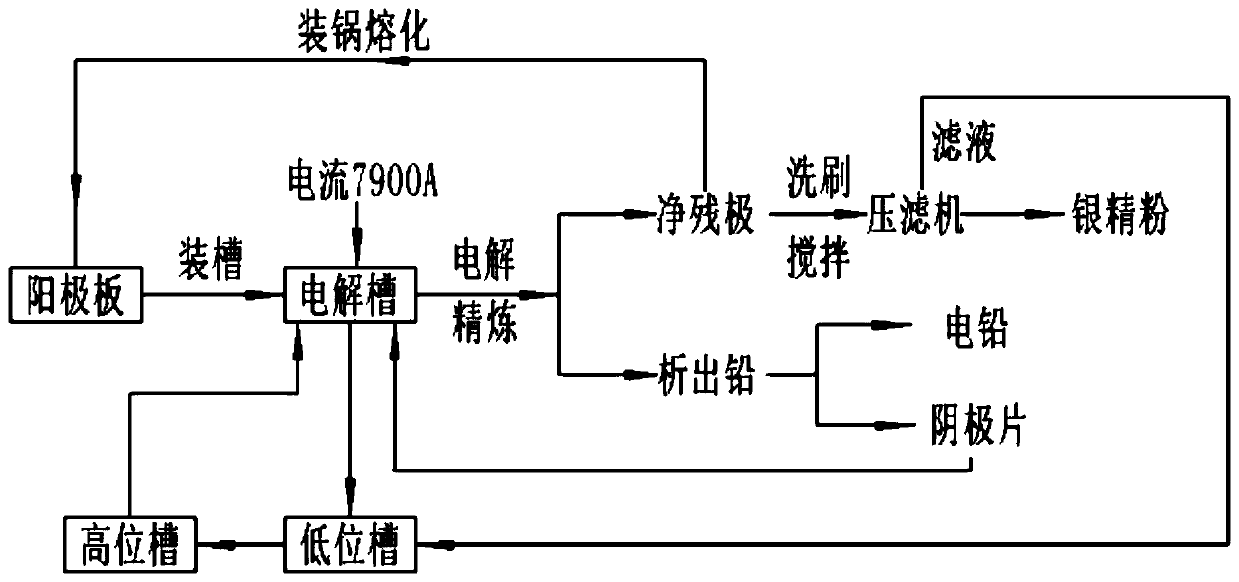
Figure 1 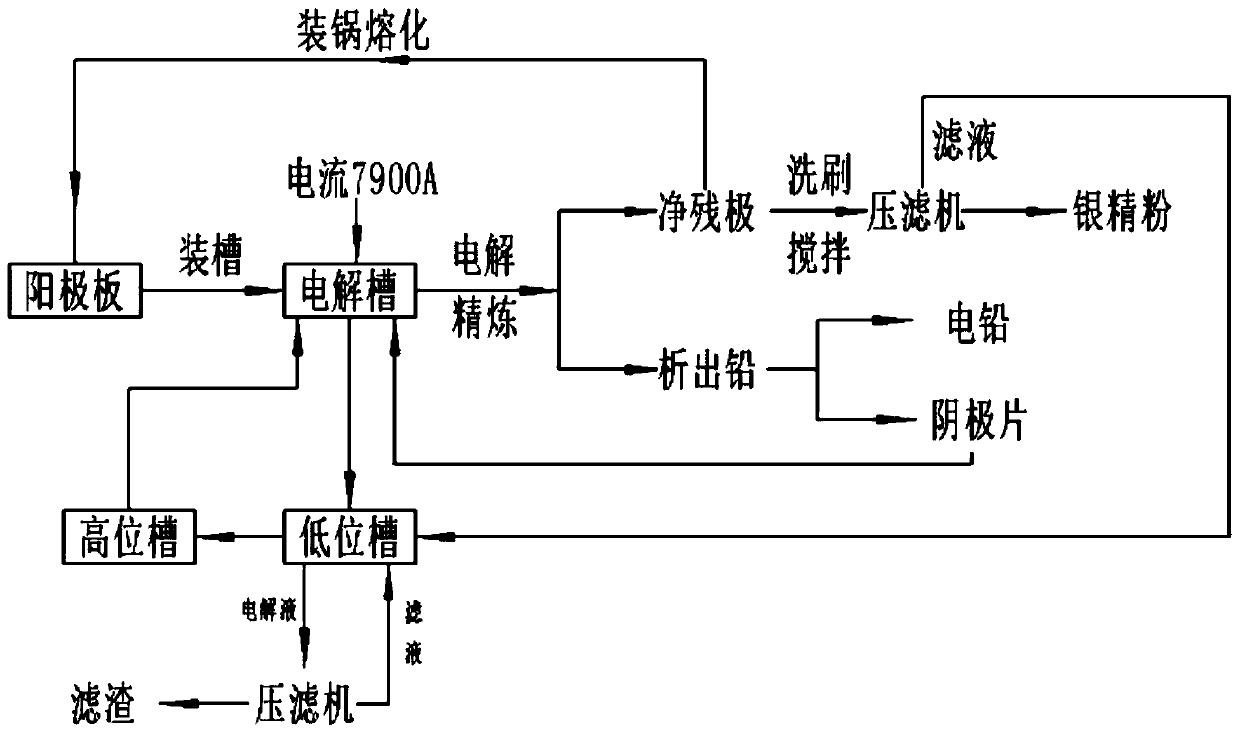
Figure 2 
Figure 3
Abstract
Description
technical field
[0001] The embodiments of the present invention relate to the technical field of lead electrolytic refining, and in particular to a process for purifying lead electrolyte. Background technique
[0002] Lead electrolytic refining is generally a process in which crude lead or semi-refined lead that has been primarily refined by fire method is electrolyzed in an aqueous solution of fluorosilicic acid and lead fluorosilicic acid, the purpose of which is to obtain high-grade lead. During lead electrolytic refining, the anode is cast from crude lead after removing copper and tin, and the cathode lead melted by electrolysis is used as the cathode, and the electrolyte is an aqueous solution of lead fluorosilicic acid and fluorosilicic acid. During electrolysis, put the cathode and anode plates into the electrolytic cell containing the electrolyte according to a certain distance between electrodes, connect the direct current, lead dissolves from the anode into the ele...
Examples
Embodiment 1
[0029] After testing, the concentration of impurity metal ions in the electrolyte to be purified: Cu=1.42mg / L, As=875mg / L, Sb=645mg / L, Bi=25mg / L, Ag=2.1g / t.
[0030] The above electrolytic solution is subjected to the following purification process: use a filter press equipped with a 600-mesh anti-fluosilicate filter cloth to filter and remove impurities. The filter area of the filter press is 20m 2 , the number of matching plates is 19 pieces, the pressing pressure is 19Mpa, the back pressure is 30Mpa, and the filtration pressure is 8kg / cm 2 . The auxiliary equipment includes: three-phase motor, hydraulic station, YDS low-speed motor. In addition, a new circulating pump used in conjunction with the filter press: the flow rate is 10m 3 / h, the head is 80m, the speed is 2900r / min, and the power is 18.9KW. Auxiliary equipment: three-phase asynchronous motor 18KW.
[0031] After 8 hours, the concentration of impurity metal ions in the purified electrolyte was detected, and...
Embodiment 2
[0033] After testing, the concentration of impurity metal ions in the electrolyte to be purified: Cu=1.65mg / L, As=1050mg / L, Sb=380mg / L, Bi=7.3mg / L, Ag=4.2g / t.
[0034] The above electrolytic solution is subjected to the following purification process: use a filter press equipped with an 800-mesh anti-fluosilicate filter cloth to filter and remove impurities. The filter area of the filter press is 20m 2 , the number of matching plates is 19 pieces, the pressing pressure is 19Mpa, the back pressure is 30Mpa, and the filtration pressure is 8kg / cm 2 . The auxiliary equipment includes: three-phase motor, hydraulic station, YDS low-speed motor. In addition, two new circulating pumps are added to be used with the filter press: the flow rate is 10m 3 / h, the head is 80m, the speed is 2900r / min, and the power is 18.9KW. Auxiliary equipment: three-phase asynchronous motor 18KW.
[0035] After 8 hours, the concentration of impurity metal ions in the purified electrolyte was detect...
Embodiment 3
[0037] After testing, the concentration of impurity metal ions in the electrolyte to be purified: Cu=1.60mg / L, As=680mg / L, Sb=650mg / L, Bi=36mg / L, Ag=3.1g / t.
[0038] The above electrolytic solution is subjected to the following purification process: use a filter press equipped with a 1000-mesh anti-fluosilicate filter cloth to filter and remove impurities. The filter area of the filter press is 20m 2 , the number of matching plates is 19 pieces, the pressing pressure is 19Mpa, the back pressure is 30Mpa, and the filtration pressure is 8kg / cm 2 . The auxiliary equipment includes: three-phase motor, hydraulic station, YDS low-speed motor. In addition, two new circulating pumps are added to be used with the filter press: the flow rate is 10m 3 / h, the head is 80m, the speed is 2900r / min, and the power is 18.9KW. Auxiliary equipment: three-phase asynchronous motor 18KW.
[0039] After 8 hours, the concentration of impurity metal ions in the purified electrolyte was detected...