
Convolutional Twin Point Network Blade Contour Stitching System Based on Multi-scale Feature Fusion
A technology of multi-scale features and leaf outlines, applied to the details of image stitching, image enhancement, image analysis, etc., can solve the problems of leaf error, difficult to find point correspondence, inconsistent point cloud density, etc., and achieve good feasibility Effect
- Summary
- Abstract
- Description
- Claims
- Application Information
AI Technical Summary
Problems solved by technology
Method used
Image

Examples
Embodiment Construction
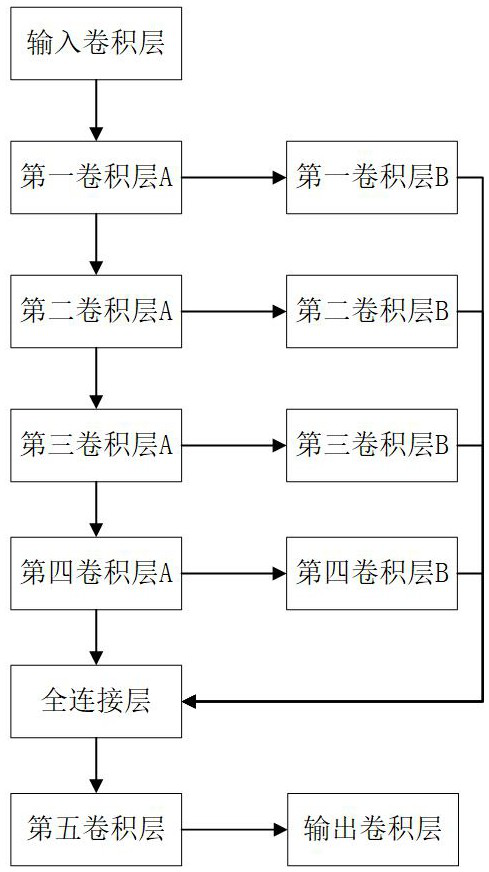
[0025] The convolutional twin point network blade contour stitching system based on multi-scale feature fusion provided in this embodiment includes a data acquisition module, a convolutional twin point network, and a data stitching module.
[0026] The data collection module is used to collect point cloud data of the blade B contour under different viewing angles, specifically using a line laser profiler A equipped with a four-axis measurement system, such as figure 1 As shown, the four-axis measurement system includes three translation axes and one rotation axis. The line laser profiler A is installed on the translation axis and is moved by the translation axis. The blade B is installed on the rotation axis. This occurs due to the rotation and translation. The change of becomes the rigid body transformation. The blade B profile data includes the source point cloud data X of the field of view 1, X={x 1 ,x 2 ,...,x i ,...,x n} and field of view 2 target point cloud data Y, ...
PUM
 Login to View More
 Abstract
Description
Claims
Application Information
 Login to View More