Check patentability & draft patents in minutes with Patsnap Eureka AI!

Multi-label classification method and system based on semantic-label multi-granularity attention

A classification method and classification system technology, applied in the field of multi-label classification, can solve the problems of time efficiency limitation of sequence-to-sequence architecture, unstable prediction, difficult large-scale application, etc., and achieve good migration ability, guaranteed transitivity, advanced performance. Effect

Active Publication Date: 2021-07-16
QILU UNIV OF TECH
View PDF5 Cites 3 Cited by
  • Summary
  • Abstract
  • Description
  • Claims
  • Application Information

AI Technical Summary

Problems solved by technology

This makes sequence-to-sequence architectures limited in time efficiency
In addition, for specific MLC tasks, ideally, the order factor cannot be considered between the output labels
However, the label sorting of the above model is fixed (usually in descending order) during the training process, which leads to the model often producing unstable predictions during testing, which reduces the performance and interpretability of the model.
For the graph neural network model, only the relationship between labels and samples is measured, without considering the impact of different content in the text on the prediction results, so it is difficult to apply it on a large scale to other classic MLC tasks

Method used

the structure of the environmentally friendly knitted fabric provided by the present invention; figure 2 Flow chart of the yarn wrapping machine for environmentally friendly knitted fabrics and storage devices; image 3 Is the parameter map of the yarn covering machine
View more

Image

Smart Image Click on the blue labels to locate them in the text.
Viewing Examples
Smart Image
  • Multi-label classification method and system based on semantic-label multi-granularity attention
  • Multi-label classification method and system based on semantic-label multi-granularity attention
  • Multi-label classification method and system based on semantic-label multi-granularity attention

Examples

Experimental program
Comparison scheme
Effect test

Embodiment 1

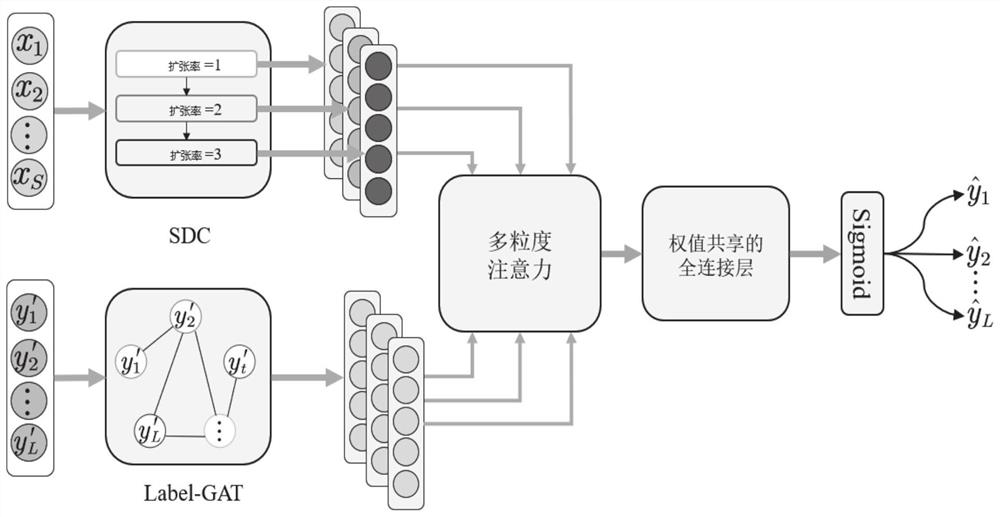
[0040] Such as figure 1 As shown, this embodiment provides a multi-label classification method based on semantic-label multi-granularity attention. In this embodiment, the method is applied to a server for illustration. It can be understood that this method can also be applied to a terminal. It can also be applied to a terminal, a server and a system, and is realized through the interaction between the terminal and the server. The server can be an independent physical server, or a server cluster or distributed system composed of multiple physical servers, or it can provide cloud services, cloud database, cloud computing, cloud function, cloud storage, network server, cloud communication, intermediate Cloud servers for basic cloud computing services such as software services, domain name services, security service CDN, and big data and artificial intelligence platforms. The terminal may be a smart phone, a tablet computer, a laptop computer, a desktop computer, a smart speaker...

Embodiment 2

[0096] This embodiment provides a multi-label classification system based on semantic-label multi-granularity attention.

[0097] A multi-label classification system based on semantic-label multi-granularity attention, including:

[0098] The semantic-label multi-granularity attention model building block is configured to: connect the stacked dilated convolutional encoding module and the output of the label map attention module to the multi-granularity attention mechanism network, and the weighting of the multi-granularity attention mechanism network output The final label is used as the input of the fully connected layer, and the output value obtained by the fully connected layer for mapping the predicted label is input into a Sigmoid layer to obtain the predicted probability of each label;

[0099] The model training module is configured to: use the multi-label data set to train the constructed semantic-label multi-granularity attention model, adjust parameters until the sem...

Embodiment 3

[0103] This embodiment provides a computer-readable storage medium, on which a computer program is stored. When the program is executed by a processor, the multi-label classification method based on semantic-label multi-granularity attention as described in the first embodiment is implemented. A step of.

the structure of the environmentally friendly knitted fabric provided by the present invention; figure 2 Flow chart of the yarn wrapping machine for environmentally friendly knitted fabrics and storage devices; image 3 Is the parameter map of the yarn covering machine
Login to View More

PUM

No PUM Login to View More

Abstract

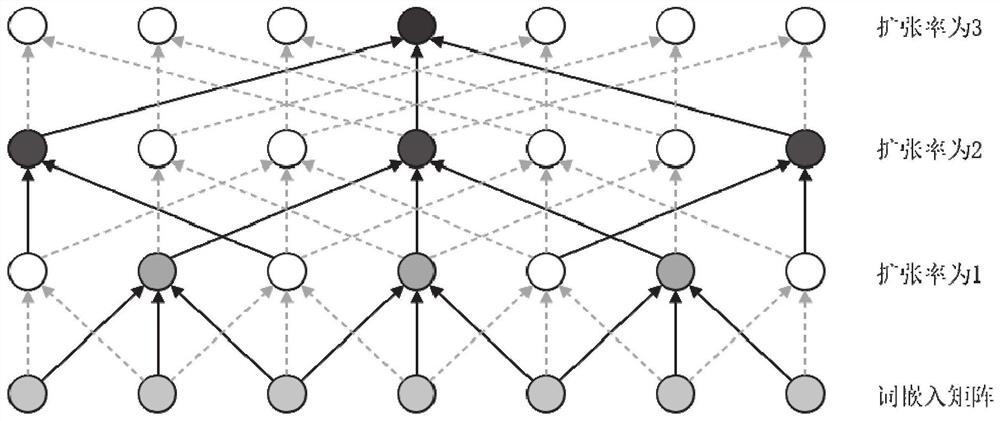
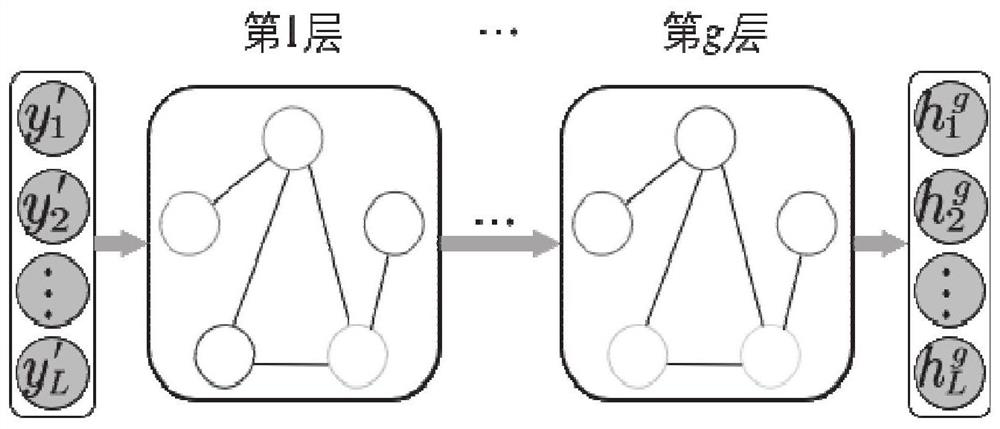
The invention provides a multi-label classification method and system based on semantic-label multi-granularity attention. The method comprises the following steps: constructing a semantic-label multi-granularity attention model: jointly connecting outputs of a stacked expansion convolutional coding module and a label map attention module to a multi-granularity attention mechanism network; taking a weighted label output by the multi-granularity attention mechanism network as an input of a full connection layer; and inputting an output value which is obtained by the full connection layer and is used for mapping the prediction labels into a Sigmoid layer to obtain a prediction probability of each label; model training: adopting a multi-label data set to train the constructed semantic-label multi-granularity attention model, adjusting parameters until the semantic-label multi-granularity attention model converges, and obtaining a trained semantic-label multi-granularity attention model; and taking a to-be-classified multi-label data set as input, and outputting a classification result by the trained semantic-label multi-granularity attention model.

Description

technical field [0001] The invention belongs to the field of multi-label classification, in particular to a multi-label classification method and system based on semantic-label multi-granularity attention. Background technique [0002] The statements in this section merely provide background information related to the present invention and do not necessarily constitute prior art. [0003] Multi-label classification (MLC) is the task of assigning one or more labels to a given input sample. It has broad application scenarios in the real world, such as document annotation, tag recommendation, information retrieval, and dialogue systems. Since tags usually have complex dependencies, this makes this task extremely challenging in the field of natural language processing. [0004] Some early research works include: Binary Relevance (BR), Classifier Chains (CC) and Label Powerset (LP), all of which have achieved good results. With the great progress of deep learning based on arti...

Claims

the structure of the environmentally friendly knitted fabric provided by the present invention; figure 2 Flow chart of the yarn wrapping machine for environmentally friendly knitted fabrics and storage devices; image 3 Is the parameter map of the yarn covering machine
Login to View More

Application Information

Patent Timeline
no application Login to View More
Patent Type & Authority Applications(China)
IPC IPC(8): G06K9/62
CPCG06F18/24G06F18/214
Inventor 杨振宇刘国敬王钰马凯洋
Owner QILU UNIV OF TECH
Features
  • R&D
  • Intellectual Property
  • Life Sciences
  • Materials
  • Tech Scout
Why Patsnap Eureka
  • Unparalleled Data Quality
  • Higher Quality Content
  • 60% Fewer Hallucinations
Social media
Patsnap Eureka Blog
Learn More